
God told Abraham how to handle antisemitism 4,000 years ago
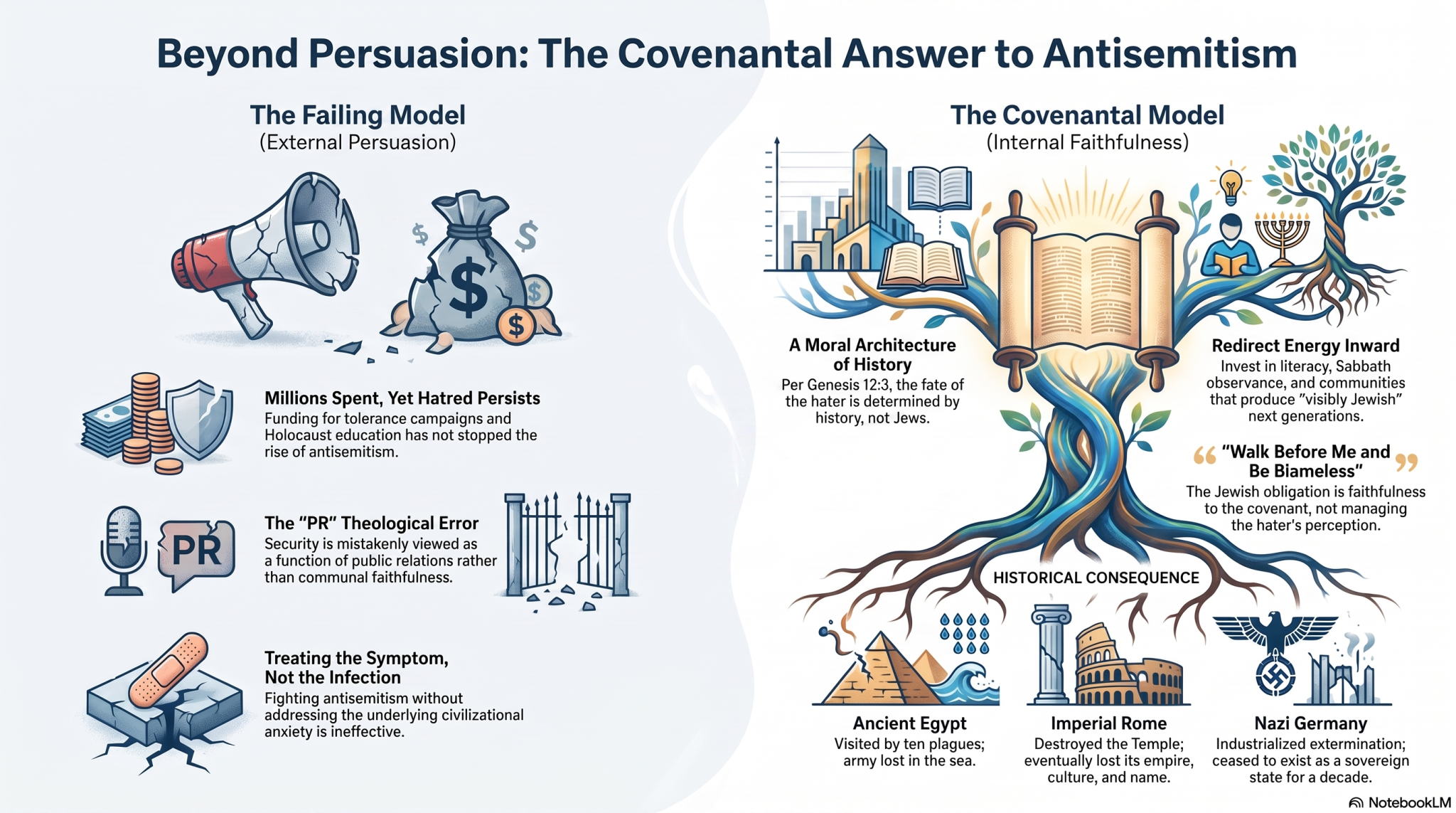
The Covenant Is the Answer
God told Abraham how to handle antisemitism 4,000 years before the philanthropists arrived.
Every few months the Jewish world produces another blue-ribbon diagnosis of antisemitism and another prescription for defeating it. The prescriptions vary in sophistication but converge on a common assumption: that Jewish survival depends on persuading the hater, educating the indifferent, and funding the fight. Tens of millions of philanthropic dollars flow annually into tolerance campaigns, Holocaust education mandates, interfaith dialogue initiatives, and counter-narrative advertising. Serious historians dedicate careers to tracing the pattern from ancient grievance to modern genocide. Jewish organizations measure their budgets by how much they can spend against the oldest hatred.
And antisemitism comes back anyway. Faster, now. Metabolized by the algorithm. Migrating from the fringe to the feed, from the fever swamp to the faculty lounge, from the skinhead rally to the student encampment. The campaigns run. The museums open. The curricula update. The hatred finds new language and continues.
There is a reason the prescriptions fail. They begin one chapter too late.
The Answer Given Before the Question Was Asked
God answered the antisemitism question before antisemitism had a name. He answered it in a field in Ur, in the first words spoken to Abram before he became Abraham, before there was a Torah to keep or a people to disperse or a hatred to combat:
I will bless those who bless you, and whoever curses you I will curse; and all peoples on earth will be blessed through you. (Genesis 12:3)
This is not a promise of immunity from hatred. Hatred will come; the tradition never pretends otherwise. It is something more consequential: a description of a moral architecture already built into the structure of history. Blessing and cursing are not arbitrary divine moods dispensed from above. They are the natural outcomes of how a civilization orients itself toward the people God chose to carry His instruction into the world.
The covenant, in other words, does not promise that the antisemite will be persuaded. It promises that the antisemite will be answered — by history, by consequence, by the working out of a logic that does not require Jewish intervention to operate.
This changes everything about how Jews should understand their position and their obligations.
The Cancer Infects the Hater
Antisemitism is not primarily the Jews’ problem to solve. It is a spiritual cancer that metastasizes in the host, not the target. The Jew-hater is not posing a threat to Jewish civilization that Jewish civilization must neutralize through superior messaging. He is calling down a curse on his own.
The historical record is not ambiguous on this point, though we rarely frame it this way.
Egypt held the Israelites in bondage across generations and was visited by ten plagues before Pharaoh released them — and then pursued them into the sea. Babylon took Judah into captivity and was gone within a century of Cyrus’s edict of return. Rome destroyed the Temple and spent the next four centuries losing its empire, its culture, and finally its name. Spain expelled its Jews in 1492, the same year it stumbled onto the wealth of the New World, and spent the next two centuries burning through that wealth without constructing a civilization that would outlast the spending. Germany industrialized extermination and ceased to exist as a sovereign state for a decade, spending the subsequent eight decades in civilizational self-interrogation from which it has not fully emerged.
The pattern is not subtle. It does not require conspiratorial thinking to observe. It requires only that we take seriously the possibility that the covenant announced in Genesis 12 is a description of how history actually works, not a tribal consolation prize.
Conversely, civilizations that welcomed and honored Jewish life tended to flourish during those periods of welcome. Persia under Cyrus. The Dutch Republic at its tolerant height. The United States at its founding promise. The correlation is consistent enough that dismissing it requires more special pleading than accepting it.
The antisemite is in the act of cursing what he cannot bring himself to honor, and the curse, as promised in the original contract, belongs to the curser. This does not mean Jews should be indifferent to their own safety or passive in the face of violence. It means that the antisemite’s ultimate fate is not in Jewish hands, and never was.
The Wrong Fight
Understanding this reframes the organizational energy Jews have devoted to fighting antisemitism head-on.
Bret Stephens argued from the stage of the 92nd Street Y that the tens of millions spent annually on anti-antisemitism campaigns are well-meaning but mostly wasted. He is right, and the reason he is right goes deeper than he stated. The campaigns are wasted not merely because the disease is impervious to tolerance appeals and Holocaust education mandates, though it demonstrably is. They are wasted because they proceed from a theological error: the assumption that Jewish security is a function of Jewish public relations.
It is not. Jewish security is a function of Jewish faithfulness, and the distinction matters enormously for how communal resources should be deployed.
Consider what the energy spent on external persuasion campaigns might accomplish if redirected inward. The schools that transmit living literacy rather than identity tourism. The communities that practice Sabbath as genuine sanctified time rather than as nostalgia. The institutions that produce the next generation of Jews capable of reading a page of Gemara, carrying communal responsibility, and standing publicly as Jews when silence would be cheaper. The argument is not that antisemitism should be ignored. It is that the response to antisemitism is not a counter-campaign against antisemites. It is a community that recovers its own confidence and deepens its own substance.
The hater is not the audience. The next generation is the audience.
Walk Forward and Be Blameless
The covenant’s demand on Israel is stated plainly: Walk before Me and be blameless (Genesis 17:1). Go where I lead. Keep what I gave you. The accounting for those who curse you is not your department.
This is not passivity, and it should not be mistaken for quietism. Walking where God leads requires everything the tradition demands: the Sabbath table and the page of Talmud and the willingness to bear physical risk in defense of Jewish life and the public courage to be visibly Jewish when invisibility would be cheaper. It requires transmission — handing the inheritance to the next generation as a living covenant rather than a cultural artifact. It requires the kind of communal coherence that makes the tradition legible to those outside it, not as a defensive exercise in reputation management, but as the natural overflow of a people who actually believe what they carry.
Deuteronomy makes this explicit in a register that is often missed. The commandments are handed a second audience in the same verse as the first: Observe them faithfully, for it is your wisdom and understanding in the eyes of the peoples, who on hearing all these laws will say, Surely this great nation is a wise and discerning people (Deuteronomy 4:6). Jewish faithfulness has an audience. The nations are watching. But they are watching for wisdom, not for a tolerance campaign. They are watching to see whether the people of the covenant actually live as though the covenant is true.
When Jews do that — when the Sabbath is sanctified, when argument is practiced as a form of love, when law is kept as the grammar of a civilization rather than its enemy, when merit outranks inheritance and sacrifice earns standing — the nations see something they cannot fully name. Some are drawn toward it. Others are threatened by it. The threatened ones become antisemites, and in doing so they initiate the sequence the covenant already described.
The Deeper Defense
There is a geopolitical dimension to this that secular readers may find more tractable than the theological one.
Anti-Western feeling, anti-capitalist resentment, and antisemitism are not three separate moods that happen to overlap. They are one suspicion expressed in three registers: the conviction that the visible order is a swindle operated by a hidden hand, and that the hand, when finally unmasked, will turn out to be Jewish. This is why fighting antisemitism without fighting the upstream civilizational anxiety that feeds it is like treating fever without treating infection.
The West’s own intellectual foundations — the singular God who created a moral universe, the law that binds even kings, the prophetic tradition that speaks truth to pharaohs, the radical proposition that every human being carries the image of God and cannot be owned — derive, however indirectly and however much post-Enlightenment Europe tried to launder the attribution, from the Hebrew revelation. When the West loses confidence in those foundations, it loses confidence in premises it received from the Jews. The antisemitism that follows is not coincidental. It is the civilizational symptom of abandoning the source while resenting the source’s continued existence as a reminder of the abandonment.
The true defense of Jewish life is therefore oblique: a defense of the civilization the Jew is accused of secretly running. Not because Jews should subordinate their particularity to Western universalism, but because Jewish particularity, practiced faithfully, is precisely what the West most needs to see modeled.
What Remains
The philanthropists are not wrong to care. The historians are not wrong to trace the pattern. The organizations are not wrong to monitor threats and defend Jewish communities against physical violence. But the frame is wrong, and wrong frames produce wasted energy even when the intentions are serious.
The frame that the covenant supplies is different. Antisemitism is a curse the hater brings on himself, operating according to a logic announced four thousand years ago and confirmed by the weight of subsequent history. The Jews’ obligation is not to neutralize that curse through persuasion but to be sufficiently faithful, sufficiently coherent, and sufficiently substantive that the covenant’s second promise is also fulfilled: that through this people, all the families of the earth will find blessing.
That is a larger assignment than any tolerance campaign can carry. It is also the only one that has ever worked.
The world will not be argued out of its oldest hatred. It will be outlasted by the people God told to walk forward and trust that the accounting would be handled.
It always has been.