


Grab your chamomile tea
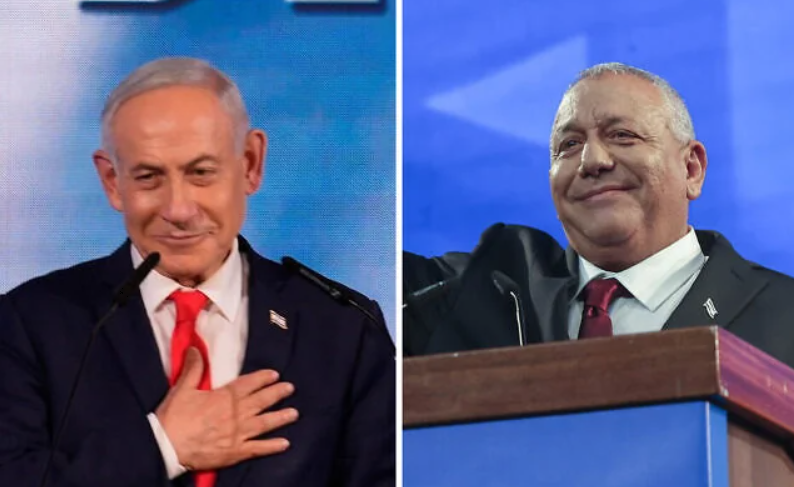
Nobody won Israel’s election on Tuesday night, and most of the leaders who claimed otherwise were reading speeches drafted before the first ballot was counted. Netanyahu and Eisenkot each promised to form the next government. Bennett announced that Netanyahu had lost. Smotrich told his supporters that the opposition would not be allowed its celebration. The arithmetic did not move while they spoke.
The three exit polls gave Likud 27 seats, five or six ahead of Eisenkot’s Yashar, and gave the pro-Netanyahu bloc 51 or 52. With a little over half the ballots counted by Wednesday morning, the Times of Israel tally had that bloc at 55, the Jewish-led opposition at 49 and the Arab-led parties at 16. Sixty-one is the threshold. Netanyahu is six short with no obvious source. The opposition can reach 61 only by seating Ra’am or the Joint List, and Bennett, Lapid and Liberman have each pledged not to. The stalemate is a problem of campaign promises rather than seats, which is why it will not yield to a recount.
The framing both camps share deserves more attention than the speeches themselves. Netanyahu claimed a decisive majority among the Jewish public, a formulation that quietly subtracts roughly a fifth of the citizenry to arrive at a win. Eisenkot, for his part, spoke of a Zionist, responsible majority, and Bennett and Lapid of a Zionist government. The vocabulary differs; the premise does not. Both blocs treat the Arab parties, who posted a record result, as a pivot they will not touch, and both therefore guarantee that the largest pivot in the Knesset stays unused.
Israeli commentators have reached for 1996, when early projections suggested Shimon Peres had beaten Netanyahu and Netanyahu won by roughly 30,000 votes. The analogy flatters the opposition’s anxiety and misleads. In 1996, the country voted directly for prime minister, a binary contest in which a polling error was the entire story. Today the question is who can assemble 61, and the soldiers’ ballots, counted last after turnout among troops reached 79.9 percent, can move a seat or two but cannot manufacture a majority for anyone. A better precedent is 2021, when Bennett himself led a government that included Ra’am, the first independent Arab party to join an Israeli coalition. It proved the arithmetic can be made to work, and it collapsed within a year under the weight of its own defections. His pledge this week reads as a lesson learned at his own expense.
Where the outcome gets decided is inside Likud. Eisenkot demands that Netanyahu leave political life, which makes any unity government a coup against Likud’s leadership dressed as a compromise. Liberman publicly urged Likud members to rebel. Ben Gvir warned Netanyahu that a deal with Eisenkot would be a terrible mistake, which tells us the option is circulating. Deri’s Shas, projected to fall from 11 seats to six or seven, disputed the exit polls and went quiet. Every one of these actors has a reason to wait for the double-envelope count, and Liberman expects a much clearer picture by Friday.
My neoclassical realist reading is that the external environment will not wait for the Knesset to sort itself out. Netanyahu closed his remarks by calling the moment a historic, one-time opportunity, alongside President Trump, to remove the Iranian threat. Israeli press reports describe a prime minister who pressed for a strike before the vote and a Chief of Staff who resisted, and reports have Washington warning Gulf states of a short, intensive campaign after the American midterms on November 3rd. Systemic pressure of that kind reaches policy only through the domestic filter: who holds the premiership, who commands the army, and whose coalition can survive a war. Israeli history offers the awkward precedent of Olmert, who launched Cast Lead in 2008 as a lame-duck prime minister with an election weeks away. That analogy fails at the point that matters, because Olmert was departing and Netanyahu intends to remain. A leader with 55 seats and a strategic window has an incentive to prefer a crisis that makes unity look like patriotism. I do not claim that is his plan. I claim the incentive exists whatever his intentions.
So the next several days belong to the counters, the lawyers, and the Likud backbenchers.
Expect each party leader to repeat on Friday what he said on Tuesday, with the same confidence and, unless someone defects, the same numbers.