
TV Host, and war correspondent at the Channel 9
Graingate: Twitter Diplomacy and European Blindness
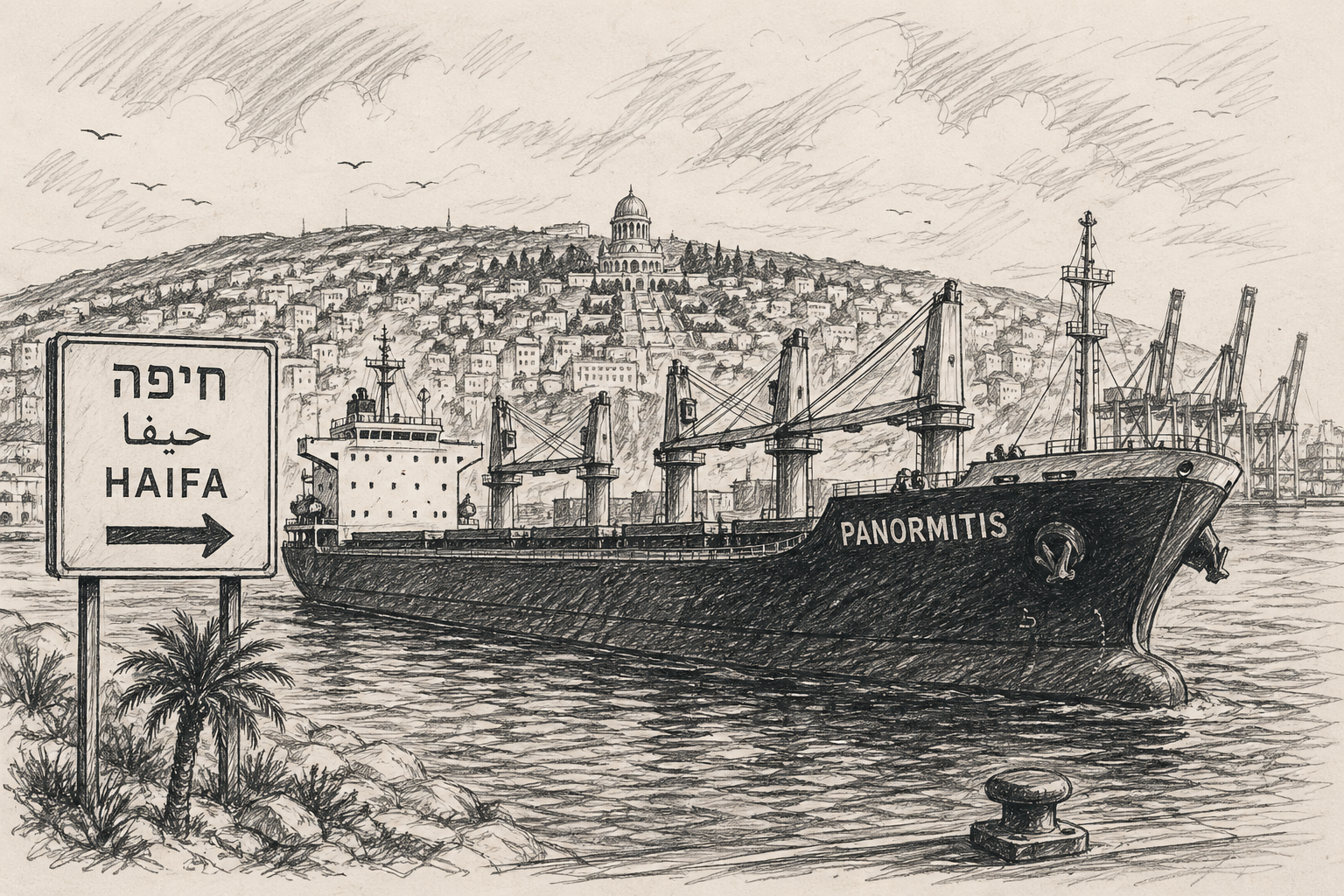
Panormitis entering Haifa
Why the PANORMITIS Scandal Exposed the Hypocrisy of the Global Grain Market
The saga of the PANORMITIS, a vessel nearing the Port of Haifa laden with potentially plundered Ukrainian grain, has transcended a mere maritime investigation. It has morphed into a high-stakes diplomatic thriller—one that perfectly illustrates why fighting a global shadow market with angry tweets is a strategy destined for theatrical success but practical failure.
Here is how Ukraine attempted to solve a complex legal crisis through a media blitz, why Israel stood its ground, and how the European Union is currently putting on a masterclass in performative hypocrisy.
The Siege of Twitter vs. The Rule of Law
Under international law, blocking a stolen shipment is a tedious, pedantic process. Prosecutors in the originating country must build a rigorous evidentiary chain—AIS satellite data, laboratory probability reports, and intercepted documentation—before sending a formal Mutual Legal Assistance (MLA) request to the destination country.
In the case of Israel, Ukrainian diplomacy opted for a “media battering ram” instead:
- The Warning: Foreign Minister Andrii Sybiha took to X (formerly Twitter), warning Israel of “damage to relations” and summoning the Israeli ambassador.
- The Threat: President Volodymyr Zelensky threatened sanctions against all involved, accusing Israel of violating its own laws.
- The Chorus: EU representative Anouar El Anouni joined the fray, threatening to blacklist individuals and entities in “third countries” for circumventing European sanctions.
Jerusalem’s response was predictably clinical. Foreign Minister Gideon Sa’ar reminded his counterparts of a fundamental reality: Diplomacy is not conducted on Twitter.
The timeline of this “absurdity” is telling: at the height of the media firestorm, the ship had not even entered Israeli waters or filed customs declarations (bills of lading). The formal MLA request from Ukraine arrived only on the night of April 29— conveniently after the social media scandal had already been stoked. As a rule-of-law state, Israel’s police and customs cannot board a commercial vessel without a court order based on “ironclad” evidence—evidence that, until the final moment, simply did not exist.
The Science of Plunder: Why Lab Tests Aren’t “Smoking Guns”
A common refrain in this scandal is: “Just take a sample to the lab and prove it’s stolen!” However, wheat does not carry a passport. While laboratory analysis can confirm origin, it provides a probabilistic expert opinion, not a definitive verdict.
- The Methods: Techniques like Isotopic Analysis (SIRA/IRMS) and Multi-element Analysis (ICP-MS) create a “mineral fingerprint” based on regional geology and soil.
- The Catch: To say grain is specifically from “Berdyansk,” a lab needs reference samples from Berdyansk, Kherson, Rostov, and Krasnodar. Given that the climate and soil of Southern Ukraine and Southern Russia are nearly identical, the “fingerprint” is often blurred.
- The Blend: Grain is often “laundered” at elevators, mixed into a profile compatible with the Black Sea region at large.
In a courtroom, a lab report is only one card in a “royal flush” that must also include AIS tracking, ship logs, invoices, and phytosanitary certificates.
The Great European Mirror
The most cynical aspect of this “Twitter diplomacy” is its selective outrage. While the Ukrainian MFA summons the Israeli ambassador over 25,000 tons of grain, massive hubs like Turkey, Saudi Arabia, and Egypt are processing millions of tons of this same “grey” grain in industrial proportions.
Turkish ports like Iskenderun and Bandırma have served as laundering hubs for Russian bulk carriers arriving from occupied Sevastopol for years. Yet, we see no threats of broken ties or sanctions against Turkish flour mills. It is far more convenient to lecture Israel—a nation already under immense international pressure—than to anger a partner that controls the Bosporus. However, the “masterpiece of hypocrisy” belongs to the EU. While officials in Brussels threaten Israel, the European Union has not sanctioned Russian food and grain. In fact:
- The Spanish Connection: In 2023–2024, Spain became a top importer of Russian grain. Investigations proved that the Russian front company “Agro-Frigate” shipped peas and wheat directly from occupied Sevastopol to Spanish firms.
- The Italian Pasta: Italy has spiked its purchases of Russian durum wheat, ignoring how this grain is blended in the Rostov region with harvests from occupied Ukrainian territories.
While Brussels bureaucrats threaten Israel over the PANORMITIS, European ports are quietly offloading hundreds of thousands of tons of the same “blends,” shielded by paperwork claiming “legal Russian origin” that no isotope lab can 100% disprove.
The Bottom Line
Attempting to dismantle a systemic shadow market through public ultimatums backfires. One cannot demand that Israel abandon its legal procedures to seize a ship without a pre-prepared evidentiary base—especially when Kyiv’s own “strategic partners” are actively financing the same Russian “shadow fleet” by purchasing discounted grain.
As long as the fight against stolen bread is waged for PR in social media rather than with documents in courtrooms, the “Sevastopol-to-the-World” pipeline will continue to run like clockwork.
Related Topics