
Writing on Jewish identity, Israel, and American politics
Guilty
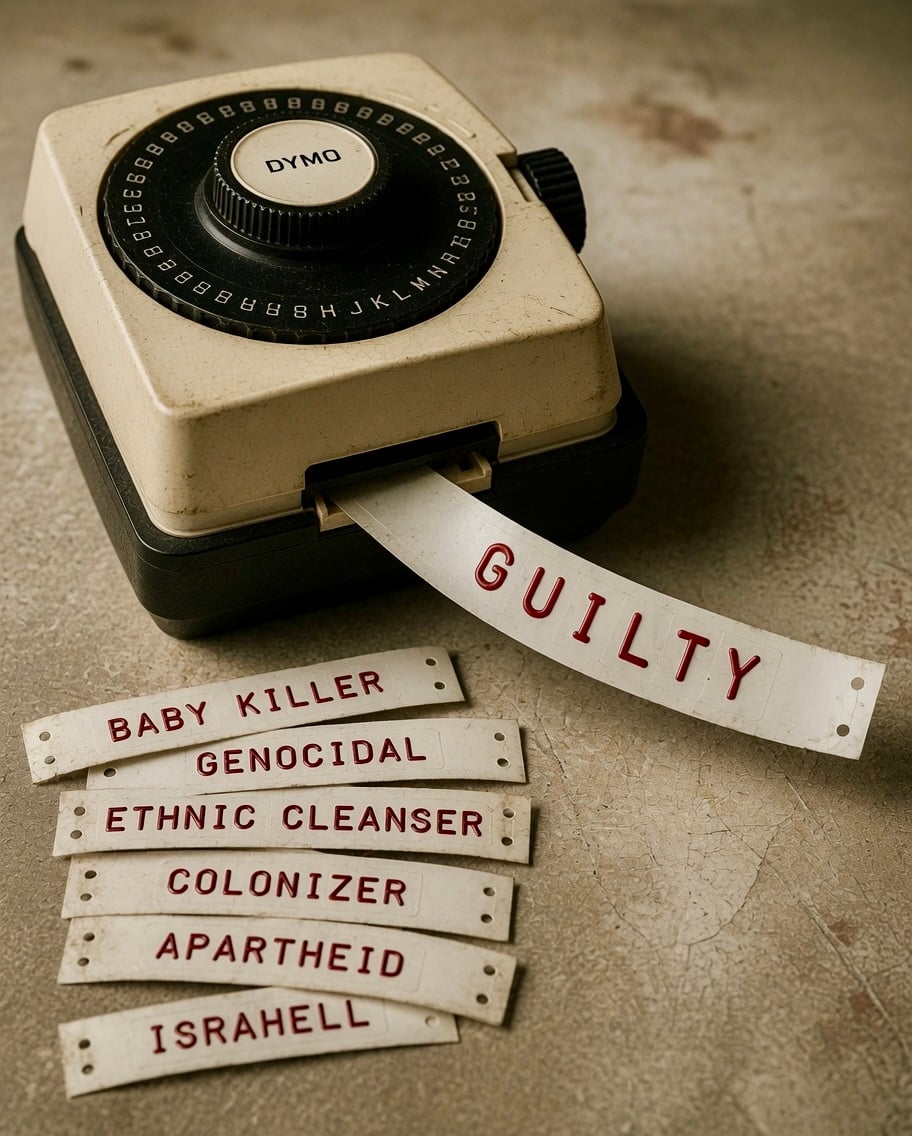
The labels change, the verdict doesn’t. Guilty. (courtesy)
The labels change. The verdict doesn’t.
A week ago, I published an essay called Bad Jew.
The title was deliberate.
The image was deliberate.
It showed a man’s hand wrapped in tefillin extending its middle finger to the world. It wasn’t meant to mock tefillin or Judaism. It was meant to express something I believe many Jews are feeling today: defiance.
For too long, we’ve been told that acceptance comes at the price of silence. That we should apologize for defending ourselves, for loving Israel, for refusing to fit someone else’s political narrative.
I reject that bargain.
That was the point of Bad Jew.
It wasn’t about religious observance, and it wasn’t an attempt to decide who is or isn’t a “good Jew.” It was about a phenomenon I’ve watched accelerate since October 7: the expectation that Jews, particularly on the political left, must publicly distance themselves from Israel to remain acceptable. Increasingly, Jewish credibility seems to depend on condemning the Jewish state, and sometimes other Jews, loudly enough.
The response was overwhelming. Most readers understood exactly what I meant. Others disagreed, sometimes passionately. That’s part of writing.
But a number of observant Jews reached out with a different criticism. They told me the image caused them pain because it used something sacred in a way they found disrespectful.
I heard them.
To those readers, I apologize. Not because I regret the message, but because I never intended to diminish something that has sustained the Jewish people for thousands of years.
To everyone who was simply offended by the argument itself, I don’t apologize.
What stayed with me wasn’t the disagreement.
It was how quickly people decided they already knew exactly who I was.
Baby killer.
Genocide supporter.
Colonizer.
Racist.
Fascist.
Pro-genocide Zionist.
Hasbara.
Those labels aren’t unique to me. Anyone who has spent time publicly defending Israel has encountered some version of them. They arrive in direct messages, on X, on Threads, in comment sections, podcasts, protests, and campuses. They are designed to foreclose debate by defining the speaker before anyone considers the argument.
I’ve developed thick skin.
You have to.
But I’d be lying if I said they don’t still sting.
Maybe they sting because I recognize something of my younger self in that certainty. I once believed good intentions were enough. That history sorted itself neatly into heroes and villains. That moral confidence was evidence enough. There was a kind of savior instinct in that worldview. I understand its appeal because, in some ways, I once shared it.
The experience taught me something I wasn’t expecting.
There is a difference between an apology and a confession.
I apologized to observant Jews because I unintentionally hurt people I respect. They deserved that apology.
But I won’t apologize for standing with Israel. I won’t apologize for believing the Jewish people have the same right to security and self-determination as every other people. And I won’t accept responsibility for accusations simply because repeating them has become fashionable.
Regretting one mistake doesn’t require confessing to every other charge someone wants to pin on you.
Somewhere along the way, we’ve forgotten that distinction.
Once a verdict takes hold in the public imagination, every new accusation reinforces it. Every demand for another apology becomes proof that the previous one wasn’t enough. Allegation begins to carry the weight of conviction. Public certainty often outruns public evidence.
That doesn’t mean every accusation is false.
It also doesn’t mean every accusation is true.
That realization changed the question I was asking.
I stopped worrying about whether strangers on the internet thought I was guilty.
I started wondering whether the case itself had earned its certainty.
If Israel is going to stand accused of some of the gravest crimes imaginable, then those accusations should withstand the gravest scrutiny imaginable. Not because Israel deserves a different standard, but because no nation, no government, and no people should be condemned by a lower one.
So I started reading.
Not headlines.
Methodologies.
Footnotes.
Raw data.
Competing analyses.
I wanted to understand where the numbers came from, how they were collected, what could be verified, what was estimated, and where certainty quietly replaced evidence.
That journey changed more than my opinion.
It changed the way I think about certainty itself.
This essay is not an attempt to convince you that war is clean, that Israel is beyond criticism, or that innocent people are not suffering.
It is an attempt to ask whether we have confused repetition with proof.
Whether we have allowed slogans to substitute for scrutiny.
Whether we have reached moral certainty before doing the harder work of examining the evidence.
Because if we’re going to condemn, we owe ourselves something more than certainty.
We owe ourselves the truth.
And truth demands evidence.
The labels change.
The verdict doesn’t.
Related Topics