The views expressed herein are solely mine.
Guterres Shields Offenders While Targeting Israel
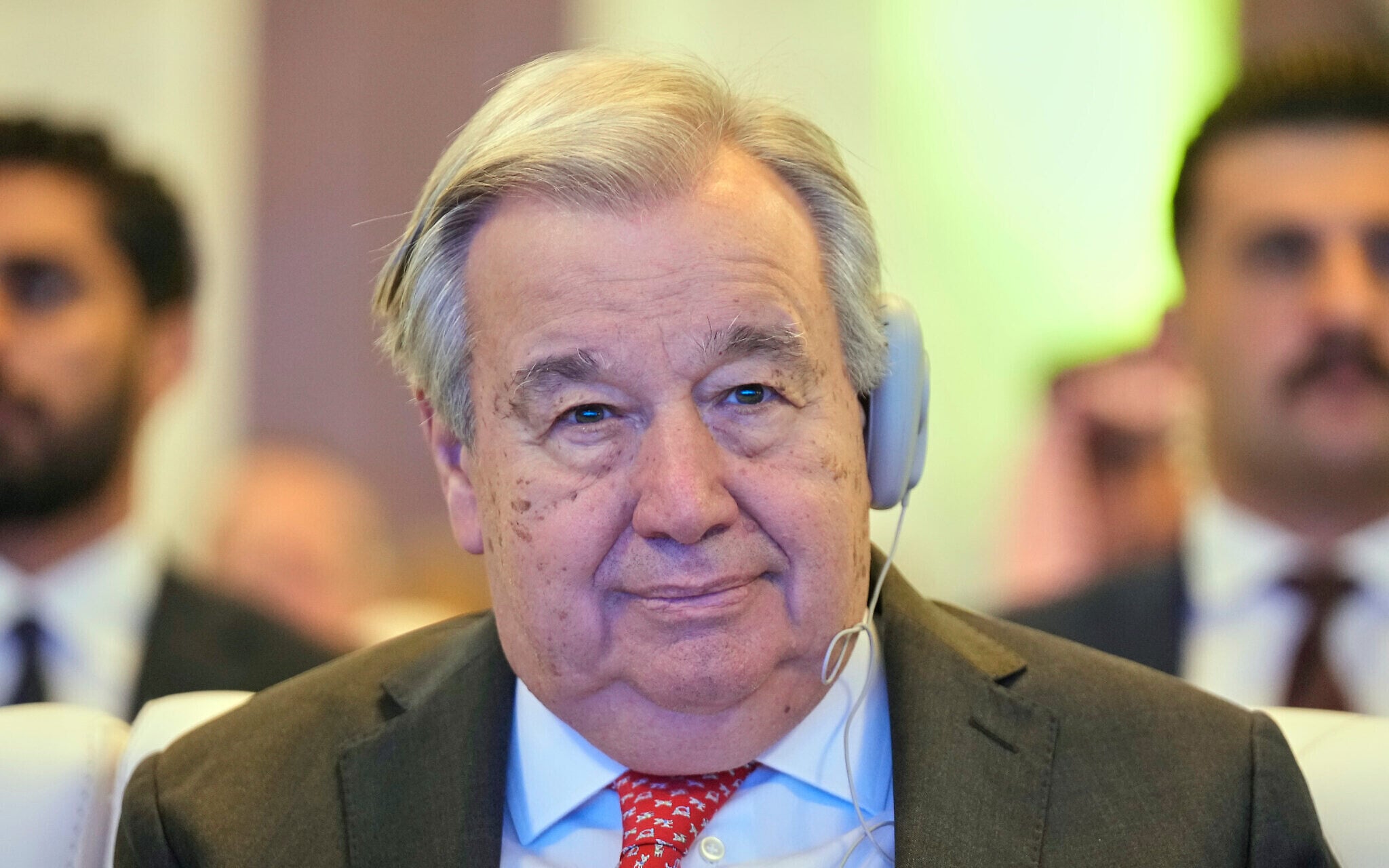
United National Secretary-General Antonio Guterres attends an event to mark the end of the UN political mission in Baghdad, Iraq, December 13, 2025. (AP Photo/Hadi Mizban).
António Guterres has spent nine years claiming to combat sexual exploitation while presiding over an institution that shields its own offenders. At the same time, he has led a relentless campaign against the Middle East’s only democracy. This is not neutral diplomacy. It is a calculated double standard that undermines both the United Nations (UN) and regional security.
The numbers expose the rot. In his March 2025 report on 2024 cases, Guterres himself documented 125 victims of sexual exploitation and abuse by UN personnel, including 27 children. Since he took office in 2017, the organization has logged well over 1,000 such allegations. The problem has not been solved. It has been normalized at the highest levels.
Two cases prove the point. In late 2020, three women accused senior official Fabrizio Hochschild of sexual harassment, bullying, and fostering a toxic workplace. Guterres’ own office was aware of the complaints by December. Weeks later, he promoted Hochschild to the position of Special Envoy on Technology. Only after a Politico investigation made denial impossible did Guterres act.
Then Colin Stewart’s story came out. In 2017, Guterres appointed him head of the UN mission in Western Sahara despite prior accusations of sexual harassment involving Ethiopian staff in Addis Ababa. Reports later revealed that Guterres was prepared to extend Stewart’s contract anyway. These were not low-level mistakes. They were decisions made at the very top.
After Hamas murdered 1,200 people and committed systematic sexual violence during and after October 7, Guterres declared that the attacks “did not happen in a vacuum” and blamed “56 years of suffocating occupation.” Israel’s ambassador rightly called it a blood libel. In October 2024, Israel declared Guterres persona non grata after he demanded a ceasefire following Iranian missile attacks without strongly condemning Iran. In August 2025, his annual report on conflict-related sexual violence placed Israel “on notice” alongside Russia. On May 28, 2026, Israel’s UN ambassador, Danny Danon, announced that Jerusalem was freezing all cooperation with Guterres’ office after the UN placed Israel on its list of parties credibly suspected of patterns of sexual violence.
Thus, this is not isolated criticism. It is a pattern of institutional hostility. From 2015 through 2024, the UN General Assembly passed 173 resolutions condemning Israel — more than the 80 resolutions targeting every other country on Earth combined. In 2025 alone, the General Assembly adopted 15 resolutions against Israel and only 11 against the rest of the world combined, including Russia, Iran, North Korea, and Myanmar.
At the UN Human Rights Council, Israel remains the only nation with its own permanent agenda item — Item 7 — while all other countries fall under the general Item 4. Since 2006, Israel has faced 103 of the Council’s 280 condemnatory resolutions, more than Afghanistan, Myanmar, North Korea, and Syria combined in many years. The Council has also held nine special sessions on Israel, more than on any other country.
Indeed, Guterres has now added his own chapter to that record. In 2024, he placed the Israel Defense Forces on the UN’s “blacklist” for grave violations against children under the Children and Armed Conflict agenda — a decision widely criticized as selective and politicized. He took more than seven weeks to acknowledge reports of Hamas’s systematic rape on October 7 and continues to frame Israeli self-defense as the ‘primary problem’, while ignoring that the UN Charter’s article 51 protects this inherent right.
Yet, the strategic damage is severe. Every time Guterres attacks Israel while protecting offenders inside his own institution, he strengthens Iran’s so-called “axis of resistance” — Hamas, Hezbollah, the Houthis, and the Palestinian Islamic Jihad. He weakens Israel’s deterrence precisely when the region most needs it against Iran’s messianic expansionism. He undermines the Abraham Accords and makes Saudi normalization more difficult. He signals to every moderate Arab state that the United Nations will always side against Israel, no matter what Hamas or Hezbollah does.
Doubtlessly, Guterres is destroying what little credibility the UN still possesses. When the Secretary-General appears more interested in targeting the Jewish state than in protecting children from UN peacekeepers or New York-based white-collar employees, he accelerates the erosion of support among the very nations that keep the institution afloat. This is not sophisticated diplomacy. It is self-destructive behavior that emboldens America’s adversaries while harming its allies.
The United Nations under António Guterres is no longer a serious actor in Middle Eastern security. Under his disastrous so-called “leadership” — a masterclass in institutional failure — he has dragged the organization into the orbit of the São Paulo Forum’s radical left, the Muslim Brotherhood, and Iran’s terror axis, turning the UN into a platform for anti-Israel activism disguised as moral authority. Cuba, one of the bloc’s flagship members, continues to jail thousands of dissidents and crush basic freedoms; Iran does the same. Why is the UN so quiet about this? That explains why Guterres even lobbied for Iran to chair the UN Human Rights Forum in 2023.
Until the organization applies the same standards to itself that it demands of Israel and flushes the 1975 “Zionism is racism” soul, it will continue to lose relevance — and the region will continue to pay the price. Israel’s decision today to freeze ties is not an overreaction. It is the inevitable result of years of hypocrisy.
Related Topics