

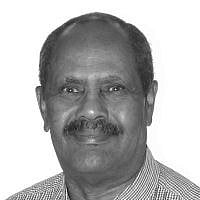
Hadrawi: The Shakespeare of Somalis and a Voice of a Nation
Mohamed Ibrahim Warsame, known by his pen name Hadrawi, was one of the most influential figures in Somali literature and culture. Often called the “Shakespeare of Somalis,” he was a poet, playwright, philosopher, songwriter, and peace advocate whose work shaped Somali society for more than five decades. Through poetry, theater, and public engagement, he became both a literary icon and a moral voice for Somalis at home and across the diaspora.
Born in 1943 in Burco, present-day Republic of Somaliland, Hadrawi grew up in a nomadic camel-herding family. He spent part of his childhood in Aden, Yemen, where he received his early education and earned the nickname “Hadrawi” because of his gift for language and storytelling. After Somaliland and Somalia’s independence and unification, he moved to Mogadishu, studied literature and education at the Somali National University, and later worked as a teacher and lecturer.
Hadrawi began his career in education before joining Radio Mogadishu and the government’s Department of Information in the 1960s and 1970s. During this period, he became a leading literary figure, writing more than seventy songs and numerous poems that formed part of Somalia’s cultural golden age. His works were performed by renowned artists such as Magool, Hassan Adan Samatar, and Mohamed Mooge Liibaan. He also established himself as a playwright through productions such as Hadimo (Conspiracy), which explored political issues including the assassination of Congolese leader Patrice Lumumba.
As President Siad Barre’s government grew increasingly authoritarian, Hadrawi’s writing took on a stronger political dimension. His poetry and plays criticized repression, injustice, and social inequality. Works such as Siinley, Tawaawac (Lament), and the co-authored play Aqoon iyo Afgarad (Knowledge and Understanding) challenged government policies and encouraged critical thinking. As a result, he was imprisoned without trial for five years in Qansax Dheere prison.
Following his release in 1978, Hadrawi worked briefly with the Somali Academy of Science, Arts, and Literature. Refusing to produce political propaganda, he left Somalia in 1981 and joined the Somali National Movement (SNM) in Ethiopia. Exile inspired some of his most important work, including Daba Huwan (Cloaked in Black), an epic poem examining displacement, identity, colonial legacies, and the hardships faced by Somali refugees.
Over his lifetime, Hadrawi produced hundreds of poems, songs, and plays that blended traditional Somali oral poetry with modern political and philosophical themes. His cultural and romantic works, including Baladweyn, Jacayl Dhiig ma Lagu Qoraa? (Is Love Written in Blood?), Saxarlaay ha Fududaan, and Cajebey, remain highly regarded in Somali literature. At the same time, political works such as Siinley and Gudgude, as well as his contributions to the celebrated Deeley chain-poetry debates, demonstrated how poetry could serve as a powerful tool for civic engagement and peaceful resistance.
His dramatic works were equally influential. Through plays such as Aqoon iyo Afgarad, Tawaawac, and Hadimo, he used theater to raise awareness about governance, education, and social reform while encouraging audiences to question political oppression.
In his later years, Hadrawi increasingly explored philosophical and social themes. Poems such as Hooyo (Mother) and Sirta Nolosha (Life’s Essence) reflected on morality, memory, human existence, and the role of women in society. Through these works, he expanded the scope of Somali poetry, transforming it into a medium for reflection, dialogue, and social change.
His greatest contribution came after the collapse of the Somali state, when he became a leading advocate for reconciliation and peace. During the 1990s and early 2000s, as Somaliland sought stability after years of conflict, Hadrawi used his influence to encourage dialogue among communities and political leaders. He became known not only as a poet of resistance but also as a poet of reconciliation.
His most visible peace initiative was the Hadrawi Peace March, launched in 2003. Traveling across Somali-inhabited regions, often without armed protection, he met elders, youth, and community leaders to promote peaceful coexistence. Using poetry and public dialogue, he encouraged unity and emphasized that poverty, ignorance, and division—not fellow Somalis—were the region’s greatest challenges.
Hadrawi also supported the demobilization of former militia members, urging young people to abandon conflict and contribute to nation-building. His efforts reinforced broader peacebuilding initiatives and helped foster trust during Somaliland’s transition toward stability and democratic governance.
International recognition of his work continued to grow through translations and cultural programs that introduced his poetry to audiences beyond the Somali-speaking world. In 2012, he received the prestigious Prince Claus Award, honoring both his literary achievements and his contributions to peace, dialogue, and civil society. He dedicated the award to Somali-speaking people everywhere.
Hadrawi passed away in Hargeisa on August 18, 2022, at the age of 79. He left behind a remarkable legacy as a poet, intellectual, and peacebuilder. Like Shakespeare’s impact on English literature, Hadrawi profoundly shaped modern Somali language, culture, and political thought. His work continues to inspire discussions about love, justice, identity, and national unity, securing his place among Africa’s most important literary figures.