Rabbi, Economist and Community Builder
Hamas in the Torah?
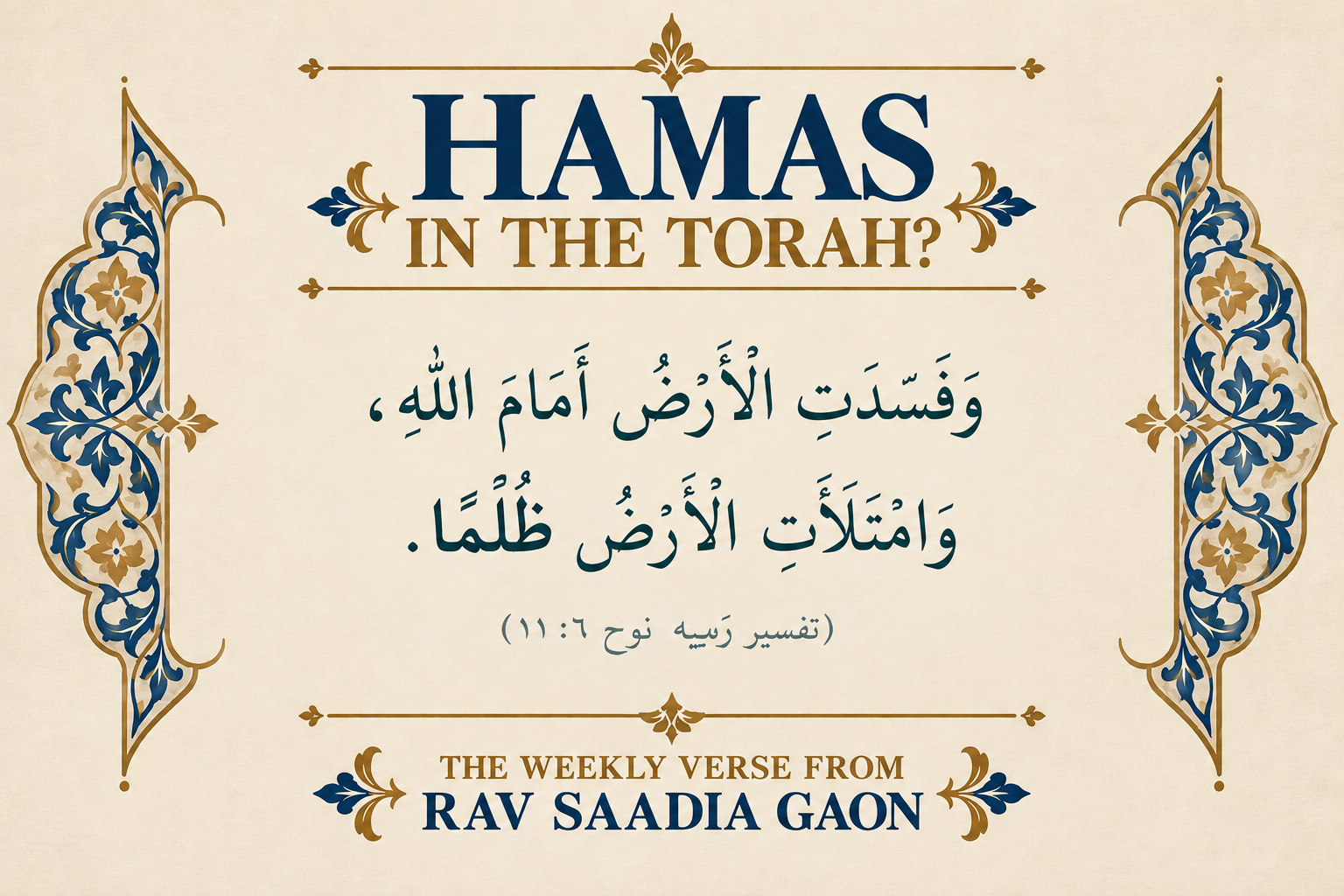
Rav Saadia Gaon's Arabic Translation of the Torah: Beresheet 6:11
The word “Hamas” (חָמָס) already appears near the very beginning of the Torah, in Parashat Noah, and is in fact presented as the reason for bringing the Flood upon the earth:
“The earth became corrupt before God, and the earth was filled with hamas” (Genesis 6:11).
This should not be confused with the modern Arabic word Hamas (حماس), which is both an acronym for the “Islamic Resistance Movement” (Harakat al-Muqawama al-Islamiyya – حركة المقاومة الإسلامية) and an Arabic word meaning “enthusiasm,” “zeal,” or “fervor.”
The Sages interpreted the hamas of the Flood generation primarily as robbery. In his Arabic translation of the Torah, however, Rabbi Saadia Gaon does not attempt to preserve the sound of the Hebrew word. Instead, he chooses an Arabic word that sharpens its moral meaning.
As we have noted, more than a thousand years ago, Rabbi Saadia Gaon produced his monumental Arabic translation of the Torah, known as the Tafsir (تفسير) – an Arabic word meaning “interpretation” or “commentary,” derived from a root related to the Hebrew word pesher (“interpretation”). Saadia’s choice of words often reveals how he himself understood the deeper meaning of the biblical text. Each week, we select one verse from the weekly Torah portion and try to uncover a new insight that emerges from his translation.
Saadia translates “hamas” as “ẓulman” (ظُلْمًا), from ẓulm (ظلم), a word whose basic meaning is injustice, wrongdoing, or the doing of injustice. Depending on the context, it can also mean oppression, exploitation, or wrongful harm.
This choice distinguishes it from “violence” in its narrow sense. Saadia could have chosen other Arabic words that refer more specifically to force or physical violence. Instead, the word he chose places the sin primarily in the moral and social realm. In other words, the biblical concept of hamas is not limited to physical violence. It includes injustice, exploitation, and harm inflicted upon others – the corruption of the very fabric of human relationships.
The Arabic root ظلم (ẓ-l-m) is also extremely important in the language of the Quran, where it describes violations of the moral order. The term al-ẓālimūn (الظالمون) – “the wrongdoers” or “those who commit injustice” – appears repeatedly throughout the Quran.
For Saadia’s Arabic-speaking Jewish readers – who lived within an Arabic and Islamic cultural and linguistic world – the word ẓulman (ظُلْمًا) would therefore likely have carried a particularly powerful moral resonance. Saadia’s choice suggests that the hamas of Noah’s generation was not merely violence: justice between human beings had collapsed, and the earth had become filled with wrongdoing. This was the corruption that ultimately brought about the Flood.
Here too, a single Arabic word chosen by Rabbi Saadia Gaon helps us see a dimension of the biblical verse more clearly.
And this is precisely one of the reasons why Saadia’s Tafsir is one of the great treasures of Jewish writing in Arabic. For centuries, it shaped the way Arabic-speaking Jews read and understood the Bible, and its influence extended far beyond translation alone.
In a divided and polarized world, differences of language can easily become yet another wall separating people.
In this weekly series, we are trying to demonstrate precisely the opposite: how the similarities and differences between Hebrew and Arabic can become a source of connection – and how the two languages can illuminate, through one another, profound ideas that neither language reveals in quite the same way on its own.
We owe a deep debt of gratitude to Rabbi Yom Tov Gindi of Kfar Chabad, who several years ago published Rabbi Saadia Gaon’s Tafsir in a modern edition using Arabic script, making it accessible to all of us. We could not have embarked on this journey without his work, and we invite you to join us.
Shabbat Shalom, and see you next week!
Related Topics