The views expressed herein are solely mine.
Hamas’s Hollow Elections: Abu Suhaib Endures
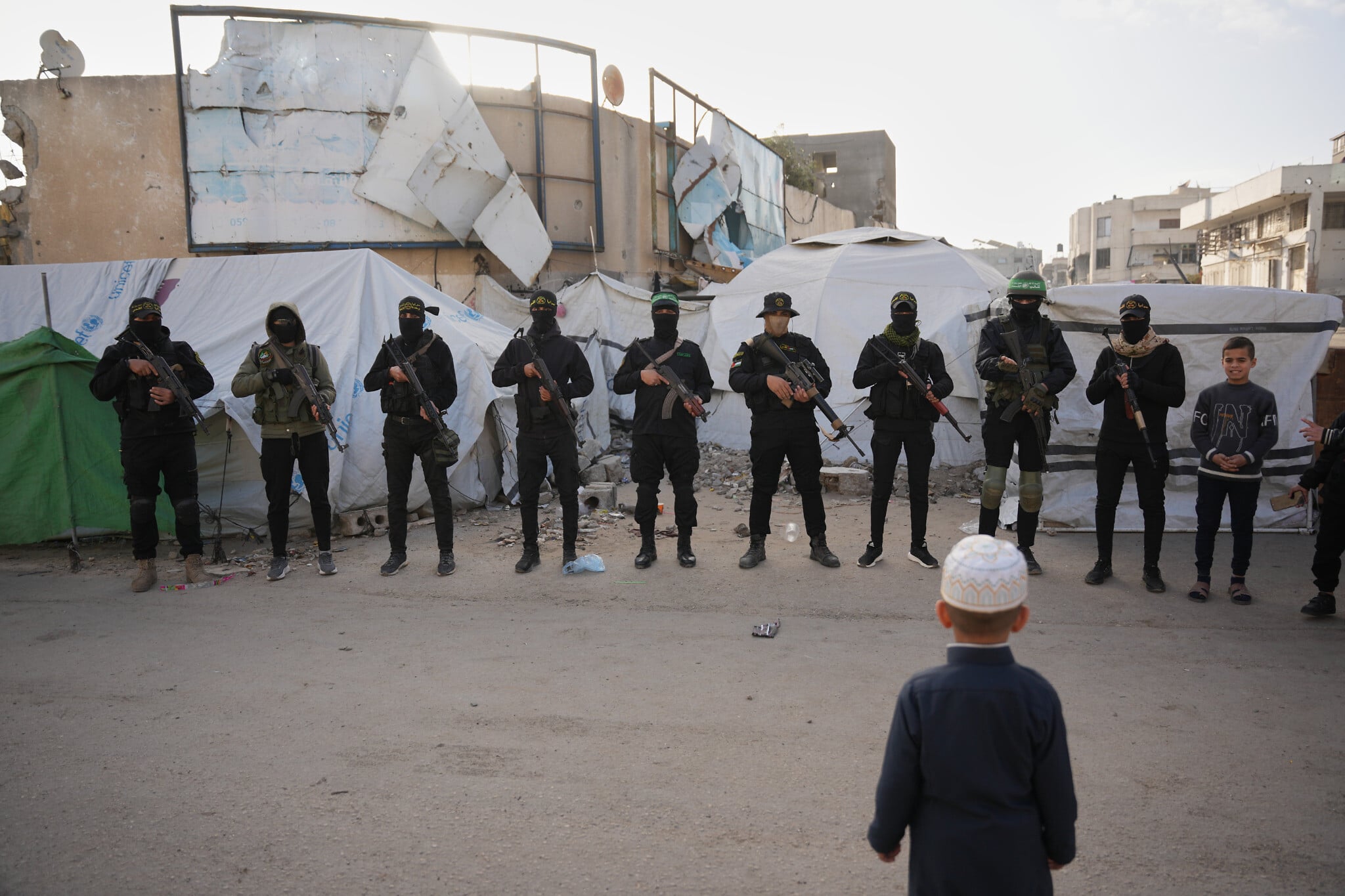
Armed members of Hamas and Islamic Jihad greet people gathering for Eid al-Fitr prayers in Gaza City, March 20, 2026. (AP/Abdel Kareem Hana).
Hamas’s internal leadership elections confirm that the group has no interest in moderation or disarmament. The terror organization has elected hardliners fully committed to continuing its Muslim Brotherhood-backed war against Israel.
Izz al-Din al-Haddad, known as Abu Suhaib or the ‘Ghost of the Al-Qassam Brigades,’ stands at the center of this continuity. One of the few original-generation commanders still operating inside the Gaza Strip, Abu Suhaib directs military operations from tunnels beneath Gaza City. He survived at least six Israeli assassination attempts during the 2023–2025 Gaza War.
In the aforementioned internal selection process, Hamas elected Khalil al-Hayya to lead its Gaza branch and placed Khaled Mashal -one of their historical leaders- in charge of external operations and assigned him a transitional role heading the Political Bureau. Although Abu Suhaib maintains stronger ties to al-Hayya than to Mashal, this new scenario unmistakably states something very clear: Hamas is not going to change its strategy at all.
Indeed, these elections further entrench Hamas as Iran’s primary proxy in the eastern Mediterranean. Tehran provides funding and weapons through established smuggling routes as part of the so-called ‘Axis of Resistance.’ This network coordinates attacks against Israel from Gaza, Lebanon, Yemen, and the West Bank.
Due to this, Hamas sustains its campaign of perpetual conflict through the systematic diversion of resources. Before October 7, 2023, the group had accumulated cash stockpiles worth $700 million. Since then, it has diverted between $500 million and $1 billion in international humanitarian aid toward tunnel construction and weapons production. Aid monitoring data from the 2023–2025 Gaza War shows that 88 percent of aid trucks entering Gaza were looted or taxed by Hamas operatives. These resources have enabled the group to rebuild its military capabilities amid widespread destruction.
The elevation of Khaled Mashal carries special significance for the United States and its allies. Frequently portrayed as a more pragmatic operator with connections to Qatar and Turkey, Mashal offers no genuine shift in policy. Since the early 2000s, Iran has attempted to sideline him from senior roles within Hamas (due to its proximity to the aforementioned regional Sunni competitors) but his unique survival instinct has allowed him to remain as a key influential figure inside the branch of the Muslim Brotherhood in Gaza.
Mashal’s personal net worth now stands between $4 billion and $5 billion. This fortune derives largely from diverted international donations, including funds channeled through the United Nations Relief and Works Agency, which receives more than $1.6 billion in annual contributions, as well as Gulf aid streams. These resources have financed investments in Egyptian banks, Gulf real estate, and Hamas-linked construction projects inside Gaza. While ordinary residents of Gaza face severe hardship, Mashal and his inner circle maintain luxury lifestyles in Doha.
This leadership arrangement directly undercuts American strategic goals in the Middle East. It complicates efforts to expand the Abraham Accords—the main reason why the October 7, 2023, butchering campaign took place—and exposes the contradictions in Qatar’s dual role as host to Hamas leaders while claiming to serve as a mediator.
Clearly, al-Hayya’s bond with Abu Suhaib and Mashal’s prominent regional alliances ensure that Hamas will continue exploiting aid flows, expanding its victimhood narratives, and increasing diplomatic engagement while rejecting Israel’s right to exist. The structure preserves long-term threats to Israeli civilians and American regional interests in containing Iranian influence across the region.
Abu Suhaib’s survival as the highest-ranking active military commander inside Gaza reveals the limits of Israel’s campaign against the group’s senior leadership. Although Israeli forces have eliminated most planners of the October 7, 2023 massacre, Abu Suhaib continues to direct operations from the northern Gaza sector. His endurance allows Hamas to maintain roughly 27,000 terrorists under his leadership and preserve approximately 390 kilometers of terror underground tunnels.
In this environment, Israel’s continued operations to degrade Hamas’s military capacity and destroy its tunnel network remain essential. The United States should provide consistent support for these efforts. This includes terminating financial support for the United Nations Relief and Works Agency and exerting maximum pressure on Qatar to end its sheltering of Hamas’s political leadership.
Hamas’s latest elections change nothing on the ground. They demonstrate the group’s strategy of survival through endless war, financed by diverted Western and international resources. Only sustained military pressure and financial isolation can prevent Hamas from reconstituting its forces and achieving its goal of regional destabilization.
Related Topics