Evolve Hadassah Northeast Network, Hadassah Educators Council
Hanukkah 2025: Why I Didn’t Realize I Was a Zionist Until Now
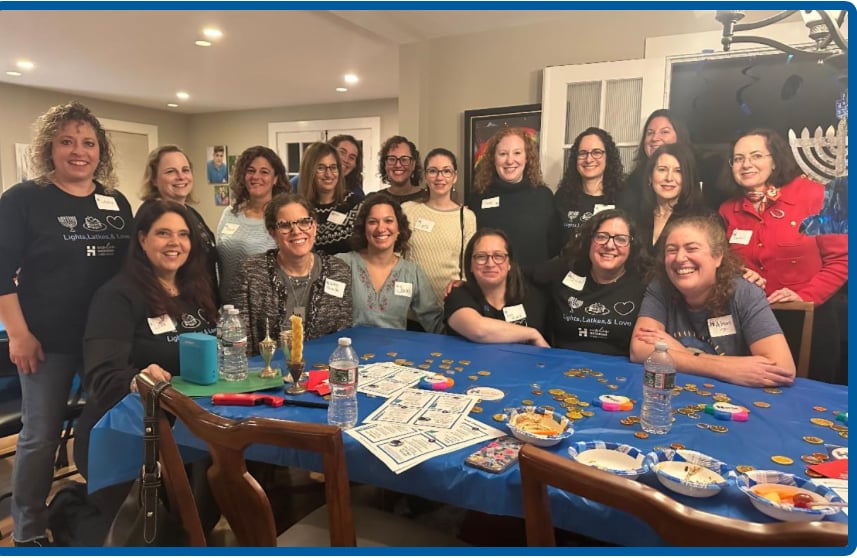
Members of Hadassah Northeast's Evolve program celebrating Hanukkah together in December 2024. Photo supplied by the author who is seated in the first row on the far right.
Hanukkah is approaching — the holiday where we spin dreidels, give gifts and eat latkes and fried donuts until our bellies hurt.
But mostly, Hanukkah is a celebration of Jewish pride. It’s a time to place our brightly lit menorahs in our windows for all to see. And it’s a time that the Jewish people get to decide, for ourselves, what it means to be Jewish and how we want to express that identity.
Hanukkah is also one of the many Jewish holidays that demonstrate the Jewish connection to the land of Israel. The key events of the story take place in Jerusalem, as well as in the territory that is now the West Bank.
Here’s a little known fact: When you play dreidel anywhere in the world other than Israel, you use a dreidel whose letters, נ ג ה ש stand for “A Great Miracle Happened There” ; (נס גדול היה שם) The letters in Israel, נ ג ה פֹּ stand for “A Great Miracle Happened Here” (פֹּה (נס גדול היה .
Like many Jews, my connection to Israel is very strong. When I was in middle school, high school and college, I was an active member of Young Judaea (YJ), Hadassah’s peer-led youth movement, now independent, though still receiving Hadassah support.
I remember thinking that Young Judaea’s emphasis on our calling ourselves Zionists felt silly to me. “Why do we even need a word to state that?” I wondered. Of course, the Jewish people are connected to the land of Israel. Jewish people have lived in the land of Israel since the beginning of recorded history. Most of our holidays are tied to the land of Israel in some way. In our prayers, we often address G-d as the “G-d of Israel.” My favorite prayer is Shalom Rav (Abundant Peace), a prayer for peace for all the people of Israel.
When Jews pray, no matter where in the world they are located, the tradition is to position themselves facing Jerusalem.
To me, the word “Zionist” is synonymous with “Jewish.” Jewish practice, Jewish tradition and Jewish history are all rooted in Israel. Close to half of the world’s Jewish population lives in the modern state of Israel.
Because the words “Zionist” and “Jewish” felt interchangeable to me, I never used the word “Zionist” to describe myself.
Until recently.
We are living in a time with a staggering acceleration of antisemitic hate crimes all over the world. Here in the US, we are bombarded by hate speech from both the far-right (Tucker Carlson, Nick Fuentes, for example) and the far-left.
The hate speech and hate symbols on the right are familiar. We see a swastika or hear the phrase, “Jews will not replace us” and we know we are dealing with Jew hatred. The antisemitism on the left is less familiar to most of us. (Unless, of course, you are from Russia and lived there through the Cold War era when anti-Zionism was used to justify brutal, state-sanctioned oppression of Russian Jews.)
It’s hard for some people to understand that anti-Zionist phrases and imagery gives most Jews as much of a gut punch as far-right phrases like “Hitler should have finished the job.”
I didn’t know I was a Zionist when I was younger, but now, with the resurgence of anti-Zionism, it’s very clear to me that I am a Zionist and have always been one. It was this realization that prompted me to seek out my local Hadassah chapter. Surrounding myself with proud Zionist women who, not only support Israel but also take seriously their mission to combat antisemitism, has made me feel both comforted and empowered.
Being a Zionist does not mean that I personally agree with everything the Israeli government does. It doesn’t mean I don’t care what happens to the Palestinian people. I mourn the loss and devastation in Gaza.
Being a Zionist also does not mean I can’t tolerate hearing criticism of Israel. I ask only that the criticism be grounded in an honest history of the region.
There are those who say they are “anti-Zionist” and believe they can attack the part of me that feels connected to Israel without wounding the rest of me. It doesn’t work that way. And I’m tired of people acting like it does.
A few weeks ago, there was a disturbing incident in New York City. The Park East Synagogue hosted an event with Nefesh B’Nefesh, an organization that provides information and support to individuals who want to move to Israel. A protest was organized outside the synagogue, allegedly because Nefesh B’Nefesh not only helps people settle new immigrants in the State of Israel, but also in the West Bank.
You can’t justify what happened there: the protest turned ugly. Members of the mob chanted, “Globalize the intifada” and “Death to the IDF (Israel Defense Forces).” They yelled, “f–king Jewish pricks” at families entering the synagogue. The protest leader repeatedly told the crowd, “Keep it up! We need to make them scared!” Anti-Zionists would tell you that the protest was against Zionists, not against Jews. Perhaps they believe that is true. But if someone called me a Jewish prick, I would view it as an attack on my Jewish identity, not an attack on my support of Israel. Wouldn’t you?
A little closer to home, I recently had an email exchange with a non-Jewish acquaintance about the uptick in antisemitic incidents in our community. My email was short (four paragraphs detailing how I had recently been called a “baby killer” when I attended a vigil in support of the hostages and how my husband was followed home from synagogue by a driver who yelled, “Free Palestine” out of his car window).
The response I received was four pages long. My acquaintance did not respond at all to the experiences I described. Instead, he questioned my motives, tried to silence me and suggested that I do more research on divisions within the Jewish community. He pointed to Ezra Klein, a political commentator and New York Times columnist, as a starting place.
As we begin to celebrate Hanukkah, it’s fitting to think back to 175 BCE, where the story begins. The Jewish people were living under the rule of the Seleucid Empire. In the early years of this empire, Jews had been left alone to live by their own customs and traditions, though some chose to assimilate and take on Seleucid customs.
When King Antiochus became the empire’s leader in 175 BCE, things began to change. He tried to force the Jews to give up their traditions and killed those who disobeyed. You probably know the rest:
Mattathias, Judah Maccabee and his followers refused to give up their way of life. The small group fought for three years against the powerful enemy and the Maccabees eventually won. They reclaimed and rededicated the Temple and lit a menorah whose oil miraculously burned for eight nights.
Now, every year on Hanukkah, we light the menorah and remember our brave ancestors who refused to let the ruling power define what it meant to be Jewish. We celebrate our heritage and our right to live freely as Jews.
I am tired of protestors who use the word “Zionist” as a slur. I am tired of people in my social circles who talk more than they listen. I am tired of the outside world telling me I should (or could) be Jewish without being a Zionist.
This Hanukkah season, I intend to continue speaking up against Jew hatred in all its forms and to proudly celebrate the joy and beauty of Jewish life, including my connection to Israel and my participation in the work of Hadassah.
And I intend to pray for a peaceful future for my Jewish community here in the US and for all the inhabitants of my spiritual home, the land of Israel.
—
Alison is a member of the Hadassah Writers’ Circle, a dynamic and diverse writing group for leaders and members to express their thoughts and feelings about all the things Hadassah does to make the world a better place. It’s where they celebrate their personal Hadassah journeys and share their Jewish values, family traditions and interpretations of Jewish texts. Hadassah members are proud of their Zionist mission and their role as keepers of the flame of Jewish values, traditions and beliefs as well as advocating for women’s empowerment and health equity for all. Since 2019, the Hadassah Writers’ Circle has published nearly 800 columns in The Times of Israel Blogs and other Jewish media outlets. Interested? Please contact hwc@hadassah.org.
Related Topics
Related Posts