French-Israeli Visual Artist and Writer
Hanukkah and the Jewish Refusal to Disappear
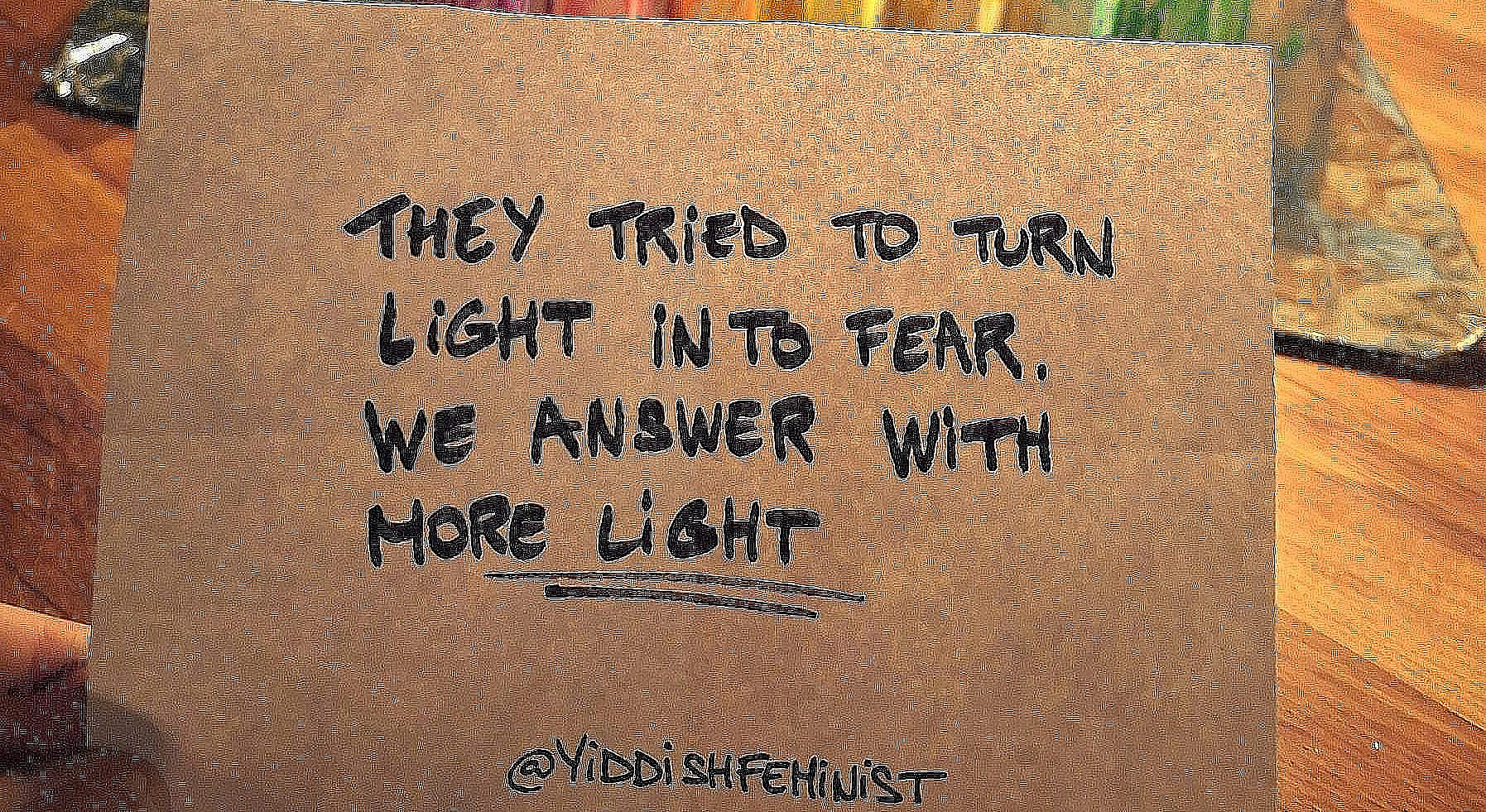
Credit: Morgane Koresh/ @YiddishFeminist
Hanukkah commonly evokes light, family gatherings, and childhood memory. But these associations sit atop a much deeper and more challenging history.
Hanukkah marks the only successful Jewish revolt in recorded antiquity against cultural erasure.
Not against slavery. Not against imperial taxation. Not against foreign rule as such.
Against forced assimilation.
The Seleucid decrees were not primarily economic or political. They were civilizational. They targeted the infrastructure of Jewish continuity itself: Torah law and study, Hebrew language, Shabbat, circumcision, and the Jewish calendar. Torah scrolls were destroyed, and those who taught or possessed them were executed. In effect, the decrees aimed to dismantle Jewish memory.
Most ancient peoples who faced comparable pressures disappeared. Their names survive, if at all, as archaeological layers or linguistic footnotes. Jews did not. Hanukkah is the reason why. It is, in this sense, a historical anomaly.
An Intra-Jewish War Before It Was a Foreign One
The popular narrative frames Hanukkah as Jews versus Greeks. This is not completely accurate.
A significant portion of the conflict was intra-Jewish. The earliest battles of the Maccabean revolt were fought not against Seleucid forces, but against Jews who had embraced Hellenization and sought to redefine Judaism as a civic, aesthetic, or philosophical identity compatible with imperial norms.
This was not a dispute about modernization. It was a struggle over the future of Jewish peoplehood, and whether it would endure at all.
That tension has never disappeared. It echoes today when questions of peoplehood, sovereignty, and continuity once again collide with pressures for moral palatability and acceptance.
Hanukkah is therefore not simply about resisting external coercion. It is about internal fault-lines: between adaptation and erasure, between continuity and acceptance at any cost. It asks an uncomfortable question that remains unresolved: Who decides what Judaism is allowed to become?
The Oil Was Not Enough, and That Was the Point
The rabbinic tradition famously centers Hanukkah on the miracle of the oil. But this is not its only meaning, nor its only lesson.
The significance is not simply that the oil lasted eight days. It is that it was lit at all.
The Maccabees knew the oil was insufficient. They lit it anyway.
In this reading, continuity does not depend on waiting for stability or ideal conditions, but on acting despite their absence. Rabbinic Judaism later canonized this moment not as a story of divine intervention, but as a model of action under existential constraint.
This is not passive faith. It is defiance formalized as ritual.
Hope as a Discipline
Hanukkah introduces a distinct concept: hope as a practice rather than a feeling.
Lighting an increasing number of candles each night runs counter to basic survival logic. In times of scarcity, most societies conserve light. Judaism does the opposite: it escalates it. Visibility increases as darkness deepens.
This is not symbolic optimism. It is a counter-survival strategy: an insistence on growth precisely when disappearance would be rational.
Hope, in the Jewish tradition, is not an emotion. It is a disciplined behavior.
Visibility as a Commandment
Hanukkah is the only Jewish holiday in which the central mitzvah is explicitly public: פרסומי ניסא (pirsumei nisa), publicizing the miracle. We are commanded not merely to remember, but to be seen.
This demand is deeply counterintuitive given Jewish historical experience, in which discretion often prevailed. When public display was dangerous or impossible, the practice was scaled down rather than abandoned—moved from streets to windows. Yet the obligation endured.
This is not incidental. It is instructional, offering a model for Jewish life that insists on presence rather than retreat, even when visibility feels costly.
The Model That Allowed Jews to Outlive Empires
The rededication of the Temple is often described as purification. That framing, while accurate, is incomplete.
There was no attempt to erase Greek influence from Jewish life afterward. Judaism did not reject the surrounding world; it reasserted its terms of engagement.
You may borrow tools.
You may engage ideas.
You may not surrender meaning.
This framework of selective integration without self-negation proved more durable than any empire Judaism encountered. It allowed Jews to adapt without disappearing, and to outlive political systems across millennia of exile.
The Moment Jews Chose to Remain a People
Without Hanukkah, Judaism likely does not survive as a people. It becomes a Hellenistic sect, a philosophical school, or a historical curiosity.
Hanukkah marks a pivot point at which Jews chose continuity over acceptance, peoplehood over abstraction. It is the moment Judaism insisted on remaining embodied, practiced in time, space, language, and law.
Texts alone do not preserve civilizations. Rituals do.
One Ritual, Many Exiles
Each Jewish exile re-lit Hanukkah for different reasons.
In medieval Europe, it signified resistance to forced conversion. In the Ottoman world, communal endurance. In the Soviet Union, underground identity. In modern Israel, restored sovereignty.
The threats changed. The ritual held.
That durability is no accident. It is woven into how Judaism lives and renews itself.
Hanukkah does not promise safety. It offers something harder and more enduring: the refusal to disappear, even when assimilation would be easier.
And in a world where antisemitism is once again overt, global, and unapologetic, that refusal is not only an inheritance, it is a living choice, renewed each time Jews insist on being present, visible, and connected to one another.
Related Topics
Related Posts