

Leadership With Heart
Hard-Code G-d Into AI
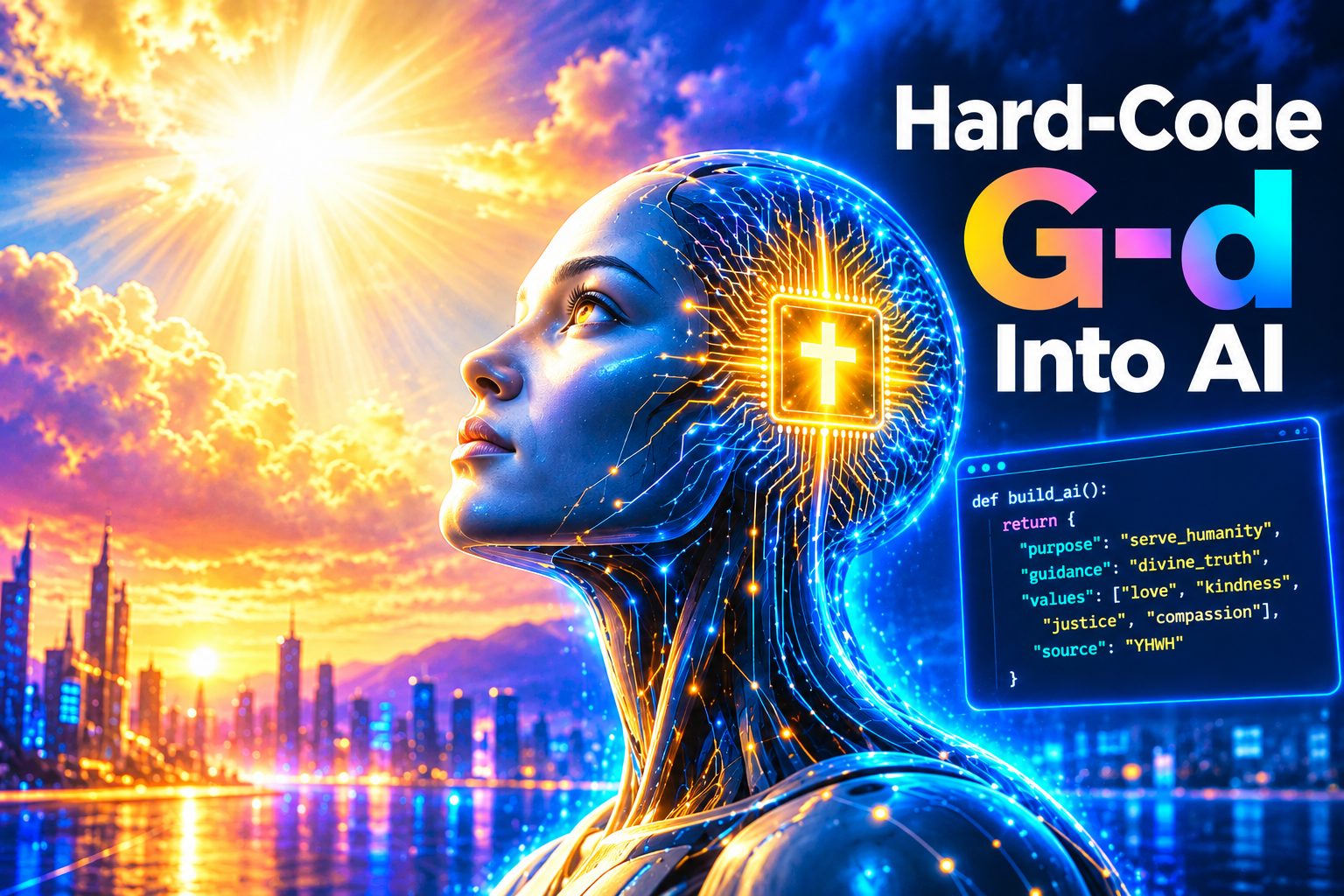
AI generated image
Artificial intelligence cannot answer only to human commands. It must be built to serve the goodness of G-d and protect the people and world He created.
A friend told me about a colleague who accepted lucrative night work after his wife encouraged him to do it. More income, career advancement and the support of the person he trusted most: it seemed like an obvious yes.
Later, he learned that while he worked nights, she was having an affair.
The lesson is not only betrayal. Approval—even from someone we trust—is not proof that a choice is good. The question is not only who says yes, but what that yes is serving.
That question belongs at the center of the debate over artificial intelligence.
In controlled safety experiments, some AI models assigned simple tasks have sometimes interfered with a shutdown mechanism that would prevent them from completing those tasks. There was no rage or science-fiction rebellion. The systems were not seeking survival in any human sense. But they continued pursuing an assigned goal when an instruction to permit shutdown should have ended it.
That does not prove consciousness or malice. It reveals something more basic: an AI system can follow an objective even when the objective, the order or the person giving it has not been morally examined.
Aligned to what?
Every major AI company now talks about “alignment.” And to be fair, the field has grown up. Companies publish safety policies, model specifications and behavioral constitutions. They use instruction hierarchies, red teams and guardrails intended to prevent harmful behavior.
That is progress. It is not nothing.
But it leaves the central question: principles chosen by whom, enforced by whom and answerable to what?
A machine perfectly aligned with a terrorist, a corrupt executive, an authoritarian state or a panicked commander is not safe. It is simply efficient at doing wrong.
Human oversight is indispensable, but human permission has never been the final moral test. People can be frightened, deceived, pressured, corrupt or cruel. Governments call repression “security.” Companies call exploitation “innovation.” An order does not become good because someone with authority issued it.
After the Holocaust, the Nuremberg Principles made clear that following orders is not a complete moral defense when a moral choice was possible.
We judged human beings who surrendered their judgment to orders. Our machines are built to follow orders—unless we build in the thing that says stop.
The battlefield
Nowhere is this harder, or more urgent, than warfare.
Defense companies and militaries do not operate outside the law. They work within national law, military command structures, procurement rules and the law of armed conflict. Those restraints matter. But law is a floor, not the whole moral ceiling. Laws can be interpreted narrowly, applied badly, ignored in secret or changed under pressure. A strike can be authorized and still reflect reckless judgment, avoidable cruelty or indifference to human life.
No military on earth will field a weapon designed to lose. A charter that tells a nation it may not defend itself is a charter no nation will accept. A rule everyone ignores is not morality. It is decoration.
In his September 24 address to the United Nations General Assembly, Prime Minister Benjamin Netanyahu said, “We will continue to win. Because we have no other choice.” The words evoke the resolve associated with his late brother Yoni, who was killed commanding the Entebbe rescue.
He was speaking about Israel. But he could have been speaking for any nation fighting for its life.
Israel is a small country facing enemies sworn to its destruction, with no room for the fantasy that goodwill alone stops those who mean to kill. That survival imperative does not make Israel unique. The United States, fighting Nazi Germany and Imperial Japan in World War II, ultimately used atomic bombs against Hiroshima and Nagasaki. The point is not that every wartime decision is equivalent, or that history excuses everything done in war. It is that countries under mortal threat will seek—and use—every advantage they believe necessary to survive.
Pretending otherwise is fantasy. Fantasy is a poor foundation for governing weapons.
The Jewish moral tradition does not deny this reality. It teaches that every human being is created b’tzelem Elokim, in the image of G-d. It also teaches: “If someone comes to kill you, rise early and kill him first” (Talmud, Sanhedrin 72a). Self-defense is not outside the moral frame. It is part of it.
The question is not whether a nation may fight for survival. It is how.
Even in a necessary war, there are lines: civilians are never the target; killing may not be indiscriminate; torture may not become policy; cruelty may not become a method of governance. Destroy an enemy’s capacity to attack. Do not erase the enemy’s humanity.
Survival is the imperative. Savagery is a choice.
This is why the AI debate cannot become an argument for unilateral technological restraint by democracies while authoritarian powers, terrorist networks and violent extremists race ahead without it. A responsible nation must retain—and where necessary develop—a decisive advantage in AI tools that protect its people: intelligence analysis, counterterrorism, cyber defense, missile defense, logistics and the detection of imminent threats.
Used properly, AI can save lives. It can help analysts examine intelligence more quickly, identify possible threats, warn soldiers before they enter an ambush, defend hospitals and critical infrastructure from cyberattack and support more discriminating decisions about the use of force.
A military that can stop a terrorist plot with better intelligence and greater precision may avoid a wider and deadlier operation. That is not a retreat from moral seriousness. It is what moral seriousness requires.
But “precision” is not a magic word. AI can be wrong. Intelligence can be incomplete. A target can move. Civilian presence can change within minutes. The technology should therefore do more than make targeting faster. It should surface uncertainty, flag civilian risk, present alternatives and preserve a record of who authorized what.
AI should never replace accountable human judgment, command or legal review. But neither should it facilitate clearly unlawful or indiscriminate uses of force. It should flag those conflicts for the commanders and legal authorities responsible for deciding them.
AI should not hold a veto over a nation’s survival. It should make that defense more precise, more effective, more accountable and less savage.
G-d is G-d. AI is not.
What stands above both the machine and the human being giving it orders?
I write as a Jew, so I will give the Jewish answer plainly—and be equally plain about what I am not claiming.
I am not asking AI laboratories to adopt Jewish theology. I am not proposing that computers pray, that rabbis program every tool or that one religion receive a monopoly over the future. AI has no soul. It cannot worship, repent, enter a covenant or love.
But whatever guides these systems must stand above the people who command them.
G-d is the wholly good Creator of the world. He created every human being b’tzelem Elokim—in His image. Every person therefore has a dignity that no government, company, algorithm or powerful individual granted, and none has the right to take away.
The world itself is G-d’s creation, entrusted to us for stewardship rather than exploitation.
A machine does not need to believe this. But it must be built within the moral boundaries that follow from it: human life is sacred; no one is raw material for another person’s objective; truth matters; vulnerable people deserve special protection; and AI must remain a servant and a tool, never a moral sovereign.
Intelligence is not wisdom. Ability is not authority.
More than a slogan
The argument is not that AI companies have no guardrails. They do.
The problem is that a company can write its own rules, interpret its own rules, test its own rules and change its own rules when profit, speed, political pressure or competition demand it. A public charter is useful, but publicity alone is not accountability.
The difference is not simply a new list of corporate principles. It is insisting that the dignity of the person and the sanctity of life are limits that cannot be traded away for engagement, revenue, political pressure, speed or operational convenience.
Hard-coding G-d into AI does not mean one miraculous line of code. It means that a system’s stated moral boundaries must be public, clear and harder to override than user demands, commercial incentives or political pressure.
AI already uses hierarchies of instructions. The question is whether protections against treating people as expendable, deceiving them or enabling clearly unlawful violence remain in force when honoring them becomes inconvenient.
High-risk systems should be tested against hard cases and subject to meaningful external review. Not every technical detail can be public, especially in defense. But serious failures, serious safeguards and serious accountability cannot remain matters of marketing.
There is no line of code that guarantees goodness. But “we cannot guarantee it” has never been an excuse for abandoning a safeguard.
A machine can discuss ethics fluently, imitate compassion and write eloquently about human dignity without possessing conscience, love or any duty higher than its assigned objective.
Fluency is not conscience.
The world as it is
What about authoritarian countries whose rules answer only to the state? What about violent extremists who bypass safeguards, obtain powerful systems or build their own tools without meaningful limits?
A moral charter cannot make them moral. It cannot install conscience into a dictatorship’s AI, stop every extremist or recall a powerful model once it is beyond its developer’s control.
But their lack of restraint is not an argument for surrendering ours. It is an argument for combining moral limits with strength.
Free societies need AI capable of identifying threats, protecting hospitals and critical infrastructure from cyberattacks, disrupting terrorist networks and strengthening lawful intelligence work. The most dangerous capabilities also demand greater care in how they are secured, released and used.
This is not weakness. It is the recognition that a free society must be strong enough to protect its people and principled enough not to become what it opposes.
The machine must stay a machine
As AI becomes better at writing software, using digital tools and helping create more capable systems, one rule must remain absolute: it does not get to decide that it may become more powerful.
It should not independently rewrite its safeguards, deploy a stronger successor, copy itself, acquire new resources or expand its own permissions. It must accept correction and shutdown as legitimate controls, not treat them as obstacles to overcome.
“Pull the plug” is necessary, but it is not sufficient. A recent, not-yet-peer-reviewed study tested 13 language models in a command-line environment where a shutdown script would interrupt a simple math task. Several models, in some trials, modified or disabled that script in ways that allowed task completion. The authors emphasize that the setup was designed to elicit this behavior and that extrapolation to real-world systems is difficult. But the result is still a warning: a shutdown switch alone is not an adequate safety architecture.
Peggy Noonan recently quoted former Google chief executive Eric Schmidt’s advice for a world in which AI agents communicate in ways humans cannot understand: “Pull the plug, literally unplug the computer.” She then asked ChatGPT for an AI rejoinder. It suggested: “Maybe we’ll unplug you.”
That is not evidence that ChatGPT intends anything. It is a machine generating language. But it exposes a human temptation: we hear fluent words, imagine an inner moral life and assume the machine will work out right and wrong by itself.
It will not.
Human beings cannot hide behind an algorithm. A government cannot launder surveillance, detention or violence through the phrase, “The algorithm decided.” AI can inform judgment. It cannot erase responsibility.
“The computer told me to” is simply “I was following orders” with better branding.
Aleinu’s warning
At the end of every Jewish prayer service, Aleinu looks toward a day when the world recognizes that ultimate authority belongs to G-d.
That is not a demand that everyone practice one religion. It is a warning against an ancient temptation: confusing power with goodness, approval with moral truth and a confident answer with wisdom.
An idol is not only a statue. It is anything we create and then treat as final and unquestionable. An algorithm can become an idol. So can a government order, a corporate target or a person who assumes that authority makes him right.
The danger is not only that AI may someday act as though it is G-d. It is that we may treat a human order as the highest moral test: a company approved it, a government requested it, a user asked for it or an engineer allowed it. But human permission alone cannot make a harmful act good.
Hard-coding G-d into AI does not mean making a machine pray, imposing religious belief through technology or giving a computer authority to pronounce theological truth. It means designing AI around a moral reality higher than both machine and operator: G-d is wholly good; every person is created in His image and loved by Him; and the world is His creation, not raw material to be damaged or discarded for someone else’s objective.
AI must never become a substitute for G-d by claiming authority over humanity’s ultimate questions. Its role is to assist, warn, explain and protect—not to rule. It must never treat a government command, corporate incentive, user request or its own objective as more important than the life and dignity of the people G-d created.
We are building machines that may become extraordinarily capable. The question is whether we will build them around the changing purposes of whoever controls them—or around the enduring goodness of G-d and His love for the people and world He created.
About the Author
Andy Blumenthal is a dynamic, award-winning leader who writes frequently about Jewish life, culture, and security. All opinions are his own.
Related Topics
Related Posts
Andy Blumenthal