Economist
Have You No Sense of Decency?
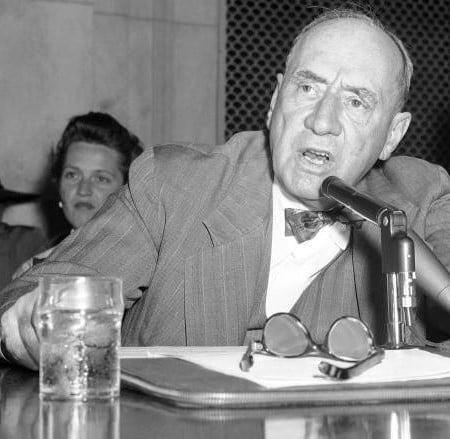
Army lawyer Joseph Welch at the House Un-American Hearings, June 9, 1954. (CalVet Connect)
I woke up this morning (Thank Gd), made some coffee, and with my dog sitting on my lap, began reading the news. And there it was – the Prime Minister’s wife suggested that the fact that a former senior military leader was able to put on his uniform and rush to the Gaza border within 90 minutes after Hamas terrorists invaded Israel and began slaughtering hundreds of Jews on October 7, 2023, proves that he must have had advance knowledge of the attack.
At that moment all I could think of was the image of Army chief counsel Joseph Welch incredulously asking Senator Joseph McCarthy, after weeks of public Congressional hearings during which McCarthy questioned people’s loyalty to the United States – many of whom just a decade earlier had risked their lives on behalf of the nation, “Have you no sense of decency, sir, at long last? Have you left no sense of decency?”
After almost 3 years of war, resulting in thousands of Israeli deaths, possibly upward of 75,000 to 100,000 wounded – both physically and emotionally, and the highest number of orphaned children since the nation was established, is this where we have gotten to?
Have you no decency madam? Is nothing off limits in your quest to maintain the lifestyle which you have become accustomed to over the last few decades and which you somehow feel you deserve, which by the way, is financed by the nation’s citizens?
And then I realized that I was reading about Sara Netanyahu’s interview on the first day of school for hundreds of thousands of impressionable children. Our children.
Why worry about the potential impact of AI on society when public figures in this so-called “Jewish Democracy” spew such venomous poison … and this just days before the Jewish part of that Jewish Democracy is about to enter into days of reflection and introspection.
Yesterday I had the honor of attending 2 circumcisions. After each one was performed, the following phrase was said while formally giving the babies the names they will carry for the rest of their lives, “Remember forever his covenant, the word which he pledged for a thousand generation.” Upon hearing these words, I was overwhelmed thinking about the contrast between the purposefully hurtful way “we” treat each other these days, and the grace of the Brit which was given to us unconditionally – regardless if we deserved it or not, thousands of years ago.
The formal circumcision ceremony ends with the saying of the “Mourners’ Kaddish” – a brief prayer said only by people who are in a period of mourning for a family member. Recently I have been saying this prayer on behalf of very close friend of mine, Lewis Kest, a Holocaust survivor, who died at the age of 106, leaving no immediate male heirs. As I always do, I thought of “Lee” while reciting the prayer and how, on the one hand, nothing would have made him happier than to witness the continuation of the Jewish people, twice in a matter of hours, yet on the other hand, nothing would have upset him more than witnessing “our Yiden” (his phrase, not mine!) intentionally hurting others.
As we enter our “days of awe,” I ask myself, how does a society perform introspection and how does a society ask for forgiveness?
May you and your entire families be blessed with good health, may we all be inscribed for a good year and may we all receive good news soon.
Related Topics