CFO | Empower Society for Good I Author
Hebron: Whose Legacy Is It Really?
https://www.youtube.com/watch?v=ggljfAfREjU
Hebron is one of the oldest continuously inhabited cities in the world. Its origin is Hebrew, not Arabic. The very name “Hebron” (in Hebrew: Chevron, חֶבְרוֹן) comes from the root ח־ב־ר, meaning to connect or to join. It speaks of covenant, friendship, and unity—deeply tied to the life of Abraham, the forefather of the Jewish people.
It is here, in Genesis 23, that Abraham purchased the Cave of Machpelah to bury his wife Sarah. This was not a symbolic act, but a documented and witnessed land acquisition, making Hebron the first piece of the Promised Land to be owned b Jew—purchased, not conquered. This moment is etched into Jewish identity as one of the cornerstones of our connection to the Land of Israel.
Hebron Day – A Return After Centuries
Each year, on the 29th of Iyar, we commemorate Hebron Day (Yom Hevron)—the date in 1967 when, during the Six-Day War, the Jewish people peacefully re-entered Hebron. Unlike other cities where heavy battles were fought, Hebron was not taken by force. The Arab army fled, and Israeli soldiers entered without firing a shot. Jews returned not to conquer, but to reclaim their ancestral city after nearly 2,000 years of foreign domination.
See the Feature video of reclaiming Hebron.
Since then, the Jewish community in Hebron has been re-established, reviving ancient roots while facing modern challenges.
A Shared Figure, But Not a Shared Claim
Centuries after the Jewish covenant was made, Islam emerged and adopted many biblical figures—including Abraham (Ibrahim), Isaac (Ishaq), Jacob (Yaqub), and Moses (Musa). The Qur’an reveres them, reinterpreting their stories to align with its own spiritual vision. As a result, places like Hebron (Al-Khalil) became sacred in the Muslim world.
But let’s be honest: this reverence is based on a Jewish story.
The problem isn’t that Islam honours Abraham. The issue is when a borrowed narrative becomes the basis for claiming Jewish holy sites—and worse, for denying Jewish presence and ownership. This is not merely theological; it’s political and existential. It affects rights, access, recognition, and peace.
Al-Khalil: A Reframing or a Rewriting?
In Islam, Hebron is known as Al-Khalil, “The Friend,” referring to Ibrahim Khalilullah—the Friend of God. But this name and the reverence surrounding it are centuries younger than the Jewish connection. The Qur’an does not mention Hebron or Jerusalem by name. The spiritual link is retroactive, constructed through Jewish sources, not through their own scripture, archaeology, or original religious practice.
Muslim rulers built beautiful structures over Jewish holy sites, including the Ibrahimi Mosque atop the Cave of the Patriarchs. But this came after Islam’s expansion, not as an Indigenous claim. What we see is a rebranding of sacred Jewish geography, with altered theological narratives and new political meanings.
When Borrowing Becomes Erasure
Here’s where it becomes a problem: Muslim devotion to Abraham may be real and sincere, but it often comes with a denial of the Jewish foundational claim. We are told that Jews “occupy” Hebron. That Jewish visits to the site are “provocations.” That this land never truly belonged to us.
This isn’t just wrong—it’s a form of historical theft.
When a faith adopts your prophets, your stories, and your holy places—and then claims that you don’t belong—what is left of truth? Of justice?
The Rewriting of Jewish History
From the Crusader expulsion to Ottoman-era restrictions (Jews could only pray at the seventh step outside the Cave), to the 1929 Arab pogrom—where 67 Jews were murdered and the rest of the Jewish community expelled—Hebron’s history has been marked by attempts to sever Jews from their past.
But Jews returned.
In the late 1800s, Jews began returning to Eretz Yisrael, reviving the land. Many Arabs from Syria, Jordan, and other countries migrated too, seeking work and better conditions created by Jewish development. Let’s be honest: these were Arabs, not “Palestinians.” That term was coined by the Romans, and there is no distinct or ancient Palestinian culture or state known to history.
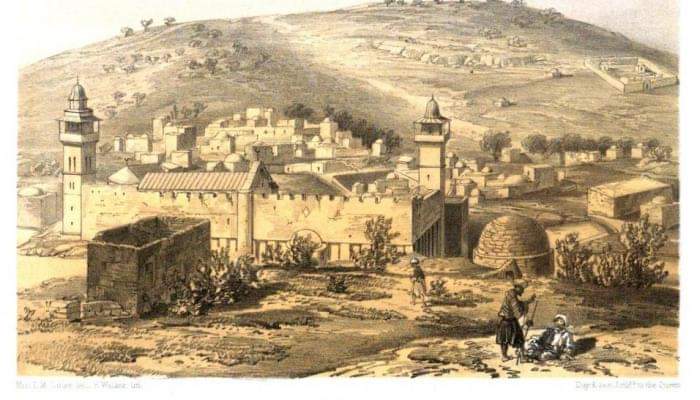
A photo of Hebron in 1853, sourced on Facebook, shows a small town with no large population. Where and when did all the Arabs come from?
History Cannot Be Erased.
When I studied history, I believed it was fixed. But today, I see how history is rewritten—how Jewish presence is erased, and how borrowed legacies are repackaged as indigenous claims.
As Melanie Phillips reminds us, we must change the narrative. We must return to truth rooted in 3,000 years of texts, memory, and archaeology—not social media myths.
Even Winston Churchill saw the obvious:
“It is manifestly right that the scattered Jews should have a national centre … and where else but in Palestine, with which for three thousand years they have been intimately and profoundly associated?”
Watch Reb Shlomo Carlebach tell the story of Hebron from the soul: https://youtu.be/z7Ta2wOj52A
Conclusion: Return to Origins
The name Hebron is not Arabic. The city was not born of Islamic faith. It stands as a pillar of Jewish memory, and that must be acknowledged.
Let us share space with dignity—but let us not surrender our history for the sake of false parity.
- Hebron is Hebrew.
- The land was purchased by Abraham.
- The covenant was made there.
- The Jewish presence was never voluntarily abandoned—it was violently removed.
- And now, we have returned.
Peace and Reconciliation can only be built on the rock of truth, not the sand of borrowed narratives.
Related Topics
Related Posts