
Helping Those Left Behind By Israel’s Fallen Heroes
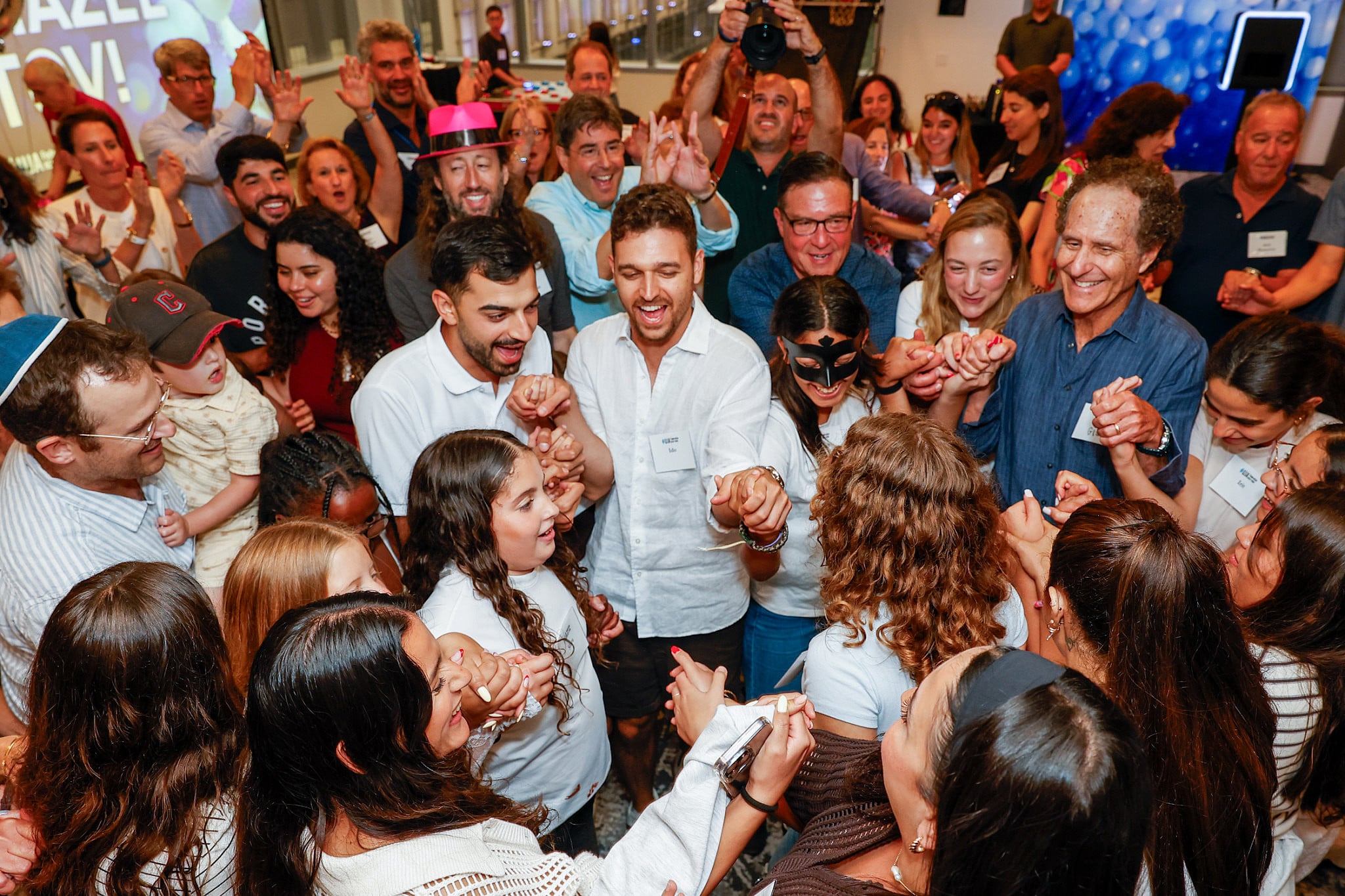
Thirty young Israeli orphans visiting New York this month took part in a joyful evening marking their bar and bat mitzvahs.
I met Tal Goldstein-Almog, 11, when he was visiting New York a couple of weeks ago as part of a group of 30 Israeli youngsters. The rising seventh grader told me he taught himself English (which he speaks well), out of boredom. Same goes for his learning to play drums. “Also from boredom, I taught myself,” he said with a smile. He enjoys coding in school, is a fan of American football, especially the Patriots, and someday would like to be a basketball player and a comedian – because “I make people laugh.”
Considering his personal history, Tal’s sweet, outgoing personality is truly remarkable.
On the morning of October 7, 2023, Tal, his parents, and three siblings hid for several hours in their home on Kfar Aza, a kibbutz near the Gaza border, before Hamas terrorists broke into the family’s safe room. They murdered Tal’s father, Nadav, 48, and sister, Yam, 20, an off-duty IDF soldier, and took Tal, his mother Chen, sister Agam, 17, and brother Gal, 11, into Gaza as hostages. For the next 51 days until their release, they were kept in “tunnels, buildings and malls,” Tal told me. “It was scary, we didn’t know what would happen and I felt lost.”
A key factor in Tal getting through this unimaginable experience and thriving these last several years is an Israeli government-sponsored group, the IDF Widows and Orphans Organization (IDFWO). Since 1991 it has provided emotional, social and financial support to thousands of bereaved spouses and children of Israel’s fallen heroes.
(In Israel, a child who has lost a parent who was serving in Israel’s military or security services is considered an orphan.)
Among the services the organization offers are legal representation, retreats and children’s camps during the year, and the group trip to the US. All of the counselors are themselves IDF orphans who went through the program when they were younger.
The evening I met Tal, he and the 29 other boys and girls, ages 11 to 13 – most of whom lost a parent in service to the state since October 7 – were at an event hosted by UJA-Federation of New York and IDFWO. It was held to mark and celebrate their bar and bat mitzvahs and highlight the power of community support for the program. New York was the last stop of a three-week visit to America, with the kids having spent a week in Chicago and a week at a Jewish camp in Wisconsin.
Dan Elbaum, the executive director of the American branch of the group, told me that its primary goal is to “make sure the families know they are not alone. We give them a community,” he said, and from the time a spouse is told of the death of his or her partner, the non-profit group offers volunteers – themselves IDF widows and widowers – to step in and provide comfort and guidance. In the past, fewer than 10 children a year usually became eligible for the program. But since October 7, 360 widows and 900 children, more than 200 of whom are under the age of five, have been added to the ranks.
“We all have an impossible task,” Elbaum noted, “but this project is about need and gratitude.”
UJA-Federation CEO Eric Goldstein, who participated in the evening’s celebration, described the IDFWO project as “a sacred task,” one that “stands out in a sea of need because it provides stability for this community.” The federation has contributed $2.8 million to the IDFWO in the last two years, part of the $300 million donated to Israel since the war began to help rebuild broken communities and support a wide range of social services.
Several dozen UJA lay leaders and professional staff were on hand to welcome and mingle with the children, making them feel at home in a large room on the seventh floor of the UJA offices decked out with colorful posters, banners and Israeli flags. There was pizza for dinner. A photo booth, an indoor basketball arcade and other games were provided, and t-shirts, necklaces and candies were handed out. The biggest attraction: a DJ playing pulsing Israeli dance music that gave the room the feeling of a high-powered disco.
Watching the spirited children and their hosts in a big circle dancing to and singing “Am Yisrael Chai” brought tears to my eyes. I felt I was witness to the living definition of Israeli resilience.
During the evening, I had an opportunity to speak with a few of the children, and each emphasized how comforting it has been for them to bond with others in the group during the meetings they have during the year. Noor Saleh, who is 13 and lives in a Druze village in the north of Israel, doesn’t speak Hebrew. But he told me he manages to communicate with his peers, and “we all feel the same thing at home because life is hard without your father.”
Noor’s father, Yosef, a sergeant in the Israeli Police Force, died of an illness in 2013.
Noor asked me to add that in his community, “we respect each other and there are no fights.”
His counselor, Shadan Khnefiss, 20, was the only Druze child in the program eight years ago. “We all had the same sorrow and so much in common, it was a relief to have someone to talk to who understands your feelings,” she said, adding that she has remained friends with the other children she met in 2018. “Now I see the full picture,” she told me, having experienced the program as a child and as a counselor for the second year. “It’s important to get to know your kids and help them be independent.” She said the program “has a special place in my heart” for all it has done for her and her family.
Rachel Aboujedid, who works with the IDFWO program in Israel and was part of the US trip, told me she was particularly moved by a recent evening session where the children sat in a circle and shared their individual stories of losing their parent. “Each seemed to have a more special story than the last one,” she said. “It’s so moving to see their resilience, and to see them hugging and comforting each other.”
Young Tal, the former hostage, described the session, too. “It was very emotional,” he told me, adding: “I didn’t cry.”