


‘Here There Are Blueberries’ revisits Auschwitz
Before an actor says a word, a camera sits alone on a pedestal at the lip of the stage.
It is a Leica, the small German 35-millimeter camera that was a small technological revolution in its own right. It allowed ordinary people to chronicle their own lives.
The play opens with what amounts to a biography of that camera. Vintage advertisements fill the back wall, one of them hailing the Leica as “the camera of modern times.”
That is how Moisés Kaufman and Amanda Gronich begin Here There Are Blueberries, which opened on Monday, Nov. 9, 2026, at the Ethel Barrymore Theatre for a 10-week run through Jan. 10. The play was a 2024 Pulitzer Prize finalist, and its off-Broadway run became the highest-grossing production in the 45-year history of New York Theatre Workshop.
You will sigh, and say: “Another play about the Holocaust.”
Yes.
And, no.
In December 2006, a retired US Army lieutenant colonel, once a member of the Army’s Counter Intelligence Corps, wrote to the United States Holocaust Memorial Museum. He had found a photo album while stationed in Frankfurt at the end of the war, and he had kept it for more than 60 years. The museum received it in January 2007. It held 116 photographs taken in and around Auschwitz during the camp’s final months.
The album belonged to Karl Höcker, adjutant to Richard Baer, the last commandant of Auschwitz. Before the war, Höcker had worked as a bank teller in Lübbecke. He arrived at Auschwitz in May 1944, and his first months there coincided with the murder of some 430,000 Hungarian Jews.
You will find no victims in Höcker’s album.
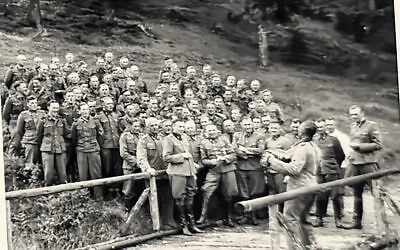
Rather, you will find the men and women who ran the place, enjoying their leisure time. Many of the pictures come from Solahütte, an SS retreat on the Soła River, where the SS rewarded guards who had performed their work “in an exemplary fashion.”
In one photograph, officers gather for a sing-along. The front row includes Höcker, Rudolf Höss, Baer, Josef Mengele, and Otto Moll, who supervised the gas chambers.
This is itself amazing.
Until the album surfaced, no known photograph showed Mengele at Auschwitz.
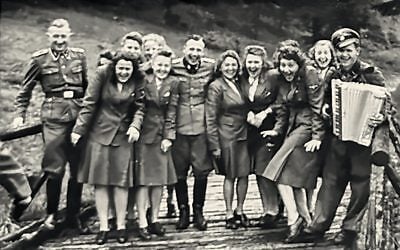
And then, there are the Helferinnen, the young women who served the SS as typists, telephone operators, and stenographers. On July 22, 1944, they posed on a wooden railing at Solahütte, bowls in their hands, an accordionist nearby. The caption reads “Hier gibt es Blaubeeren. Here there are blueberries.”
 We have visited this moral landscape before – most recently, in The Zone of Interest in 2024, Jonathan Glazer’s Academy Award-winning film about the family of Höss, and their lives in their villa outside Auschwitz.
On one side of the garden wall, Hedwig Höss tends her flowers and tries on a fur coat from “Canada,” the camp warehouse of stolen goods.
On the other side of the wall, the chimneys burn.
Hannah Arendt taught us about the banality of evil. Christopher Browning taught us about the “ordinary men” of Reserve Police Battalion 101. They wrote about how normal, even mediocre people were capable of great evil.
But, this is about something deeper, and even more troubling. This is about how people compartmentalize their lives. In The Nazi Doctors (1986), Robert J. Lifton called it “doubling,” the creation of a second self. The “Auschwitz self” does the killing, while the prior self goes on seeing itself as a “humane physician, husband, and father.”
Lifton built much of his case around Eduard Wirths, the chief SS physician at Auschwitz, a man he portrayed as decent before he allowed himself to become a killer. And here the play does something uncanny. Wirths’s son Peter appears as a character, alongside Tilman Taube, grandson of the SS doctor Heinz Baumkötter.
After the war, Höcker went back to the bank. A Frankfurt court sentenced him to seven years in 1965 for aiding and abetting the murder of a thousand people on three occasions, and he walked out on parole in 1970. He spent his remaining years insisting that he had done nothing wrong.
So, if we already read about this in Arendt or Browning, or already saw it in The Zone of Interest, what is new in this play?
It is not a “what;” it is a “who.”
We meet Rainer Höss, the grandson of Rudolf Höss, the first commandant of Auschwitz. He learned the truth about his grandfather when he was 12. In a dazzling soliloquy, he tells us that, as a young man, he was violent and beat people up. He wonders aloud: Did he inherit that propensity from his grandfather? Had the brutality survived in his body and his cells? He reaches for the vocabulary of our time and wonders about epigenetics. And he asks the haunting question: Will I hand this to my own children?
That is precisely the topic of the podcast that I co-produce with Sheryl Hoffman: To Be Continued…Reflections on Growing Up with Holocaust Survivors, in which we explore the issue of identity, trauma, and resilience among 2G and 3G survivors. Not only survivors: we have interviewed grandchildren of rescuers, and even Nazi soldiers.
The question is not only: What did Auschwitz do to the descendants of the victims? We know about that now. In 2015, Rachel Yehuda and her colleagues at Mount Sinai reported epigenetic changes in Holocaust survivors and in their adult children.
The question is also: What did Auschwitz do to the descendants of the killers?
Rainer Höss knows that he cannot change his grandfather, but “I am who I choose to be.” He wants to end the curse on his family for the sake of his own children. It is a kind of teshuvah: repentance for sins he did not commit, so that his children will not inherit them.
On the way out of the theater, there is a display in which you can actually see the photos from the album itself. There is a T-shirt for sale. It depicts a camera: “We don’t see what’s left outside the frame.”
I had to smile. My late father was a professional photographer who would have started his passion in the 1930s – with the Leica. My father knew that every photographer knows what they left out of the picture.
Karl Höcker knew it, too. In the summer of 1944, while the trains from Hungary were unloading at the ramp, he aimed his Leica at a row of young women eating blueberries and wrote a cheerful caption beneath the picture. He went back to his teller’s window in Lübbecke and rose to chief cashier. He died in 2000, at 88, in the town where he had spent his career counting other people’s money.
The chimneys never made it into his album, and he made sure they never made it into his story.