
Hezbollah’s empire in Europe
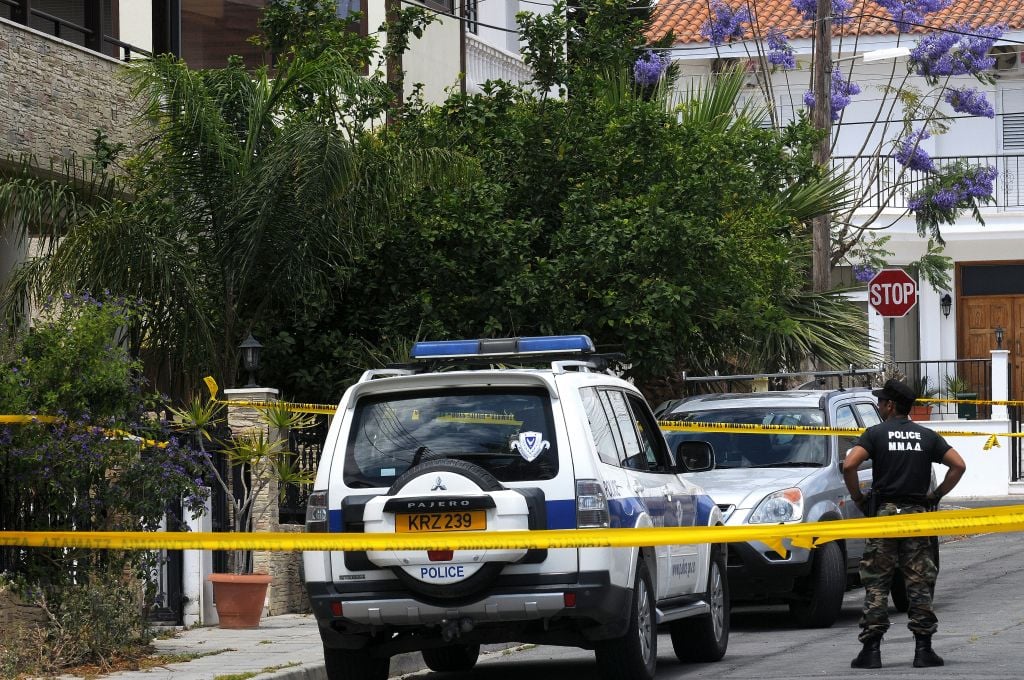
A police officer stands guard outside of the house where two tons of chemicals were found in the city of Larnaca, Cyprus, May 30, 2015. (Times of Israel; Petros Karadjias/AP)
In the sun-drenched coastal suburb of Larnaca, Cyprus, on a quiet day in late May 2015, Cypriot authorities—guided by weeks of discreet surveillance and intelligence tips—executed a daytime raid on a seemingly ordinary residential home. Descending into the cool, dimly lit basement, officers uncovered a nightmare: 8.2 tons of ammonium nitrate, a fertilizer that becomes a devastating explosive when mixed with fuel, ingeniously concealed within thousands of disposable cold packs from first-aid kits. The stockpile, one of the largest ever seized worldwide, had been meticulously built since at least 2011.
The house’s guardian, 26-year-old Hussein Bassam Abdallah, a dual Lebanese-Canadian citizen and confessed Hezbollah operative trained in weapons handling, was arrested on the spot with nearly €10,000 in fresh cash, payment for his vigilance. Abdallah had made around ten trips to Cyprus since 2012 just to check on the cache. Under interrogation, he admitted membership in Hezbollah’s military wing and revealed the hoard was intended for bomb attacks targeting Israeli and Jewish interests—not only in Cyprus but potentially exported across Europe. Escorted under heavy guard to court amid tight security, Abdallah pleaded guilty to eight charges, including explosives possession and terrorist group participation, and was sentenced to six years in prison. This chilling discovery exposed Hezbollah’s patient, low-profile terror infrastructure on European soil—a threat that thrives far from Middle Eastern battlefields.
That raid was a rare visible crack in an otherwise subtle empire. While Hezbollah’s South American operations are brazen, alliances with cartels like Venezuela’s Cartel de los Soles generating hundreds of millions annually through cocaine trafficking, arms deals, and money laundering, its European network operates way more in the shadows and with calculated restraint. Cocaine sourced in South America flows across the Atlantic, transiting West African hubs, before reaching Europe’s premium markets for distribution and sophisticated laundering. Proceeds fund the group’s arsenal and ideology amid crippling losses from the 2024 Israel-Hezbollah war and strained Iranian subsidies. Europe is the lucrative endpoint of a global chain, transforming criminal profits into clean funds and procuring critical technologies like drone components.
While precise Europe-only figures remain classified, experts estimate the continent contributes tens to hundreds of millions annually to Hezbollah’s criminal revenue stream—critical now as Iranian financial support falters.
Europol’s 2025 Terrorism Situation and Trend Report warns that Hezbollah’s propaganda continues to fuel anti-Israel hatred and potential violence, while joint US-EU assessments note intensified criminal efforts to offset battlefield setbacks.
A Sophisticated Web Across the Continent
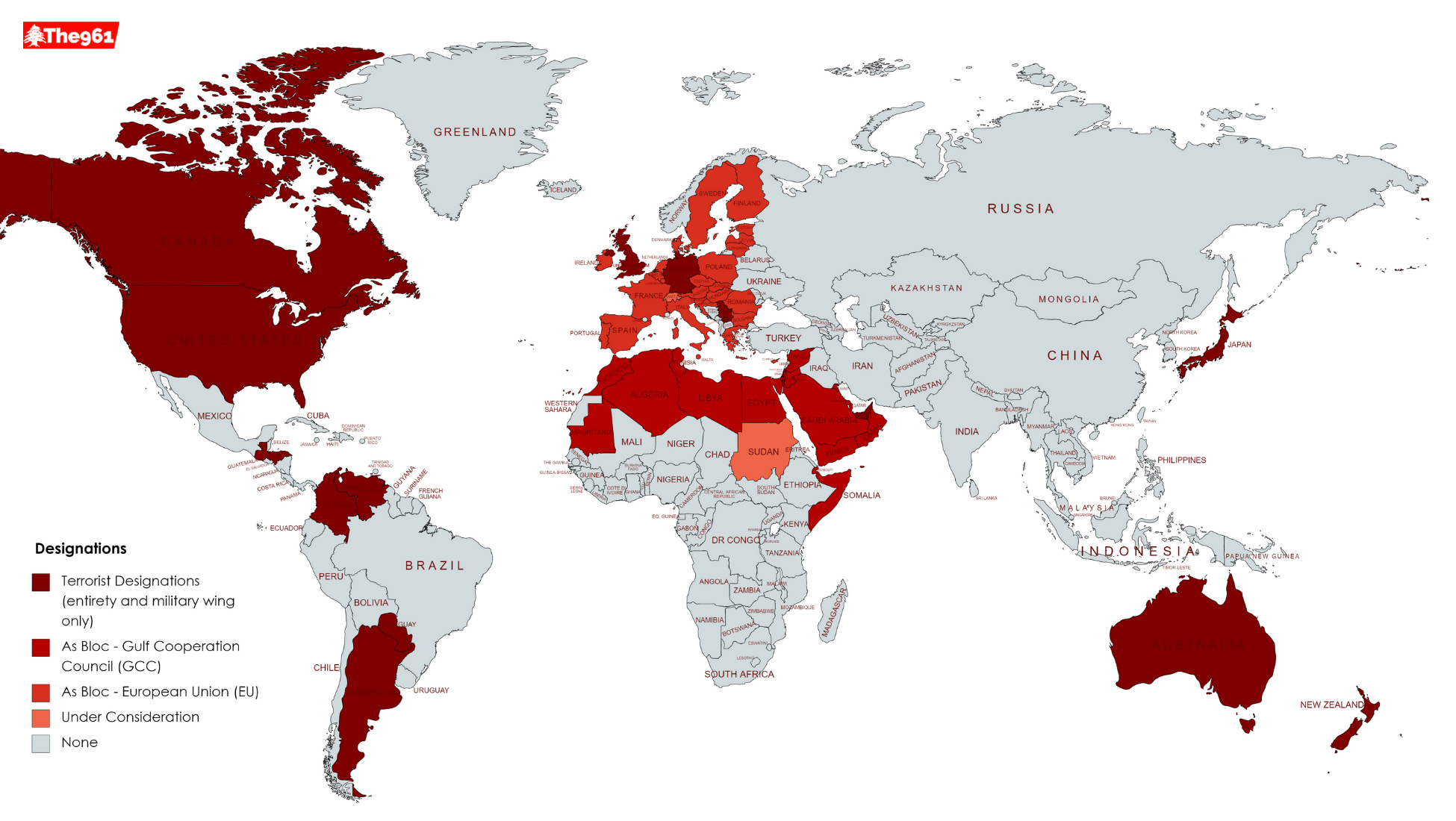
Hezbollah exploits Lebanese Shia diaspora communities—hundreds of thousands strong—for cover, fundraising, and logistics. German intelligence estimates 1,000–1,500 operatives and supporters in Germany alone, with networks relying on family clans, mosques, and business fronts. Even in countries with full bans (Netherlands, Lithuania, Estonia, Latvia, Slovenia, Czech Republic since around 2020), overt operations are curtailed, forcing underground shifts: low-level money laundering via trade-based schemes (luxury goods, diamonds), covert procurement, limited drug distribution, and online propaganda. Recruitment remains rare and virtual, focused on logistics rather than European combat.
- In Germany, the primary hub, activities center on laundering, procurement, and fundraising. Banned charities once channeled funds directly: the Orphans Project Lebanon (Waisenkinderprojekt Libanon e.V., shut down in 2014 after funneling over €4 million to Hezbollah’s Al-Shahid Foundation for martyrs’ families), People for People, and the Hamburg Islamic Centre (closed in 2024 for promoting Iran and Hezbollah agendas). Raids in 2020 targeted associations in Berlin, Bremen, Münster, and Dortmund. A high-profile 2024–2025 case saw arrests like Fadel Z. in Salzgitter for procuring €1.4 million in drone components—parts matched to attacks on Israel, including a strike on a Herzliya retirement home.
- France, Spain, and the United Kingdom were key nodes in a multinational drone smuggling ring dismantled between mid-2024 and April 2025. Arrests in Barcelona (e.g., Firas A.H.), Paris, Salzgitter, and north London targeted networks sourcing engines, guidance systems, and propellers for Hezbollah’s explosive drones—technology enabling hundreds of potential strikes.
- The UK has flagged charities like the Lebanese Welfare Committee, HELP Charity Association for Relief, and Arbar Islamic Foundation for promoting pro-Hezbollah events such as Al-Quds Day marches.
- In Belgium, diamond trade and port-based laundering persist quietly, with US-sanctioned figures like Kassim Tajideen historically involved.
- Italy featured in past drug and luxury goods schemes from Operation Cedar (2016). Partial EU designation (military wing only since 2013) creates enforcement gaps, allowing informal fronts—import/export firms, mosques, and entities tied to Al-Qard Al-Hassan—to operate under humanitarian covers.
The Diaspora Divided: Loyalty vs. Growing Backlash
Hezbollah’s influence depends on diaspora “zakat” collections and subtle coercion—extortion of businessmen or social ostracism. Many Shia Europeans still view the group as a defender against Israel, offering voluntary support. Yet the 2024 war’s devastation has fractured loyalty. Polls reflecting broader Shia sentiment, including diaspora trends:
An Arab Barometer (February–April 2024) showed: Only 30% of Lebanese expressed a “great deal” of trust in Hezbollah overall; 55% had “no trust at all,” with Shia trust high (~85%) but stagnant amid broader decline. Washington Institute surveys (late 2023–2024): 93% of Shia viewed Hezbollah positively pre-escalation, but non-Shia majorities prioritized domestic reforms over “foreign wars.”
Critics face intimidation, yet opposition grows—Shia voices increasingly demand disarmament.
The Global Loop: From South America and Africa to Europe—and Beyond
Europe completes Hezbollah’s transnational circuit: South American cocaine transits West Africa before premium European sales and laundering. Funds return via hawala or fronts. Outward flows from Europe are limited but vital: procured dual-use tech diverts to Lebanon for attacks. No major reverse drug trafficking or recruit smuggling to South America/Africa; Europe focuses on revenue and tech sourcing. Hezbollah avoids core human trafficking—occasional associate links (e.g., Syrian refugee exploitation)—but no systematic recruit smuggling to Lebanon. European contacts support local logistics or anti-Israel operations.
Law Enforcement Gains and Adaptations; moves and counter moves
Law enforcement has notched significant victories, often driven by persistent US pressure through initiatives like Project Cassandra—the decade-long DEA campaign (2008–2017) that exposed Hezbollah’s transformation into a global crime syndicate, tracing drug proceeds from South America through Europe. A key offshoot, Operation Cedar (2016), saw coordinated raids across France, Belgium, Germany, and Italy arrest around 15–16 operatives in a Hezbollah-linked laundering network, seizing €500,000 cash, millions in luxury watches, vehicles, and properties—disrupting a “European cell” washing South American drug money.
More recently, the multinational dismantling of a Hezbollah drone smuggling network (2024–2025), involving arrests across Spain, Germany, France, and the UK, intercepted components for potentially hundreds of explosive drones—some already used in attacks on Israel. Charity shutdowns and asset freezes have cost the group millions. Yet Hezbollah adapts resiliently: shifting to more highly encrypted communication channels, employing more non-Shiite collaborators, quicker crimes that are harder to trace like drugs sales over traceable businesses. Propaganda via banned Al-Manar and “Al-Aqsa Flood” narratives risks continued radicalization.
Europe’s Enduring Challenge
Despite these successful law enforcement blows to Hezbollah , the EU’s artificial military-political split, stubbornly defended by countries like France to protect diplomatic channels with Lebanon and UNIFIL troop safety, continues to shield parts of the organization, blocking a full bloc-wide ban that requires unanimity and creating exploitable gaps.
Despite near unanimous agreement among experts, law enforcement agencies and intelligence services and Hezbollah themselves who all say this distinction is artificial, yet politics trump more effective law enforcement in Europe.
Also hindering stronger law enforcement is the total absence of any meaningful cooperation from Lebanese authorities, whose government, deeply influenced by Hezbollah’s political bloc, has historically refused to investigate or extradite operatives linked to the group’s global activities.
With its military degraded by Israel in self defense after Hezbollah launched large scale strikes on northern Israel on October 8th 2023, and it’s leadership shattered and decimated by successful Israeli operations, and Iranian funding strained after the 2024 war, Hezbollah’s European shadow empire, quiet, resilient, and largely intact, has become perhaps its most valuable remaining asset. As long as political caution prevails over security imperatives, the continent risks remaining a critical lifeline for a group still committed to its ideological mission. Europe’s vigilance or lack of will determine if this empire endures. Europe has to ask itself if it wants to be a part of the solution or a part of the problem.
Stay tuned for Part 3, detailing Hezbollah’s African operation and Asian operations.
Related Posts