Hide The Poor
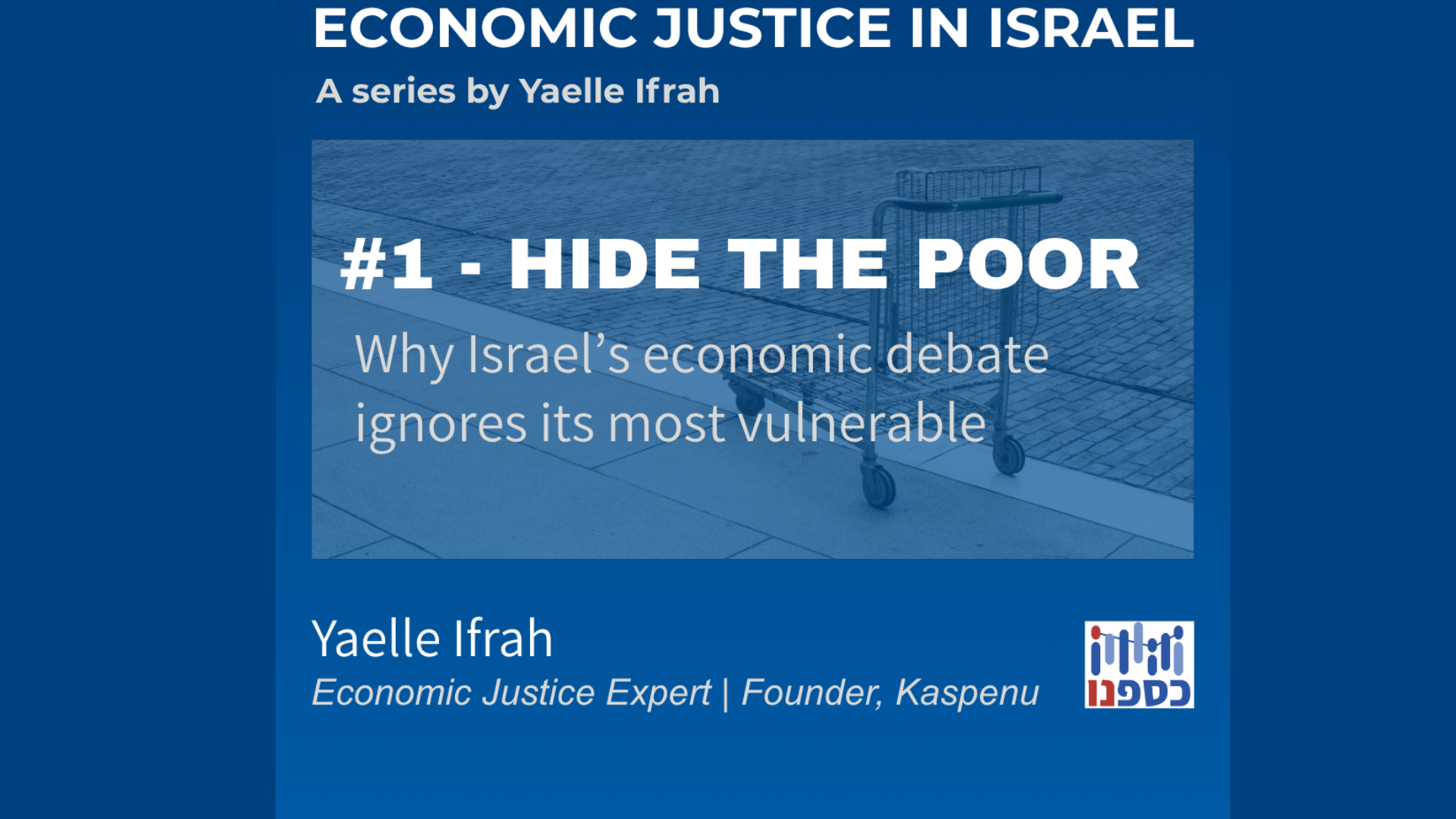
Election Year: D minus 365 to bring Economic Justice on the table
Social justice has been at the core of my business and political involvement from the first day I arrived in Israel.
Israel’s medium salary is quite high. The tech scene drains billions of dollars of investments from all over the world every year. But almost a third of Israeli children are considered below the threshold of those having a decent standards of living.
How on earth did we reach this situation?
I’m launching a new series devoted to the roots of economic injustice in Israel and its deep impact on society and politics.
1. Op-Ed | Hide the Poor
In Israel, we don’t talk about the poor. We hide them.
They appear as a number at the end of a news report, an annual statistic, a collective silence.
And yet, Israel holds the tragic record for the second highest rate of child poverty in the developed world — over 28%. One out of every five Israelis lives below the poverty line. According to the NGO Latet and its alternative poverty report, that figure may actually exceed 2.7 million people. All this, in the most expensive country in the world — the one with the widest gap between prices and purchasing power in the OECD, a staggering 35%.
The poverty line is never linked to the cost of living, although that would be the most basic way to evaluate it. It’s a purely arbitrary sum — half of Israel’s median income, around 3,300 shekels, less than $1,000 a month per individual. It says nothing about the real cost of basic products, which in Israel are priced absurdly high compared to any normal country. It’s blind to what a person can actually put in their shopping cart and pay in necessities and housing for that amount. And we, the consumers, know it well: it’s obviously not enough.
Here, poverty has no face — it’s always someone else’s.
There’s always a millionaire writing a check, always a foundation distributing food packages. So that many people seem to think that’s enough. Charity replaces public policy. Compassion replaces justice.
Israel has become a society where money and consumption fill all the space — start-ups, luxury real-estate projects, and cars — the average price of a new car is 200,000 shekels, paraded in ads as if that were a normal price — it takes forty minimum wages, ie three and a half years of work — to buy one, and four hundred to buy an average apartment (2 million shekels).
The country lives to the music of exits and success stories, not end-of-month struggles.
The poor don’t inspire dreams.
They have no platform, no camera, no spokesperson.
In Israel, there are two kinds of poor. The “poor by choice” — the ultra-Orthodox — represented by powerful political parties; and the “poor by destiny” — the working poor, the elderly, single-parent families — represented by no one.
The first group has parties, budgets, ministers, and Knesset members.
The second one has nothing.
They have no party, no representative, they vote little; no one speaks about them.
I worked for six years at the Knesset, and I saw firsthand how poverty — like a ministerial portfolio — was politically kidnapped.
It now “belongs” to one political camp, one party, one electorate.
As a result, non-Haredi poor have disappeared from the political language of Israel. They are invisible, because they belong to no one.
Israel is a profoundly unequal country: even its inequalities are unequal.
There are the poor by choice, who are lucky enough to have political power — and the poor by destiny, by exhaustion, by fatality — those whom no one represents, no one sees.
A black hole at the center of society.
Poverty is not an accident — it’s a structure.
It cannot be fought with food packages or free schoolbags.
It can only be fought with bold public policies: massive investment in education, housing, transportation, and vocational training.
Not sectoral charity, but national strategy — giving every poor child a real chance.
⸻
My proposal: Return the poor to the center of the political debate even though it’s uncomfortable— let the State take responsibility and treat them as equals.
I no longer want a country where poverty is handled with donations and photo-ops.
I want a country where poverty is a matter of public policy, not charity.
Here are three first, simple, actionable steps:
1. Update and re-publish Elie Elalouf’s national poverty report.
With measurable goals: for example, reducing child poverty by 20% within five years, ensuring universal access to school meals until the age if 18, boosting informal education, expanding public housing. Five key laws drawn from the report should be voted on each year — in housing, education, social affairs, health, and children’s rights.
2. Reform the calculation of the poverty line.
It must be recalculated based on the real cost of basic goods — food, school materials, health essentials. The cost of a healthy food basket ensuring adequate nutrition must be the baseline, updated quarterly. It’s not an abstract number — earning “less than half of what half of Israelis earn” means nothing when high prices prevents so many from living with dignity.
3. Give political visibility to the invisible.
Establish within the Knesset a Permanent Commission for Social Dignity, fully gender-balanced and including one representative from each party, tasked with organizing a National Assembly on Poverty and inviting randomly selected citizens living in poverty to speak publicly and make their voices heard.
Poverty must once again become a matter of national responsibility — not seasonal compassion.