CFO | Empower Society for Good I Author
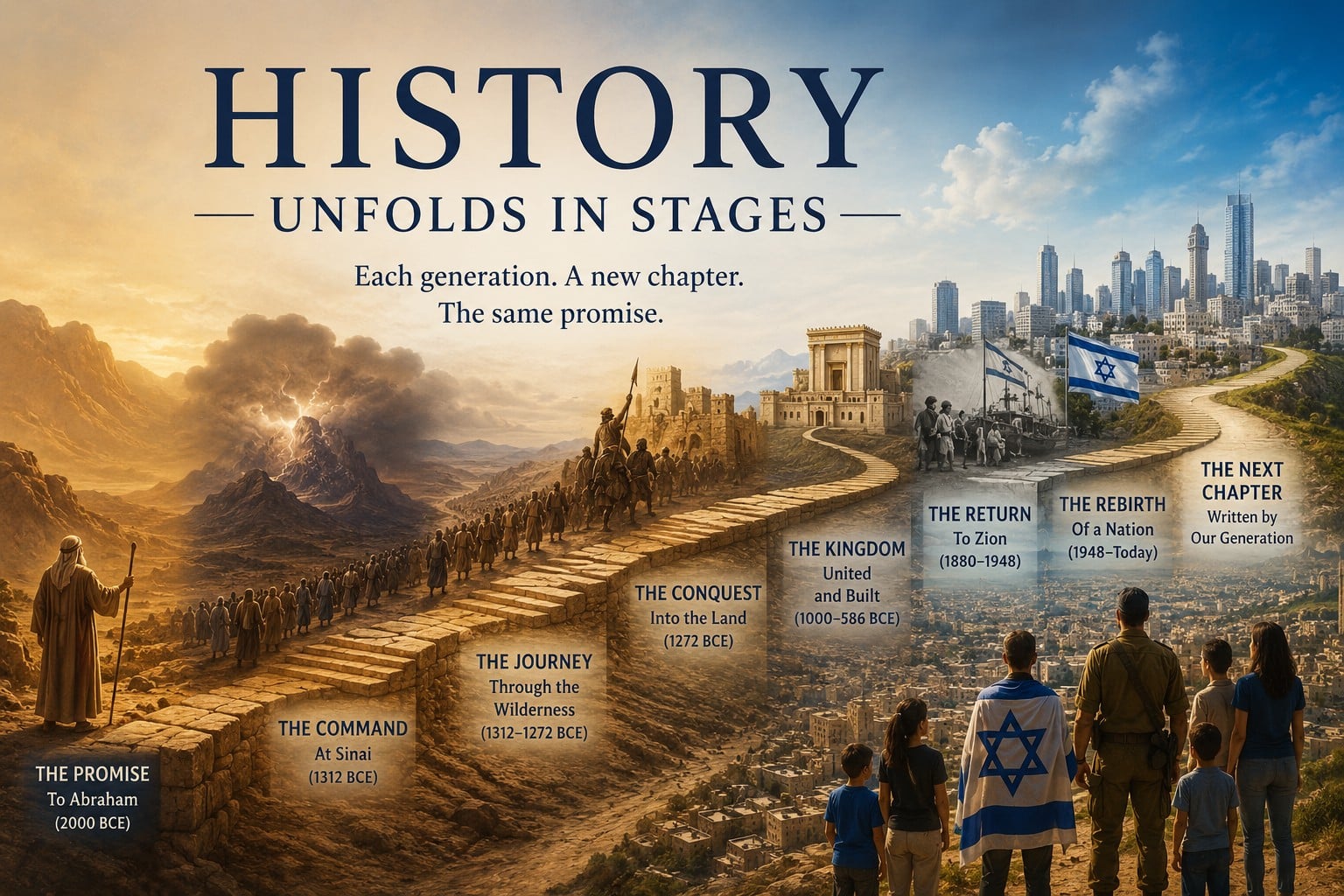
History Unfolds in Stages
History rarely announces its turning points.
When Theodor Herzl convened the First Zionist Congress in Basel in 1897, few could have imagined that his vision would lead, just half a century later, to the rebirth of Jewish sovereignty. When David Ben-Gurion declared the establishment of the State of Israel in May 1948, no one knew whether the fledgling state would survive its first week. Even the extraordinary victory of the Six-Day War in 1967, which reunited Jerusalem with the Jewish people after two millennia, did not bring the peace many hoped would follow.
Each generation believed it had reached the destination.
Instead, it had arrived at the next stage of the journey.
Perhaps one day historians will say the same about October 7, 2023. Not simply because of the horror of that day, but because it marked the beginning of another chapter in the story of Israel.
That, I believe, is one of the profound messages of Parshat Devarim.
Standing on the plains of Moab, Moses knows he will never cross the Jordan. His task is no longer to lead the people but to prepare them. Devarim is often read as a summary of Israel’s past, yet it is really a preparation for Israel’s future. Moses is teaching a new generation how to understand history, because the generation that enters the land will face challenges very different from those that left Egypt.
One detail in the parsha captures this beautifully. God tells Israel, “You have stayed long enough at this mountain” (Deuteronomy 1:6), urging the nation to move towards the Promised Land. Fear, however, overwhelms faith. The opportunity is lost, and what should have been a short journey becomes forty years in the wilderness. Four decades later, a new generation hears another command: “You have skirted this hill country long enough; now turn north” (Deuteronomy 2:3).
The promise had never changed.
The generation had.
Yet even crossing the Jordan did not complete the story. Joshua secured important victories but never conquered the entire land. The period of the Judges was marked by repeated invasions, internal divisions and political instability. David united the tribes and established Jerusalem as Israel’s capital, but he spent much of his reign fighting wars and confronting rebellion within his own household. Solomon built the Temple, only for the united monarchy to fracture soon after his death.
The Promised Land was never the end of Israel’s story.
It was the beginning of the responsibility of nationhood.
The modern return of the Jewish people to Zion has unfolded in remarkably similar stages. The pioneers of the First Aliyah discovered that coming home meant draining swamps, combating malaria and creating an economy from almost nothing. Herzl transformed an ancient dream into a political movement. The Balfour Declaration and the League of Nations Mandate gave international recognition to the Jewish national home, while the United Nations vote of 1947 paved the way for independence.
But independence itself was not the culmination of the Zionist project. It immediately had to be defended in a war that claimed one percent of Israel’s Jewish population. The reunification of Jerusalem in 1967 restored the spiritual heart of the Jewish people but introduced new strategic and political dilemmas. The Oslo Accords promised a “new Middle East,” only to be followed by waves of terrorism and the Second Intifada. Israel’s withdrawal from Gaza was intended to reduce conflict, yet ultimately created the conditions in which Hamas seized power and, years later, carried out the atrocities of October 7.
Every achievement solved one problem while revealing another.
History continued to unfold in stages.
Perhaps that is why October 7 feels so different from previous wars. It did not merely expose failures of intelligence or military preparedness. It shattered assumptions that had shaped Israeli thinking for years. Many Israelis concluded that Hamas could not be managed or deterred indefinitely. The massacre revealed the barbarity of an ideology that celebrated the murder, rape and kidnapping of civilians, forcing a painful reassessment of the nature of the conflict itself.
The consequences extended far beyond Israel’s borders. Within days, cities across Europe, North America and Australia witnessed unprecedented pro-Palestinian demonstrations. Antisemitic incidents rose sharply in many countries, while universities, governments and international institutions became arenas for fierce arguments about terrorism, international law, humanitarian responsibility and the legitimacy of the Jewish state. October 7 did not simply transform Israel’s security environment; it exposed deep political and moral fractures throughout the democratic world.
Yet if the external challenges are familiar, so too are the internal ones.
The Israelites who stood before Moses were not only preparing to confront hostile neighbours. They also faced the daunting task of transforming twelve distinct tribes into one nation. They would debate leadership, struggle over justice, question God’s direction and repeatedly discover that internal division carried consequences no less serious than external threats.
Modern Israel confronts remarkably similar tests.
Only a few years ago we were celebrated internationally as the “Start-Up Nation,” admired for our innovation, resilience and economic success. Today, much of the world increasingly treats Israel as a pariah. At home, our society remains deeply divided over political leadership, judicial reform, military strategy and the profoundly sensitive question of whether every sector of society is sharing fairly in the burden of defending the nation. These debates are legitimate and, indeed, inevitable in a vibrant democracy. The danger lies not in disagreement itself but in allowing disagreement to erode the sense of shared destiny upon which Israel has always depended.
October 7 also reminded us of an uncomfortable truth. Israelis may define themselves by religious observance, political affiliation, ethnic background or ideology. Our enemies do not. To Hamas, Hezbollah and Iran, these distinctions are irrelevant. They see only Jews.
Moses understood this long before the nation crossed the Jordan.
That is why Devarim is not simply a historical review; it is a handbook for nation-building. He recognised that Israel’s greatest challenge would not simply be conquering a land but sustaining a society. Security would require vigilance. Freedom would require responsibility. Unity would require constant effort. Above all, the people would need patience, because God’s promises unfold over generations, not election cycles or news headlines.
Perhaps that is the message our generation most needs to hear.
After October 7 it is easy to become discouraged. It is easy to wonder whether the divisions within Israeli society have become too deep, whether the hostility of our neighbours too entrenched, or whether the hostility of much of the international community has become impossible to overcome.
The generation standing before Moses could have asked similar questions.
They had buried parents in the wilderness. They faced fortified cities, powerful enemies and an uncertain future. Moses did not promise them an easy road.
He reminded them that they were part of a much larger story.
Abraham never possessed the land in his lifetime. Moses never entered it. Joshua never completed its conquest. David never saw the Temple built. Every generation advanced the covenant while leaving unfinished work for the next.
Perhaps our generation has inherited another unfinished chapter.
If so, our task is not merely to recover from October 7. It is to strengthen our unity, renew our sense of shared responsibility, ensure that every sector carries the burden of defending the nation, and build an Israel that remains both secure enough to survive and principled enough to fulfil the moral vision that lies at the heart of the Jewish story.
More than three thousand years after Moses addressed the Israelites on the plains of Moab, his challenge still resonates.
Every generation eventually hears God’s words:
“You have stayed long enough. Now move forward.”
History does not ask us to complete the story.
It asks whether we will have the faith, the patience and the courage to write our chapter well.
Key Takeaway
Devarim reminds us that God’s promises are fulfilled in stages. Every generation inherits an unfinished chapter, and the measure of that generation is not whether it reaches the destination, but whether it has the courage, unity and faith to move the story forward.
Questions for Reflection
- What does October 7 reveal about the chapter of Jewish history our generation has inherited?
- Why does the Torah present nation-building as a journey of generations rather than a single moment of triumph?
- Are Israel’s greatest challenges today external, internal, or the relationship between the two?
- What does it truly mean for every citizen to share the burden of defending a Jewish and democratic state?
- If Moses were addressing Israel today, what would he challenge us to change?
- How do we preserve unity without sacrificing healthy democratic debate?
- What legacy will our generation leave to those who inherit the next chapter of Israel’s story?
Continue the Conversation
This reflection looks at how Devarim teaches us that history unfolds in stages and that every generation inherits an unfinished chapter. In a companion essay, I explore the other great lesson of this week’s parsha: why a good society is built not on slogans or symbolic gestures, but on truth, justice and responsibility.
➜ Read: A Good Society Is Built on Responsibility, Not Slogans.
https://upgradingesg.substack.com/p/a-good-society-is-built-on-responsibility
Related Topics
Related Posts