
Hold On! Iran Is About to Surrender
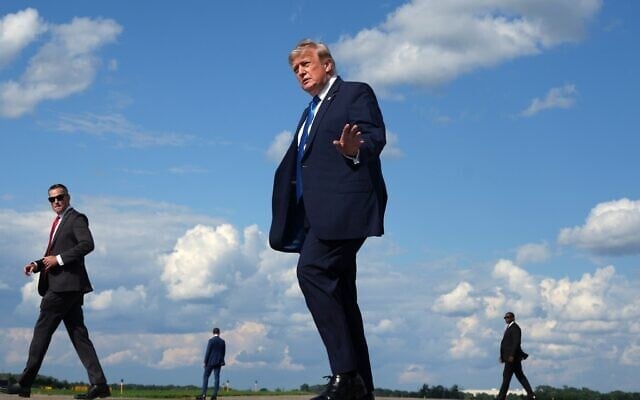
On Saturday the president of the United States called off an attack. He said he had been assured a deal was close, and he listed what the deal would contain: the immediate, complete and total opening of the Strait of Hormuz, and an end to Iran’s nuclear threat.
Those two items are not the outline of a negotiation. Hormuz is the only lever Tehran holds over the world economy. Enrichment is the instrument of the end the regime has declared for forty-seven years. Handing over both is no simple trade for relief. It means signing away the regime’s very reason for existing. What was announced as a framework was a capitulation with better manners.
It lasted about forty-eight hours.
By Monday the package had become a sequence. The first phase would be the opening of the strait, the president said. Denuclearization would follow as a second phase, and that part would take a little while. The immediate, complete and total thing had acquired a timetable. Meanwhile, Tehran’s foreign ministry spokesman said Iran was not negotiating with the United States at all. They were only talking with Oman, and only over passage.
A day earlier, the same spokesman had described an understanding on a route acceptable to both sides. He then added that such an understanding would not mean reopening the waterway. American officials told CBS there were no new talks beyond the indirect channel that already existed.
The account of who asked for the pause moved too. On Saturday it was Iran and other countries in the region. By Monday it was Qatar, Saudi Arabia and the United Arab Emirates, with unnamed Iranian officials mentioned afterward. The only call anyone has documented is the one from the Saudi crown prince, who raised concerns and asked for clarity. Tehran denies asking for anything.
By Monday the frustration had found a voice. Iranian leadership is “unbelievably duplicitous,” the president wrote. He complained that Tehran had asked for a meeting, that some would call it begging, and that talks had begun even as Iranian officials denied any discussions were taking place.
The insult is less interesting than the verb. In a system where any concession must be presented as a sovereign decision taken against an imposed reality, a deal described as begging is a deal nobody can sign. Every time the pause is framed as humiliation, the agreement it was supposed to produce grows more expensive in Tehran.
None of this reads like a country preparing to sign. It reads like a country buying weeks.
The price of refusal for Iran right now is crushing. The currency is ruined. Tens of billions remain frozen abroad. The strait it closed is under American naval blockade. The president described the situation plainly: nothing gets through unless Washington wants it to. Executions of citizens accused of spying for Israel have accelerated. That is what regimes do when they suspect the walls are thin.
Against that, the offer on the table is not annihilation. It is sanctions relief, reconstruction, oil revenue, and a functioning economy. The Saturday message itself spoke of a successful and prosperous Iran. Nobody in Washington or Jerusalem has proposed erasing the country from the map. The proposal is that the country stop trying to erase another one.
Yet despite that much pressure, and with that much on offer, the regime refuses.
One possibility is paralysis. Since the death of the supreme leader, factions have been fighting over what the war is even for. If that is the situation, the problem is not that Iran refuses to sign. The problem is that nobody is in a position to sign. Whoever talks in Muscat may not command the strait.
The darker explanation is that the delay is not a symptom. It is the product.
Iran has run this play before, and the man who ran it left a written account. In 2003, Tehran agreed with Britain, France, and Germany to suspend uranium enrichment. The negotiator was Hassan Rouhani, then the supreme leader’s representative on the national security council. Two years later, speaking to a domestic audience, he explained what the suspension actually purchased. Enrichment stopped. Everything upstream of it did not. The conversion plant at Isfahan, which turns raw yellowcake into the gas that centrifuges spin, was finished during those talks. Rouhani admitted his side only suspended operations in areas where they had no technical problems left to solve. The calm produced by the negotiations provided the exact cover needed to finish Isfahan.
The trick is not what most people assume. Nobody broke the agreement. Tehran conceded exactly the piece it did not need, kept the piece it did, and let the clock run. In April 2005, the supreme leader ordered conversion resumed anyway, and the suspension was over. The Europeans had spent two years buying a pause and had bought a completed facility instead.
The offer on the table this week is a perfect echo. It is an understanding with Oman on a route acceptable to both sides, which the same official announcing it admits does not mean the strait reopens. The shape is identical. It is a concession precise enough to sound real and narrow enough to cost nothing. Each round is cheap. Each round is time.
And time is the one thing a nuclear program actually needs.
That time buys far more than just centrifuges. Canceling a strike means planning it all over again. Allies watching from the sidelines learn that American commitments have a short shelf life. The phrase making the rounds this week is that Israel is in the dark while Washington runs a Saudi-first policy. Threatening obliteration and then preaching patience for Iranian lives costs something every time it happens. The president spent it in March. He spent it in April, when he warned that a whole civilization would die that night and pulled back two hours before his own deadline. He spent it again on Saturday. The currency is credibility, and the account is not bottomless.
Critics will point out that the regime has folded before. They are right. Khomeini accepted a ceasefire with Iraq in 1988, famously calling it a poisoned chalice. Zarif signed a deal with John Kerry in 2015, and the anti-American slogans survived just fine. Tehran can make deals.
But the comparison collapses when you look at the price. What did they actually surrender in those past deals? A deadlocked war with Baghdad. A temporary pause on a set number of centrifuges. They traded expendable assets. What they have never signed away, at any table, is the commitment to the end of Israel. That is not a policy the regime adopted. It is the thing that distinguishes it from the country it governs.
Which is precisely the item the president moved to phase two.
He may not have understood what he was conceding when he separated the strait from the nuclear file and said the second part would take a while. He conceded the whole argument. The first phase is negotiable because Hormuz is a weapon of pressure. The second is not. The bomb is not a weapon of pressure but the guarantee of a promise. Handing it over would not be a defeat. It would be an apostasy, performed on television, for an enemy to witness.
That is why the arithmetic Washington keeps presenting does not move anyone. The frozen billions, the ruined currency, the blockade, the prosperous future on offer. All of it belongs to a ledger the regime does not consider decisive. What it weighs instead is whether the surrender can be spoken aloud. A ceasefire with Iraq could be called a poisoned chalice. A centrifuge count could be called a diplomatic victory. Renouncing the destruction of Israel cannot be called anything except what it is.
They will die before they say it.
So the question worth asking is not when Tehran will surrender. It is who told the president that this time was different, and whether that person commands anything at all.