Courtyards and Characters: Wandering Through Jerusalem’s Living Stories
Featured Post
I love Jerusalem too much to pretend it holds only one story
I celebrate the miracle of Jews' return to this holy place, but we must acknowledge the others who are attached to it or risk losing the united city we cherish
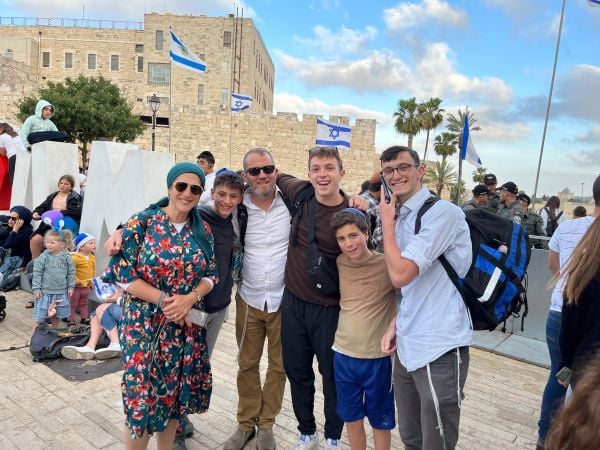
The author with family and friends on Jerusalem Day last year. (Courtesy)
This Friday is Jerusalem Day, and for me and my family, it’s one of the most meaningful days of the year.
It marks the reunification of Jerusalem after the Six Day War and the return of Jewish sovereignty over the Old City. For the first time in nearly 2000 years, Jews once again had access to the Kotel under Jewish control.
Every year, we try to get as close to the Old City as we can before the crowds become impossible. There are flags everywhere, singing, dancing, thousands of religious kids pouring through the streets, and a feeling that Jewish history is somehow happening in the present tense.
I love this day.
I feel emotional when I hear “Har Habayit b’yadeinu” – “The Temple Mount is in our hands” – and see the old photos of the paratroopers at the Kotel with Rav Shlomo Goren next to them, blasting the shofar. I look at my children and grandchildren walking through a rebuilt Jewish Jerusalem and know that I’m witnessing something generations of Jews could barely imagine.
And at the same time, I try not to ignore the fact that for roughly 40 percent of Jerusalem’s residents, the Arab population of the city, this day carries a completely different meaning.
For most Palestinians, what Jews celebrate as reunification is remembered as the Naksa, “the setback,” the Arab defeat in the 1967 war that brought East Jerusalem, the West Bank, and Gaza under Israeli control.
That narrative is not mine. I do not experience Yom Yerushalayim as a tragedy. I experience it as return, as a 2,000-year-old longing that has become reality, and as something miraculous that our Biblical prophets foresaw long ago.
But pretending the other narrative does not exist does not make any sense to me.
Over the last few years, I’ve become less interested in simple stories, especially here. Because if you actually walk this city, guide here, interview people here, and sit in people’s homes here, you realize very quickly that the story is not simple, even when parts of it are morally clear. Those are not the same thing.
My wife, who is an excellent therapist, talks a lot about the ability to “hold complexity.” At first, I thought of that as something mainly connected to relationships or emotional health. But the longer I live here, the more I think Jerusalem almost forces that skill on you, whether you want it to or not.
In therapy, holding complexity means helping people tolerate more than one truth at the same time without falling into black and white thinking. A person can love a parent and still carry pain from them. A marriage can be deeply fulfilling and still quite difficult. Mature people are able to hold those tensions without simplifying everything into heroes and villains.
I think societies need that ability too.
Because the alternative is convincing yourself that your side contains all the humanity, all the pain, all the longing, all the history, while the other side is reduced to simply being wrong or, worse, evil. That may feel emotionally satisfying for a while, but it produces shallow convictions that aren’t consistent with reality. And honestly, I think American public life could use a little more of this ability, too. Increasingly, people seem convinced not merely that the other side is mistaken, but that it is fundamentally bad.
And Jerusalem is probably the hardest place in the world to maintain simple stories. They don’t work here. The same streets, homes, and alleyways can contain memory, holiness, triumph, trauma, and grief depending on who is describing them.
As a guide, I see this all the time.
A Muslim guide points to the retaining walls around the Temple Mount and tells the story of the Prophet Muhammad tethering his mystical steed, Al-Buraq, there.
A Jewish guide points to the exact same stones and sees the last physical remnant of the Beit Hamikdash, the Temple.
Neither side experiences those stones as archaeological sites. They are part of identity itself.
And once you understand that, you begin to understand why Jerusalem affects people the way it does.
At the same time, understanding another group’s attachment to a place does not require surrendering your own story about that place.
That doesn’t mean moral equivalence, where everything becomes equally true, equally justified, equally moral. There are moments in this conflict that are morally complicated, and there are moments that are absolutely not.
The 1929 Hebron massacre is one of them.
There is an iconic picture is of one-and-a-half-year-old Shlomo Slonim, whose father, Eliezer Dan Slonim, a leader of the Hebron Jewish community and son of the city’s Ashkenazi chief rabbi, Rabbi Yaakov Yosef Slonim, was murdered before his eyes, along with his mother, brother, sister, and many others who had taken refuge in the Slonim home during the massacre. Shlomo survived.
At the same time, I also understand that on the Arab side, there were real, deeply felt fears, manipulated and inflamed by leaders like Haj Amin al-Husseini, about threats to Al-Aqsa and changing control over sacred space. And really, much of it came from a realization that the Arabs were on their way to living under Jewish control and sovereignty.
Understanding the context does not excuse the massacre. It means trying to see the world as it actually was, not as a simplified story.
And honestly, I think this is particularly important in Jerusalem. Because this city constantly forces you to confront the fact that multiple stories can and do exist around the same stones.
We also have to be careful.
There’s a tendency among some Israelis to talk as if the future of Jerusalem is completely settled forever, as if the idea of the city ever being redivided is so impossible that it’s not even worth discussing.
I think that’s naive and ignores political reality.
For decades, leaders and politicians on both sides have discussed dividing Jerusalem in one form or another, some openly and some quietly. It is not impossible to imagine a future political shift in Israel where a left-wing, or even centrist, government comes into power and begins revisiting those conversations once again.
I hope and pray that never happens.
I believe Jerusalem belongs to the Jewish people, all of it. I believe Jewish sovereignty over Jerusalem is critical for Jews historically, spiritually, and strategically, and I hope with all my heart that it remains that way.
But I also think we can jeopardize that reality if our attitude becomes: It’s all ours and nobody else matters.
Because Jerusalem is not a homogeneous city. Nearly 40 percent of its residents are Arab, and millions of Muslims and Christians around the world are emotionally and religiously attached to it. You do not need to surrender your own claim in order to recognize that.
And if we become incapable of sharing the space itself, even under Israeli sovereignty, then eventually the international pressure to physically divide the city will only grow.
I keep thinking about the story of King Solomon and the two mothers fighting over a child.
Solomon proposes cutting the baby in half to settle the dispute. One woman agrees. The other says no, it’s better to give the child away than destroy it. That was how Solomon determined who the real mother was.
And I sometimes wonder if Jerusalem works the same way. If you genuinely love the city, wouldn’t you rather figure out how to live together in it than cut it in half? A city cut in two is not really a city.
Again, I want to be very clear because people too quickly jump to conclusions. I am not talking about dividing Jerusalem. I am not talking about sharing sovereignty. And I am definitely not talking about giving up the Jewish story or pretending all claims are equal.
I am talking about something much more practical and much more necessary: learning how to live in this city without constantly pushing the other side into a corner.
Because if Jerusalem becomes a permanent winner take all battle, eventually everybody loses.
For me, Yom Yerushalayim is still a day of celebration. I say Hallel. I feel emotional when I hear “Har Habayit b’yadeinu” and see those old photos from 1967.
And I can hold that together with the awareness that another population in this same city experiences this week very differently.
Not because all narratives are equal, and not because I’m unsure what I believe, but because this is the reality of Jerusalem. Not the simplified one, the actual one: layered, emotional, holy, traumatized, beautiful, tense.
And maybe part of living here honestly is learning how to look directly at that reality without giving up clarity, conviction, or love for your own story.
Related Topics
Related Posts