Making a better world!
Holocaust teaching is failing kids — fix it now
https://elirab.au/community-engagement/
As the generation of Holocaust survivors diminishes, a pressing question confronts Jewish educators worldwide: how do we ensure that memory does not fade into abstraction?
For decades, Holocaust education has relied on testimony, historical study, and memorialisation. These remain essential. But for younger students — particularly in primary school — the challenge is different. Before they can understand the scale of the Holocaust, they must first connect to it as a human story.
If they do not feel it, they will not remember it.
That is the challenge that led us to develop In My Pocket, a Holocaust education initiative that is now expanding from Australia and South Africa into the United Kingdom and Europe.
At its core is a simple question:
What would you take with you if you had to leave home suddenly?
It is a question that immediately shifts the conversation. Instead of beginning with statistics or timelines, it begins with the child — their identity, their sense of belonging, their attachments. Only then do we introduce the story of the Kindertransport, when nearly 10,000 Jewish children were sent from Europe to Britain on the eve of war.
For those children, what they carried — sometimes literally in their pockets — represented everything they were leaving behind.
This approach does not replace traditional Holocaust education. It prepares students for it.
Across classrooms, we are seeing that when students begin with personal reflection, they engage more deeply with historical content. They ask better questions. They listen differently. They begin to understand not just what happened, but what it meant.
And perhaps most importantly, they begin to consider what it means for them today.
This matters now more than ever.
Holocaust distortion and misinformation are rising globally. At the same time, educators are reporting gaps in knowledge among younger generations. If we wait until students are older to introduce these ideas, we risk losing the opportunity to build the emotional and ethical foundations that meaningful learning requires.
Early engagement is not about simplifying the Holocaust. It is about preparing students to encounter it with empathy, seriousness, and responsibility.
Our experience across Australia — and increasingly in South Africa — has shown that this model can work across cultures and classrooms. It has engaged students in multiple languages, in diverse educational settings, and with a wide range of backgrounds.
Now, as In My Pocket expands into the United Kingdom and Europe, there is a deeper historical resonance. The Kindertransport is not just a European story — it is a defining chapter of Jewish and British history. Bringing this approach into UK classrooms is, in many ways, a return of the story to where it is most deeply rooted.
But the implications go beyond any one country.
Holocaust education is no longer only about preserving the past. It is about shaping how the next generation understands identity, responsibility, and moral choice in an increasingly complex world.
Chief Rabbi Ephraim Mirvis has often emphasised that education must instil kindness, compassion, and a sense of shared humanity. These are not abstract ideals. They are the foundation upon which meaningful Holocaust education must now be built.
That is why our work focuses not only on memory, but on values — kindness, empathy, and inclusivity.
Because if we want young people to carry the lessons of the Holocaust forward, we must first help them understand what it means to carry anything at all.
Website: https://elirab.au
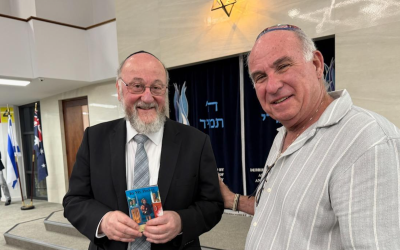
Photo: Jill Rabinowitz
Link: https://elirab.au/community-engagement/
Related Topics