
Holy Land’s Kanaani Cat Breed Makes History at WCF Debut in Finland
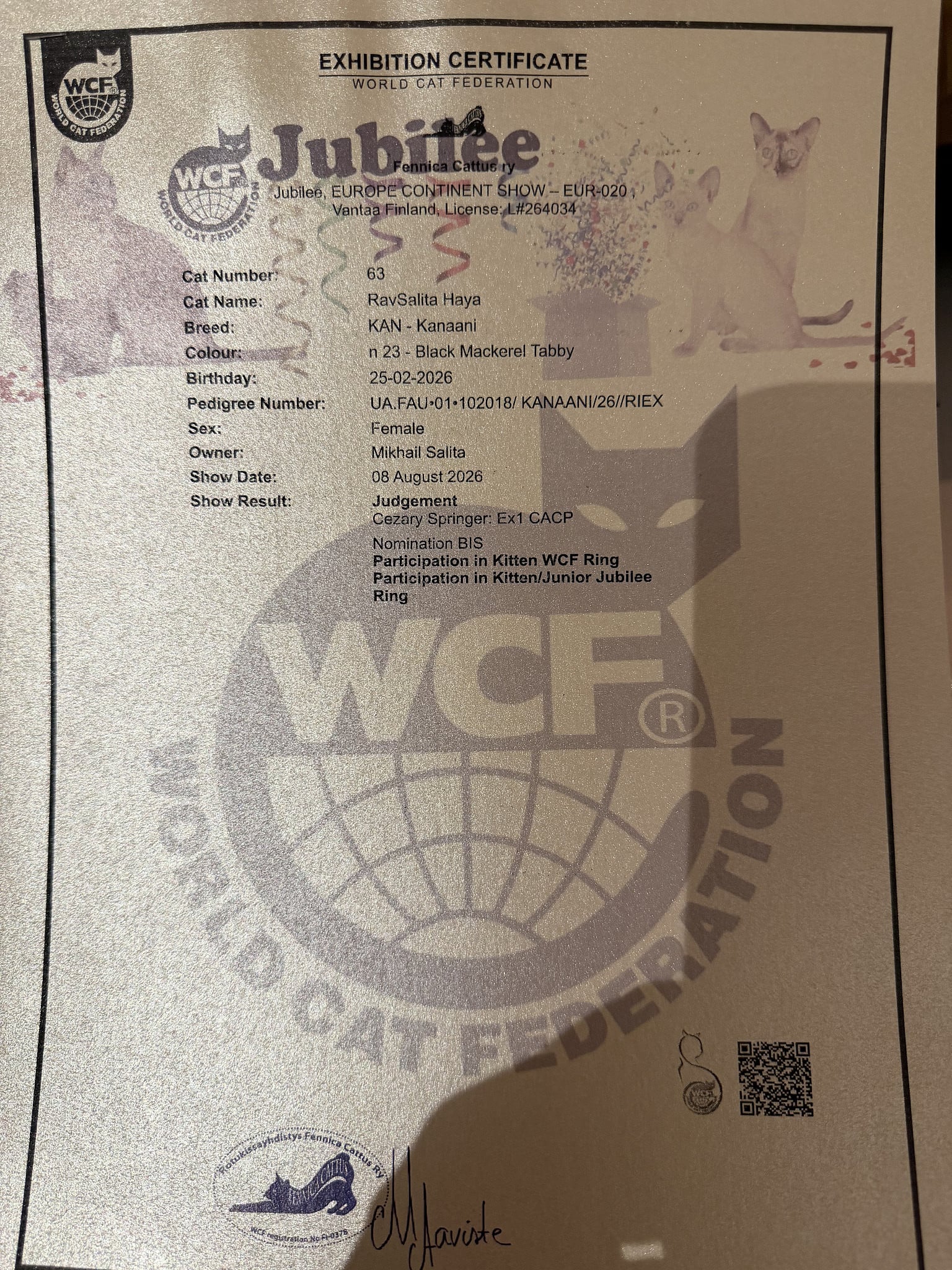
On August 8 and 9, 2026, something extraordinary happened in Vantaa, Finland. After approximately 26 years of near-total absence from the international show scene, the exceptionally rare Kanaani cat breed returned to competition and made its historic European debut within the World Cat Federation.
I travelled from New York to the FenCat Jubilee Show with two Kanaani cats from RavSalita Cattery, also known as Salita Golden Line: the adult female RavSalita Haifa, who was born in Israel, and her five-month-old daughter, RavSalita Haya, who was born in the United States.
For me, this was far more than another cat show. It was the international return of a rare breed whose history began in Jerusalem.
The Kanaani occupies a unique place in feline history. It is a fully recognized WCF championship breed originating in Jerusalem, Israel, in the Holy Land. To the best of my knowledge, it is the only officially recognized pedigree cat breed whose history began specifically in Jerusalem. This connection makes the Kanaani an important part of Israel’s natural and cultural heritage.
Israel must always be recognized first as the breed’s country of origin. Germany also played an important role in the Kanaani’s formal development and international history. Today, the United States has become a center of the breed’s modern revival.
The Kanaani is not an experimental breed within the WCF. It is fully recognized and eligible to compete for championship certificates and titles. This is why I came to Finland: not merely to display the Kanaani as an exotic rarity, but to return it to genuine international championship competition.
The results exceeded what could reasonably have been expected from a debut.
Haya received Ex1 evaluations and two CACP championship certificates from two WCF judges: Cezary Springer, representing Ireland, and Fabrice Calmes of France. She was also nominated for Best in Show on both days and finished fifth among ten kittens in a WCF Kitten Ring.
Over the two days, Haya earned 407 official WCF Best Cat points: 195 points on the first day and 212 on the second. She is currently the highest-ranked Kanaani in the WCF Kitten/Junior division.
To become a WCF Kitten Champion, Haya requires three CACP certificates awarded by three different judges. The licence for the show in Vantaa permitted only two traditional individual evaluations, so it was impossible for her to complete all three requirements during this single event. She therefore left Finland with two of the three certificates required for the title—an outstanding achievement for her first international appearance.
Time is now the challenge. Haya turns six months old on August 25. After that date, she will enter the Junior category and begin pursuing junior certificates. If she can attend another eligible WCF show before then and receive a third CACP, she may still become a Kitten Champion.
Her mother, Haifa, also achieved an important result.
During her first evaluation, Cezary Springer assessed her conformation as Excellent but did not award a certificate because she became stressed and difficult to handle. I accepted his decision and appreciated his honest and constructive advice. His judgment demonstrated that the breed was being evaluated seriously and according to the same professional expectations applied to other fully recognized breeds.
During her second evaluation, Haifa was calmer. WCF judge Clara Sébastien of Belgium awarded her Ex1 and her first CAC certificate toward the adult WCF Champion title. Haifa earned 240 official WCF Best Cat points over the weekend and is currently the highest-ranked adult Kanaani in the system.
Together, Haya and Haifa earned 647 official WCF Best Cat points, three championship certificates, two Best in Show nominations and a fifth-place result in a WCF Kitten Ring. Both mother and daughter are now represented in the official WCF Best Cat rankings, holding the leading Kanaani positions in their respective age divisions.
For a breed returning to international competition after such a long absence, I consider this a debut passed with flying colors.
The judges approached the Kanaani with seriousness, fairness and professionalism. Cezary Springer proved to be strict but objective, rewarding Haya while providing a candid assessment of Haifa’s behavior. Fabrice Calmes gave a warm and informative special presentation about the Kanaani and then awarded Haya her second Ex1 and CACP. Clara Sébastien’s Ex1 and CAC for Haifa demonstrated that a difficult first evaluation did not have to determine the cat’s entire future.
I am deeply grateful to the show organizers, Melidana and her mother Diana, whose kindness, encouragement and practical assistance helped make the Kanaani’s historic debut in Finland possible. Their support transformed an important professional event into a genuinely warm and memorable human experience.
The modern Kanaani revival is an international effort.
In Israel, I work closely with Lyudmila Vlasova, an experienced Kanaani expert and my trusted partner in this mission. My original Kanaani cats came to me through her. Her knowledge of the breed, its bloodlines and its history remains invaluable. Without her years of dedication in Israel, the revival program that I am now developing in the United States would not have been possible.
Because there is currently no accessible WCF show circuit in the United States, I participate in the WCF system through the Felinological Alliance of Ukraine, or FAU, based in Kyiv. As a citizen of both the United States and Ukraine, I am proud to represent this Ukrainian club in international competition.
I am profoundly grateful to Alexander and Natalia Melnikova of FAU. I regularly seek their advice, and their knowledge, encouragement and practical assistance have become essential to the Kanaani revival program. Without their support, returning this rare breed to WCF championship competition would have been considerably more difficult.
I also greatly value the guidance of Dr. Anna Kalinichenko of the Association of Rare Breeds of Cats. A highly knowledgeable felinologist with a PhD, she has generously shared her professional expertise and written about the Kanaani, helping to educate the public and attract international attention to the breed.
I am equally grateful to WCF judge Angelina Koltsova, who has shared her extensive knowledge of the Kanaani with me and continues to provide valuable professional advice concerning the breed’s responsible revival and future development.
Their expertise and support remind me that preserving the Kanaani is not an individual undertaking. It is a shared international responsibility connecting Israel, Ukraine, Germany, Finland, the United States and other countries.
I currently have seven Kanaani cats under my care. At this stage, I do not sell them because seven animals are still far too few to provide a secure foundation for a responsible global revival program. Every breeding decision must be made carefully, with the breed’s long-term survival placed above short-term commercial interests.
My goal is to build a stable international future for the Kanaani by cooperating with responsible breeders in Israel, Europe, the United States and elsewhere. When the population becomes sufficiently secure, I hope to place Kanaani cats with people who understand that preserving an exceptionally rare breed is not merely a matter of ownership. It is an act of stewardship.
Within the WCF, my objective is clear. I want Kanaani cats to progress through the championship levels and become Champions, International Champions, Grand International Champions and, ultimately, World Champions.
The Kanaani is currently registered with TICA as a New Experimental Breed. Achievements in the WCF do not automatically change a breed’s status in another organization. Nevertheless, documented international participation, championship certificates, professional evaluations and a growing population can provide meaningful evidence that the breed is viable and deserves further advancement.
This mission is closely connected to my spiritual life. I was ordained as a rabbi by the Jewish Spiritual Leaders Institute and, more recently, as an animal chaplain by the Compassion Consortium. Protecting a vulnerable animal population is not separate from those callings. To me, it is one expression of them.
My brother Dmitriy Salita became a WBF world boxing champion and was inducted into the New York State Boxing Hall of Fame and the Jewish Sports Heritage Association Hall of Fame. His arena was boxing. Mine, unexpectedly, has become the preservation of one of the world’s rarest cat breeds.
I believe that Hashem has entrusted me with the mission of helping the Kanaani survive, grow and eventually produce a WCF World Champion. A mission of this kind requires patience, faith and a refusal to abandon the work simply because the road is difficult.
The Kanaani’s return represents more than success at a cat show. It is an achievement for Israel, the birthplace of the breed; for Germany, which contributed to its development; for Ukraine, whose felinological community supports its return to international competition; and for the United States, which has become a center of its modern revival.
Most importantly, it is an opportunity to preserve a living part of the Holy Land’s natural and cultural heritage.
Jewish wisdom asks, “Who is rich? One who is happy with what he has.”
Today, there is much to be grateful for. Haya has earned two championship certificates, two Best in Show nominations and 407 WCF Best Cat points. Haifa has earned her first adult championship certificate and 240 points. Both mother and daughter currently lead the Kanaani rankings in their respective divisions.
The work is only beginning, but after a historic weekend in Finland, the Kanaani has returned to the international stage—and it has returned with outstanding results.
Amen and amen.