Honoring Ruth Gruber on the Day of the Dead
Today, on the Day of the Dead, or Día de los Muertos, I want to take a moment to honor someone who left a lasting impression on me: the American journalist, photographer, writer, humanitarian, and government official Ruth Gruber, born in Brooklyn to Russian Jewish immigrants.
Ruth Gruber was a “Wunderkind.” By the age of twenty, she had already earned her PhD at the University of Cologne with a dissertation titled Virginia Woolf: A Study. She knew from an early age that she wanted to be a writer, but not just any writer. She wanted to combine intellectual curiosity with deep compassion. However, when she returned to New York, she struggled to find work as a writer. Instead, she worked as a translator for the Canadian Arctic explorer Vilhjalmur Stefansson, which led her to become the first female foreign correspondent to travel to the Soviet Arctic and the Siberian gulags.
Following the publication of her book, I Went to the Soviet Arctic, President Roosevelt’s Secretary of the Interior, Harold Ickes, hired Gruber to report on conditions in the Alaska Territory, including its potential for World War II veterans to homestead. After eighteen months in Alaska, she helped escort one thousand Jewish refugees from Italy to the United States and recorded their stories in her book Haven: The Dramatic Story of 1,000 World War II Refugees and How They Came to America. Later, she witnessed the ordeal of more than four thousand Holocaust survivors aboard the Exodus 1947, who were refused entry to British-controlled Palestine.
Her humanitarian work and reporting, which also included photography, earned her numerous honors. She lived to be 105 years old.
My own connection to Ruth Gruber’s story began shortly after completing my studies at the Free University of Berlin around the turn of the millennium. One of the subjects I explored during my studies was the representation of the Holocaust in American film, comparing Steven Spielberg’s Schindler’s List to Claude Lanzmann’s Shoah. At that time, I watched a lot of Holocaust history footage, including Alain Resnais’ Night and Fog from 1956, and reflected on the ways history is preserved through narrative.
Around that time, I wrote a postcard in black ink and sent it from a post office near the House of the Wannsee Conference in Berlin to Marcia Reines Josephy, the former director of the Los Angeles Museum of the Holocaust, which back then was located on Wilshire Boulevard across from the Los Angeles County Museum of Art. When I arrived in Los Angeles in August 2001, just four weeks before September 11, I met with her and told her about an unsettling experience I had in Berlin. At a well-known institute, a colleague had asked about my siblings and what they were doing professionally. When I mentioned that one of them had a severe intellectual disability that left him in the developmental stage of a small child and had medically resistant epilepsy, she replied, “Wouldn’t it be better for him to die?” Even if she thought she meant it pragmatically, I found it appalling.
I told Marcia Josephy that I could not work in an environment where people would be capable of saying such things. This was before I fully learned about the Aktion-T4 Euthanasia program. By then, I had just heard that people like my brother were gassed under Hitler, but I was not yet aware of how it was all carried out, including the deception and systematic procedures, until after my brother’s death and a later visit to the Library of the House of Wannsee Conference in 2009.
At that point, I was unable to get any professional training in the German public media. This was partly due to the lack of recognition of my U.S. credentials, which caused delays. By the time I graduated, I was thirty-two with two degrees, one from the U.S. and one from Germany, but considered too old to break into the business. I then decided to work on a novel instead.
Marcia Josephy encouraged me and helped me build connections in Los Angeles. When I visited her in August 2001, she gave me the contact information of three people: Tobey Moss, Jack Rutberg, and Perla Karney. She said, “Start with Tobey Moss first, go to her gallery and talk to her. I’d like you to pick her brain,” an expression I had never heard before, which is why I remember it so well.
At that time, Perla Karney was still a theater producer in rehearsal for a musical. Today, she is the artistic director of the Dortort Center for Creativity in the Arts at UCLA Hillel.
And so I took the bus to the American Jewish University in Los Angeles and walked up the hill to the Gindi Auditorium to meet her. This was during the rehearsal for a musical titled Haven, based on Ruth Gruber’s book. There, I met the renowned composer William “Bill” Goldstein, who, like Ruth Gruber, was an exceptionally talented person and a “Wunderkind.”
For two days, I observed the rehearsals and helped with small tasks, such as letting actors into auditions. As a thank-you, I was invited to attend the premiere with my long-time friend Ruth Flores, who has Peruvian heritage and with whom I was staying in her Studio City home at the time. It couldn’t have been a better fit, because her parents had come to the U.S. as immigrants, she had an aunt married to a Jewish man, and there is even a song called Ruthie in the musical.
I was particularly moved by the song A Number on My Arm because, for Holocaust survivors, a number on one’s arm represents an enduring stigma. We both loved the musical.
A Number On My Arm (excerpt from HAVEN) – YouTube
That encounter led to my 2004 interview with William Goldstein for a public-access television program titled Transformations in the Life of a Composer. It was only my second on-camera interview, following the one I had done with the Holocaust survivor and painter Kalman Aron. The studio was simple, and my skills in front of the camera were modest, not like Charlie Rose’s, but the conversation was insightful.
During that interview, I asked him:
“Aside from writing music for films such as The Quarrel and Remembrance of Love, you continued working on a Holocaust theme and also created your own musical called Haven. What made you decide to write something about the Holocaust?”
He said:
“It really had nothing to do with the Holocaust initially. What happened was that I became friends with Ruth Gruber in the early 1980s. She was one of the most remarkable people of the 20th century and she was still going strong. She had written a book called Haven, and after being friends with her for many years, I thought her book would make a wonderful movie. I never saw it as a musical at first, but when Jerome Cooper Smith and Joe Darien started working on it, Ruth mentioned it to me. I realized that if they could turn this wonderful story into a musical, I would like to be a part of it. While it does deal peripherally with issues of the Holocaust, it is primarily about reminding all of us in America that freedom is not free. Those of us here are lucky to be here, and you, for example, come from Germany and are a perfect example of what makes this country strong: people have a desire to be here because it has so much to offer.
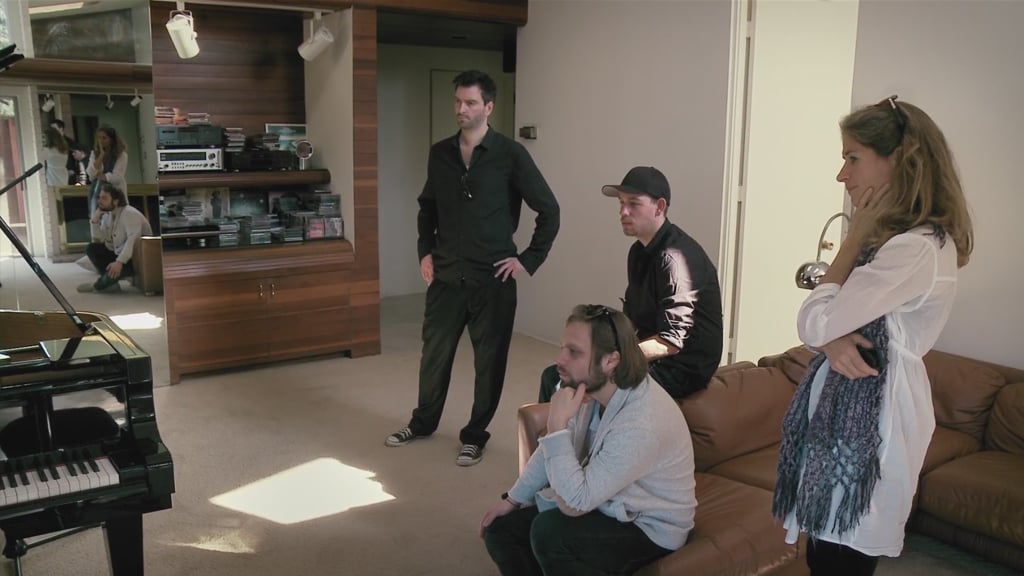
Years later, in 2010, I was contacted by the Berlin actor Carl von Hollen, who asked whether I would be open to meeting with a film team from Germany that was shooting a documentary titled Tim Sander Goes to Hollywood. I agreed and welcomed them to the home where I was renting a room from an elderly former UCLA professor named Jean Wellish. The project followed actor Tim Sander as he attempted to win a bet with Matthias Schweighöfer by securing a film role in Hollywood within four weeks.
Not even thinking about film credits or compensation, I decided to help purely out of passion. We met the day after the film team arrived, and through the kind support of songwriter Harriet Schock (by the way, a documentary about her, Hollywood Town: The Harriet Schock Story, directed and produced by Tom Solari, had just been released on Fawesome TV about a week ago), I connected them with filmmaker Henry Jaglom, who was then working on The M-Word. We already knew each other because I had written about him for the Jüdische Allgemeine in Berlin. When we met, he spontaneously decided to give Tim a small part in the film.
Knowing from previous conversations that William Goldstein wanted to perform in Germany, I facilitated a visit to his home off Mulholland Drive, where he spontaneously composed one of his “instant compositions.” He asked Tim Sander to select three notes on his black grand piano and then created a new piece of music from those tones. It’s captured in the movie.
Tim Sander Goes to Hollywood (2012) – IMDb
Twelve years later, I was delighted to find out that he performed at the 2024 Solidarity Concert in Berlin’s Rykestraße Synagogue. The concert, conceived and produced by Florian von Heintze and moderated by German actress Andrea Sawatzki, featured him and the Israeli violinist Guy Braunstein, with a performance by dancer Hanna Korostelova. The event supported Israel and commemorated the victims of the October 7 Hamas attacks. The concert included a duet with Braunstein and a three-note musical portrait dedicated to survivor Tlalit Kitzoni, who spoke about the trauma she endured.
Berlin Solidarity Concert – Dance Fantastisch
When I looked him up the other day, I was enthused to learn that in August 2025, he premiered a 45-minute one-act opera Kazimierz: A Story of Love and Destiny, for which he wrote both the libretto and the score. Honestly, I thought it was a very moving piece, and that’s why I’d like to inform you about it. It tells the story of King Kazimierz, Casimir III the Great, who reigned from 1333 to 1370 and is held in high regard by the Polish community for being a peaceful ruler and skilled diplomat. The opera, set in Kazimierz Dolny, was commissioned by Prinzessin Irina zu Sayn-Wittgenstein. It is scored for lead soprano Ewa Leszczynska and lyric baritone Łukasz Hajduczenia, a chorus of twelve from the Catholic University of Lublin vocal ensemble, and a chamber orchestra of seventeen, the Lublin Chamber Philharmonic, conducted by Lilianna Krych.
The one-act opera also contains the love story of King Kazimierz and Esterka, who played a significant role in the king’s life, advising him on initiatives such as free trade, city building, religious tolerance, and cultural development.
Kazimierz, A Story of Love and Destiny
I found this especially interesting because of the synchronicity. Artist Alexandra Grant, whose work I mentioned in my previous post and whose Supernova (2022) is included in the current immersive exhibition Experience 66: GRIEF at ESMoA, the Experimentally Structured Museum of Art in El Segundo, California, has an upcoming opening at the Fryderyk Chopin Museum in Warsaw, Poland, titled Let’s Hear It!, to which I’m invited.
Thus, two Los Angeles-based artists with a connection to Berlin are now, independently of each other, engaging with the Polish art and music community. Let’s Hear It! is a special evening presenting Alexandra Grant’s video suite A.D.D.G. (2008), shown publicly for the first time.
Fryderyk Chopin – The Fryderyk Chopin Museum
And so, after all, I became a sort of foreign correspondent myself, not a “Wunderkind” like Ruth Gruber, nor of the same prominence as German journalist and television presenter Ulrich Wickert. In February 2022, I corresponded with Wickert after discovering a 1974 open letter to Bundespräsident Gustav Heinemann, signed by him, artists, and other writers following the acquittal of Kurt Borm, who had assisted in the killing of at least 6,652 mentally ill people under Aktion T-4, and published in the Frankfurter Allgemeine. At the time, I still lived in the south of France. He could not recall the letter, and it is also not included in his new book, Salut les amis: Meine Geschichte der deutsch-französischen Beziehungen, a Spiegel bestseller—an important work full of fascinating anecdotes, making it a truly compelling read. I made it through the entire book in just a few hours.