Rabbi in the Heartland of the USA
Hope is a Jewish Word
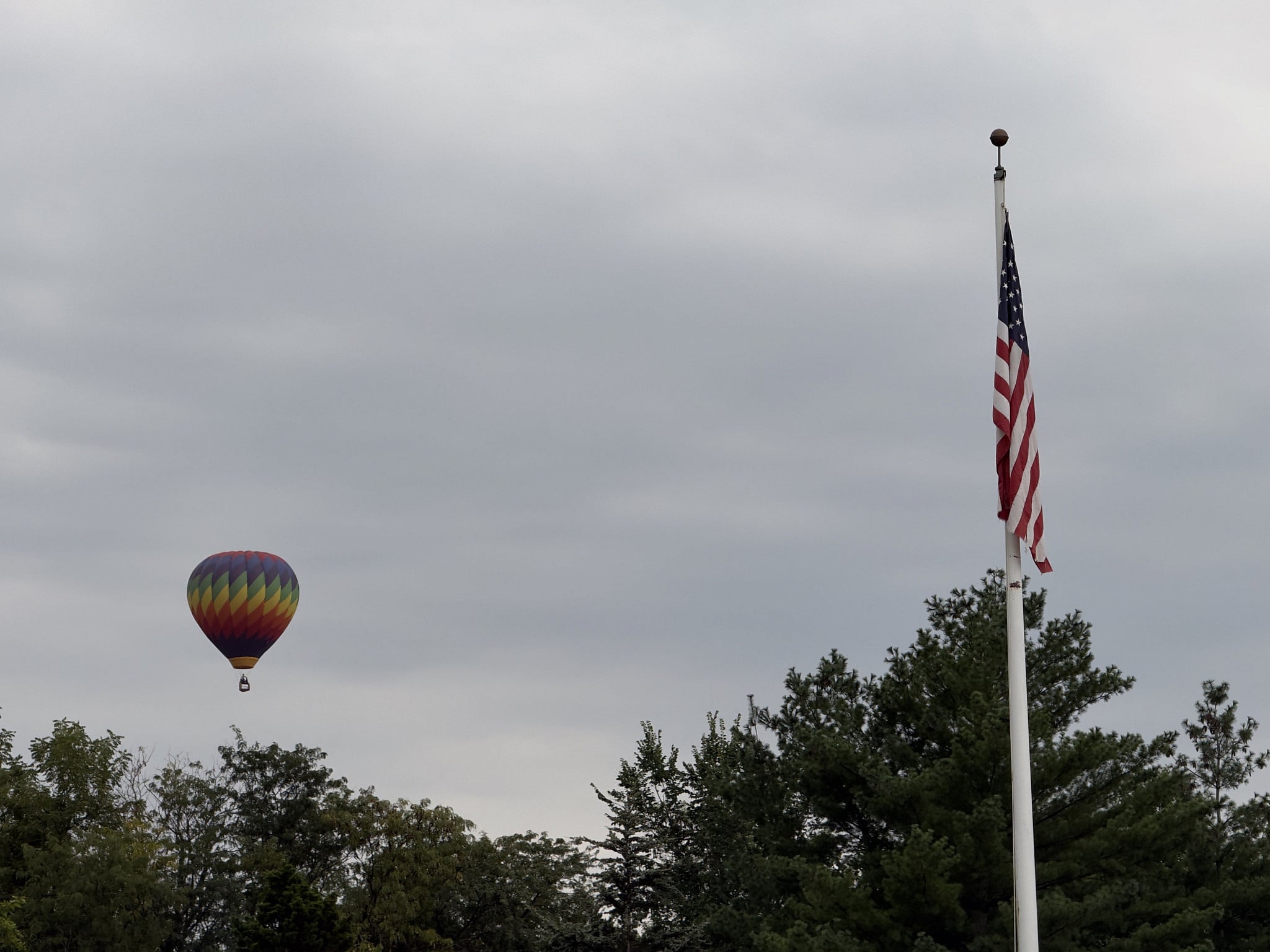
A Hot Air Balloon rises over the treelike near the flagpole at Temple Beth Sholom in Topeka, KS. (Sam Stern)
There’s a heaviness in the air right now. You can feel it in the conversations after services, in the worried glances at the news, in the questions I’ve received asking if it’s safe to wear a Star of David in public. I’m not the first to declare that the Golden Age of American Judaism, from about the 1960s to the 2010s, is well and truly over.
In the past two years, we’ve seen college campuses become hostile territory. Jewish students are told their grief is offensive, their identity is political, and their very presence is a provocation. We’ve seen mobs outside synagogues and mobs inside city halls. We’ve watched people excuse terrorism—actual terrorism and murder—as justified “resistance,” and we’ve seen prominent cultural institutions fall over themselves to stay silent when the victims are Jews.
And here’s what makes it worse: this isn’t just coming from some distant radical fringe anymore. It’s being normalized. It’s in faculty emails and fashion magazines. From both the far-left and the far-right, antisemitism is moving into the bloodstream of the mainstream.
I understand why so many of us are afraid. We should take the threat seriously. To be Jewish today is to have your eyes wide open.
But—and this is where I want to shift us—it is also to have your heart open.
Because if all we offer is vigilance, we become a people of shadows and suspicion. And that’s not who we are.
We are also the people of tikvah, of hope. Not naïve optimism, not “it’ll all work out” complacency, but Jewish hope—the stubborn, sacred belief that redemption is possible, that human beings can surprise us, that history bends because we push it.
As Rabbi Jonathan Sacks wrote:
“To be a Jew is to be an agent of hope in a world serially threatened by despair.”
And he went on:
“Judaism is the voice of hope in the conversation of humankind.”
So how do we live that out—here, now, when so many of us are just trying to stay safe?
Hope doesn’t mean pretending antisemitism isn’t real. It means we fight it—but we do not let it define the totality of our Jewish lives.
Hope means that alongside the vigilance, we keep building. We keep learning Torah. We keep raising proud Jewish children and celebrating their Jewish growth. We keep lighting candles, and going to Israel, and walking into shul with our heads held high.
Hope means that we don’t shrink ourselves to the lowest common denominator of Jewish life. We double down on what gives us joy and depth and holiness. We don’t just react. We create.
And this is where I want to root our vision of hope in something profoundly Jewish: geulah, redemption.
In traditional Jewish eschatology, the redemption is a messianic future, when the world is repaired, when the nations live in peace, and when the Temple is rebuilt. But that can feel too far off. Too cosmic.
In the Talmud (Shabbat 31a), Rava teaches that when we reach the end of our lives, the first question we will be asked is: “Did you conduct your business honestly?” The second? “Did you set aside time for Torah?” And then: “Did you look forward to the world’s redemption?”
That doesn’t mean you had to believe it would come tomorrow. It means you had to act in ways that made it more likely.
Hope, in Jewish terms, is a daily practice. It’s paying workers on time. It’s teaching our kids Hebrew. It’s walking into a protest and saying, “I’m a Jew, and I care about justice, and you don’t get to kick me out of this movement.” It’s traveling to Israel and saying, “I see the flaws and the glories, and I’m still proud to be a part of this story.”
It’s daring to believe that we are not just the inheritors of trauma, but the authors of tomorrow.
When we say the words of the Amidah—“matzmiach keren yeshua”—we bless God for causing “redemption to sprout.” That verb, matzmiach, is agricultural. Redemption is something that grows. Slowly. With effort. In fits and starts. But with the promise of life.
That’s the hope I want us to lean into right now.
Not the hope that antisemitism will magically vanish. But the hope that Judaism will outshine it.
Not the hope that the world will suddenly become just. But the hope that we will make it more just by refusing to give up our values or our voice.
And not the hope that our enemies will be convinced. But the hope that our children will be inspired to live Jewish lives of dedication and meaning.
Don’t let fear be your main Jewish experience. Let Shabbat be. Let study be. Let singing be. Let Israel be. Let friendship be. Let purpose be.
Let’s not be defined by what we’re afraid of. Let’s be defined by what we’re building toward.
Because hope isn’t just a nice idea. It’s a Jewish obligation.
And in a world that seems to want us either terrified or invisible, showing up with Jewish pride, with Jewish joy, with Jewish hope is redemption in action.
Related Topics