
How a Tax Forced the Parting of Judaism and Christianity
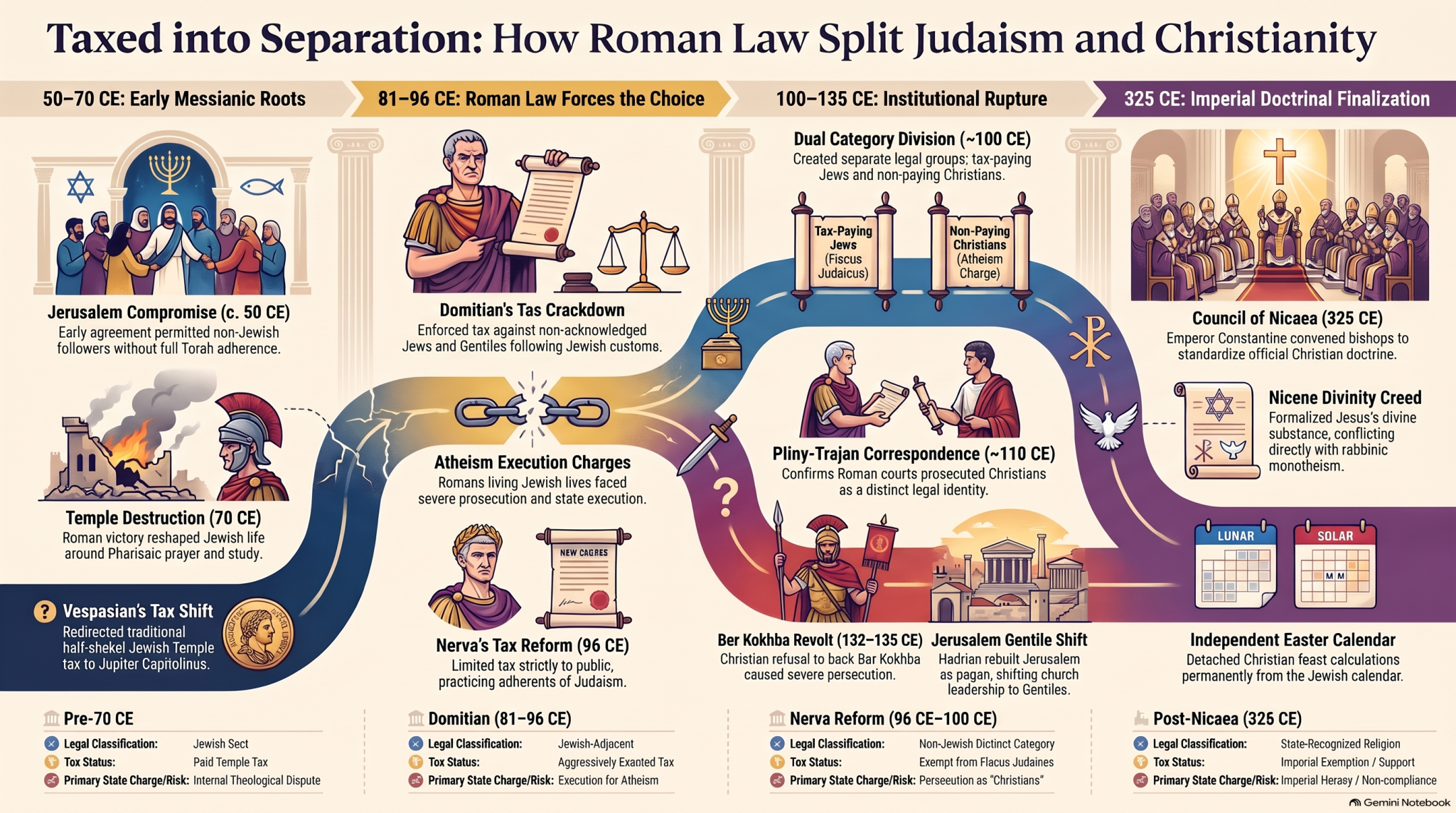
The parting of Judaism and Christianity was decided first not in a synagogue or a church council but in Rome’s tax office.
When Domitian enforced the Fiscus Judaicus harshly and Nerva then reformed it, the empire had to decide who counted as a Jew, and its answer drew a legal line between Jews and the followers of Jesus. By about the year 100, that line had made the separation largely complete in the one arena with the power to enforce it.
Theology did not drive the law. The law forced theology’s hand, by turning a long-running argument among Jews into a choice that had legal, financial and sometimes mortal consequences.
To see what the tax forced, start with what it found. The movement around Jesus began as a Jewish messianic sect, one voice among the Pharisees, Sadducees, Essenes and others competing in first-century Judea, and in Jerusalem later tradition remembers it as led by his brother James, a devout, Temple-going Jew. Its first crisis came from inside. Paul’s mission to non-Jews raised the question of whether Gentiles could join without circumcision and the Torah, and according to Acts, around the year 50 the Jerusalem leaders and Paul reached a compromise that let two kinds of followers coexist. Then, in the year 70, Rome burned the Temple. The priestly and revolutionary parties that had defined Judaism faded, and the Pharisaic survivors began rebuilding it around study and prayer, in a form with less room for those who called Jesus the Messiah. The sect arrived at the tax already shaped by an argument about Gentiles and a catastrophe about the Temple, and it was still, in everyone’s eyes, a Jewish matter.
The tax itself was Vespasian’s answer to the Temple’s fall. He redirected the half-shekel that Jews had paid to the Temple to the cult of Jupiter Capitolinus in Rome, and for a time it was collected from Jews as Jews. The pressure that matters began under Domitian. Suetonius reports that the tax was exacted harshly from two groups: those who lived a Jewish life without acknowledging it and those who concealed their Jewish origins. Cassius Dio adds that Roman citizens who had drifted into Jewish ways were executed on charges of atheism, among them the consul Flavius Clemens, the emperor’s own cousin. Those categories reach beyond people born Jewish. Jewish ways would have included Christianity, which means Gentile followers of Jesus, living Jewish-adjacent lives without Jewish birth, were exposed to informers alongside Jewish ones.
Nerva’s reform is the pivot. His coin announced an end to the abuses, and he forbade accusations of living a Jewish life, according to Dio. The reform changed how the tax was exacted and tied Jewish identity to open practice. The consequence is that those who did not openly practice Judaism, Jews and Gentiles who followed Jesus alike, could no longer be pursued through the tax courts but could be found guilty of atheism. Rome now had two categories, Jews who paid and everyone else.
The incentives followed. A Jew who followed Jesus could keep the legal standing of a Jew by publicly affiliating with the synagogue, which after 70 was being rebuilt in a narrower and more defensive form with less room for Jesus-followers. Or he could step outside, into a category with no standing in the tax system and, especially for Gentiles, exposure to a charge of atheism. Either way the ambiguity that had let Jews and Jesus-followers share the same assemblies for two generations became expensive. The later record is consistent with this: by the time of the exchange between Pliny and Trajan around 110, Christians were being tried as Christians, a category the state could name.
The tax is known from a small number of Egyptian receipts and three literary passages, and no Christian text mentions it. The step from Rome’s treatment of Jews to its treatment of those who followed Jesus is an inference and not a documented decision. The claim concerns how Rome classified people, and a classification can be complete in the law while ordinary lives still overlap beneath it.
The obvious objection is that theology came first. The dispute over Gentiles and circumcision described above does predate the tax by two decades. The theological fault line was real. But a fault line is not a fracture, and for decades Jews and Jesus-followers argued across it without breaking. What turned the argument into a rupture was an outside power that needed an answer.
Rome’s legal line left a social bond, and the Bar Kokhba revolt of 132 to 135 did much to cut it. The revolt was a messianic war. Rabbinic tradition has Rabbi Akiva hailing Simon bar Kokhba as the Messiah, and a Jew who held that Jesus was the Messiah could not easily join a movement led by another. Justin Martyr, writing within a generation, says Bar Kokhba persecuted Christians who refused to join him. The followers of Jesus were now caught between a Rome that already classed them apart and a Jewish national cause that treated their loyalty as treason. The defeat then removed the place where the old overlap had lived. Hadrian barred Jews from Jerusalem, rebuilt it as the pagan city Aelia Capitolina and renamed the province Syria Palaestina, and, according to Eusebius, the church of Jerusalem passed to Gentile leadership. Gentile Christianity, never tied to the city, kept growing. By the middle of the second century, what people called Christianity looked increasingly Gentile, Greek-speaking and detached from its Jewish origin.
The line drawn in the tax office, and deepened by the revolt, did not end the story. It set the terms for the next chapter, which is Nicaea. Once Rome had a legal category for Christians distinct from Jews, the movement became something the state could ignore, persecute or, eventually, embrace, and a movement that must answer to the state is pressed to say exactly what it is. Persecution came in waves for two centuries, until Constantine’s conversion and the Edict of Milan in 313 turned the state toward the church. When he convened the council at Nicaea in 325, he was dealing with a church that already stood on its own legal ground, and he needed it to speak with one voice.
What Nicaea settled gave Christianity its distinct shape against Judaism. Its creed declared the Son to be of one substance with the Father, answering the Arian dispute and fixing the divinity of Jesus at the center of Christian worship, a claim that rabbinic monotheism could not share. The council also moved to set Easter apart from the Jewish calendar, so that Christians would no longer depend on Jewish reckoning for their central feast. Imperial law and church canons then built on both decisions in the generations that followed. The caution is that Nicaea was chiefly about internal Christian doctrine and not about Jews, so the link to the tax is a chain of consequences and not a direct cause. But it is a chain with an order. Rome’s law made Christianity legally separate by about the year 100, and Rome’s emperor made it doctrinally and ritually separate by 325, with imperial power behind each step.
The verdict stands. Whatever the first followers of Jesus believed about him, the first line with force behind it was drawn by Roman law, in the register of taxation and atheism, and it was drawn by about the year 100. The revolt of 132 cut the bond that remained, and the creeds and the councils, Nicaea first among them, came later and gave doctrinal and ritual form to a separation the tax collectors had already sorted. That should change how we tell the story. The parting of the ways was less a family quarrel that ended in departure than one in which an empire demanded to know who belonged to which house, and the family has spent the centuries since treating that demand as its own decision.