


How a Trip to the Interior Ministry Encapsulated Things I Like About Israel
My wife and I started dating during the Gulf War, when Israelis carried around gas masks in cardboard boxes and prepared rooms sealed with plastic sheeting, in case Saddam Hussein decided to poison our air. There were around 40 scud missiles fired then, over the course of six weeks, and for warning purposes the country was divided into six areas.
This was the period following the collapse of the USSR and the concomitant emigration therefrom of hundreds of thousands of people who came to Israel. Which meant that getting anything done at the Population Registry office of the Interior Ministry, especially in the big cities, could be an all-day or even a multi-day task. You couldn’t make an appointment in advance, you had to show up early and hope you got in and hope you had all the necessary papers and hope that the clerk behind the desk wasn’t in a bad mood. Visits were often accompanied by shouting and tears.
Our youngest’s passport will expire soon. More importantly, he is now old enough to get his own state-issued ID card (teudat zehut), something we want him to have before his first appearance at the army’s draft office, which will probably be sometime this spring (he will go as part of a group, with about half of his school class). But since he’s still a minor, he needs a parent to come with him to the PRo. Fortunately, things have improved since 1991: now you can go online, on your computer or smartphone (the latter something that of course didn’t exist in 1991) to make an appointment at the PRo. So, out of consideration for his mom and pop, our son made an appointment at the PRo near where we live, to make it easier for one of us to come along, rather than make an appointment in Jerusalem (where he studies), which he would have done if could do this alone. That appointment was supposed to have happened a few weeks ago, but he cancelled it when an opportunity to do something else important arose. Then it turned out that the next appointment nearby was only in a few months’ time.
So this past Sunday, I went to the PRo’s site, and found that there were appointments available this week in Kiryat Tivon, Nof Hagalil, and Tiberius, all which are at least a two-and-a-half hour drive from where we live. But lo and behold, there were also appointments to be had in Afula on Wednesday. In 1991 that would have been a two-to-three hour drive from us, possibly longer, depending on traffic, but today, with light traffic, it takes us only about 90 minutes via Road 6 to Road 65. Added bonus for me: Afula is at the eastern edge of the Jezreel Valley, and when I first came to Israel with my parents in 1974, we initially spent time at an absorption center on a kibbutz nearby. Hence this trip would allow me see an area from my past that I don’t get to visit that often.
One of the things I love about living in Israel is that the whole land is part of Jewish history, going back thousands of years. The Jezreel Valley is mentioned several times in the Bible: inter alia, King David took a wife, Achinoam, from there; and the prophet Elijah confronted King Ahav and his evil wife Jezebel there. The drive to the Jezreel Valley on road 65 follows an ancient route, once used by armies, though a pass in the hills bordering the western side of the valley. As you come through the pass, Mount Tabor, also mentioned in the Bible and still a landmark, comes into view.
The Jezreel Valley constitutes the southwestern-most part of the Fertile Crescent, and thus at this time of year is especially green. Driving across it to Afula, I mentioned to our son how it reminded me of driving across California’s Central Valley, just on a smaller scale. That’s another one of the things I like about Israel: there are natural wonders. They’re not as big as you’ll find in some places, but they’re there. So, for example, near Beit Shemesh – which was targeted by the fun-loving members of the Religion of PiecesTM in Iran on March 1, and which sustained the single most deadly hit of the war – there’s a wonderful stalactite cave. Much, much smaller than Jewel Cave or Wind Cave or Mammoth Cave in the USA, but still a great example of a stalactite cave. Similarly, the area just south of Makhtesh Ramon is reminiscent of the Badlands, and there are places in Israel that are visually similar to the ironically-named Zion National Park in Utah, but again, on a smaller scale.
On the drive, we streamed some talks by a well-known rabbi that youngest son chose – no cassette tapes anymore. Thanks to Waze – another modern convenience that superseded the standalone GPS unit, which also wasn’t around in 1991 – we found our destination without a problem. In 1991 I would have needed a parking card with punch-out chads to park on the street, but this week I just activated the parking app on my phone.
In contrast to those visits to the PRo 35 years ago, now the guard has a list of everyone with appointments and the set time. Since we’d arrived a few minutes early, he told us to wait ten minutes. And then (again, via our cellphones), we got a warning about a missile launch from Iran, and then a few minutes later instructions to take cover.
This too is remarkable: as a result of the development of the Iron Dome, the defense forces can predict to within just a few square kilometers where a projectile is going to land if it isn’t intercepted, and when those projectiles are fired from Iran, we generally have several minutes’ warning that we might have to take cover, and then 90 seconds to get to a protected space when it’s clear we might at the receiving end of a missile. As dozens of people poured out of the PRo into the reinforced room just a few steps away, I said to our son that there’s probably a similar room on the ground floor and that it’s likely less crowded. So we went down the stairs – that’s the luxury of that 90-second warning – and my prescience was proven.
While there I found I had cell phone reception, so I text on our family Whatsapp group. Yes, they too had sirens at home. I mused that Afula must get relatively few missiles, since there’s really nothing there, and our oldest daughter confirmed (via a website that someone set up to track these things) that since the war with Iran began, Afula ranked only 536 in terms of missile attacks and how much time people had had to spend in their bomb shelters – 31 sirens, 7 hours and 44 minutes, and that includes rockets fired by the other fun-loving Shiites, the ones in Lebanon – whereas our home ranked 91, with 102 sirens, and 26 hours 48 minutes in bomb shelters. If you’re firing at Afula, just like if you’re firing at Beit Shemesh, you’re doing it solely for the sake of trying to kill civilians, because there’s nothing strategic there.
Following the all-clear, we went back upstairs and waited to be let in to the PRo. It was at that point that I noticed an office directly across the hall from the PRo, the door of which said, “צור הלוי – עורך דין” (“Tzur Halevi – Advocate”) and then below it, “ייצוג מול משרד הפנים”, which can be translated as “Representation before the Interior Ministry” but also as “Representation across from the Interior Ministry”. Perhaps Mr. Tzur has a sense of humor. (My wife was once in a car crash and her volunteer Magen David Adom ambulance driver was a lawyer, who gave her his card when he dropped her off. If you’re a personal injury lawyer, why chase ambulances when you can drive one?)
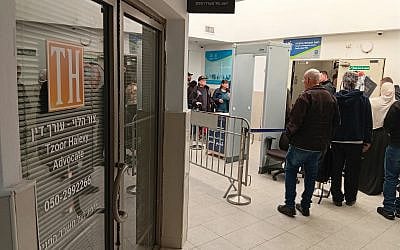
After a few minutes, we were admitted to the office, our son put his ID number into the appointments computer, he was given a call-up number, and within three minutes we were at the window of one of the clerks. I note that all the windows – at least 15 – were in service, something that wasn’t necessarily true back in the day. The clerk verified some details with him, had him sign some forms (and as his parent, I had to sign one as well), took a digital photo (no need anymore to obtain and bring your own photos), and explained how long it would take to receive his ID card and his passport (they are processed and sent via separate mechanisms), and we were free to go. We were in the office for less than 15 minutes. No raised voices, no crying, just quickly getting done what we needed to get done. Amazing.
Since the PRo is in what is designated as an “industrial area”, there were a few supermarkets around, so we stopped by one of them to pick up a few things before Pesach, include some kosher-for-Passover munchies for the ride home, since the car interior was already cleaned. We went back to the car and I turned off the parking app: 68 minutes, a little over four shekels.
I work as a patent attorney, and one of the things I like to point to as characterizing Jews generally and Israelis in particular is that, as a group, they’re always looking to better to the world, often by inventing things. Our outing to the PRo this week demonstrated just a few: between 1991 and today, Israelis have made their bureaucracy more efficient; invented missile interception systems that give us advance warning of incoming rockets within seconds, quickly determine which geographical areas might be affected, and intercept most of those objects before they do significant damage; and become a critical part of the hi-tech world.
Saddam Hussein thought he’d destroy us, and now the mullahs not seek the same end (and lie to themselves that they’re winning). So far, in four weeks, we’ve had far more objects sent our way from Iran (and Lebanon) than Iraq sent in six weeks in 1991, and we’ve absorbed far more hits this time around. But we’ve also deflected most of those shots. And what we’ve done militarily in Iran – something Bush the elder wouldn’t let us do in Iraq in 1991 – is going to be taught in military academies for years to come. We’ve done that not because we want to fight, but because we have to.
Meanwhile, over the course of 35 years, Israelis have continued to do what they do best: try to live their lives as normally as possible, which includes improving their lives and the lives of those around them. Maybe someday those who seek to kill will try to emulate us instead. It would be a win-win.
עם ישראל חי