


Reasonable Judaism: Torah for an Age of Outrage
How Antisemitism Escalates: Exposing Egyptian Jew-Hatred
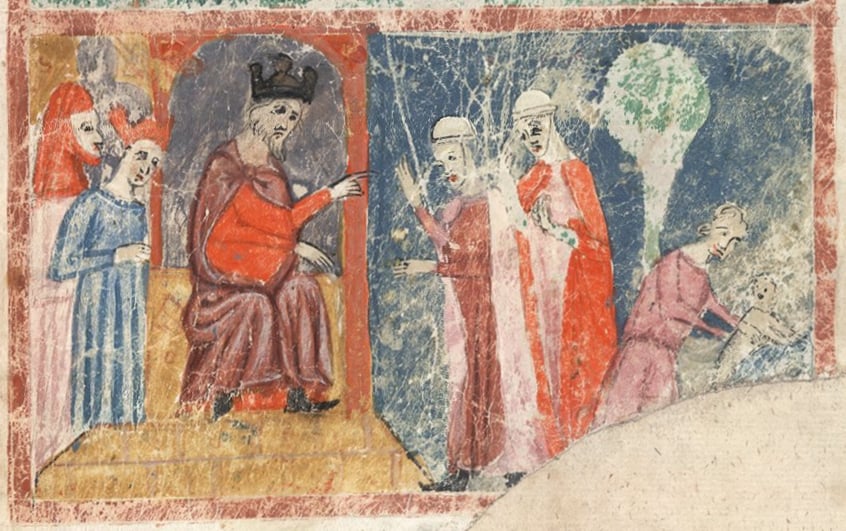
Pharaoh ordering the midwives, the casting of the male children into the Nile (Passover Haggadah, 14th century via Wikimedia)
The opening of Shemot reads like a case study in antisemitism. Pharaoh feels no allegiance to Yosef or the Jews. He casts the minority’s growth as suspect and forecasts a catastrophic future for the country.
Thinkers such as Michael Walzer have noted how closely Pharaoh’s language echoes patterns that recur throughout Jewish history – erasing past contributions to a society, exaggerating Jewish power, portraying Jews as a destabilizing force, and moving toward elimination. These readings help explain how antisemitism takes hold through a mix of manufactured fear, projection, and political calculation. (I use “antisemitism” here as shorthand for hostility toward Jews, not as a technical historical category.)
These accounts tend to emphasize how Jew-hatred begins. But upon closer examination, the Torah is also tracing something else: how antisemitism escalates, how it succeeds, and how it can be exposed.
The escalation in Egypt unfolds step by step. Pharaoh first imposes forced labor, hoping the Jews’ exhaustion will curb their growth. When that fails, he summons the midwives and issues a private instruction for them to kill the Hebrew boys at birth. This detail is often overlooked. Murder is introduced outside the public eye. State-sponsored antisemitism has turned lethal, but it is still intentionally concealed by the government.
In recounting the midwives’ response, the Torah introduces a phrase that redirects the story: vatirena hamyaldot et haElokim – the midwives feared God. Because they fear God, they refuse the king’s command. Here, yir’at Elokim does not carry the generic meaning of piety we usually assign to it. It denotes a moral boundary that no human authority may cross.
That usage appears elsewhere in Tanakh, especially in moments where one party holds overwhelming power and no external restraint exists. The clearest example appears earlier in Bereishit. When Avraham explains his fear in Gerar, he says, “rak ein yir’at Elokim bamakom hazeh, vaharaguni al devar ishti” (Genesis 20:11). Avraham is diagnosing a society where nothing restrains violence. When fear of God is absent, murder becomes conceivable because nothing stands in its way.
A similar logic appears later in the Yosef story. When Yosef addresses his brothers during the famine, he tells them, “et haElokim ani yareh” (Genesis 42:18). Yosef controls their fate entirely. His declaration of fear of God functions as a commitment that he will not exploit that power arbitrarily or prey on the vulnerable. Instead, if they bring back Binyamin, he will exonerate Shimon.
The midwives thus draw the Torah’s first bright red line against Jew-hatred. No matter what Pharaoh commands, they will not commit infanticide.
The consequences are dramatic. Pharaoh abandons secrecy and issues a public decree to his entire nation to cast the Hebrews’ baby boys into the Nile. Violence moves from covert instruction with plausible deniability to explicit collective policy. The situation worsens, and the Torah makes no attempt to soften the reality. At the same time, another consequence emerges: the midwives force antisemitism into the open. Pharaoh can no longer preserve the fiction that he knew nothing of the violence against Jewish infants.
Their refusal establishes that Pharaoh’s command is not inevitable. The breach makes other actions imaginable. Instead of despairing, Moshe’s parents place the infant in the Nile. Miriam remains nearby, seizing the opening the moment it appears. Pharaoh’s daughter implicitly challenges her father’s decree, ultimately raising the child in Pharaoh’s own house. Moshe himself intervenes on behalf of his brethren. Together, they form a fragile chain of resistance.
The Torah does not present this result triumphantly or simplistically. The midwives’ refusal leads Pharaoh to throw all his chips on the table and command mass infanticide. At the same time, there is a clear line from their defiance to Moshe’s birth and survival. Each decision opens space for the next, until redemption becomes possible. Egypt offers a model not only of how antisemitism begins, but of how it escalates – and where it can be disrupted.
Read this way, the Torah offers an insight that feels especially urgent today. Antisemitism often advances not only through hostility, but through intellectual dishonesty. It hides behind abstraction, euphemism, pseudo-scholarship, and moral language that obscures what is actually being justified. Violence is laundered through rhetoric that allows people to avoid naming what they are supporting. I have seen this firsthand as a graduate student taking gender studies courses and reading the likes of Judith Butler, whose rhetoric tends to obscure rather than present a coherent argument argued from logical building blocks that scholars can evaluate on the merits.
Now, in periods when liberal norms are stable and social boundaries enforced, it can be better for antisemitism to remain unfashionable. The story of the second half of the twentieth century is less about the disappearance of antisemitism than of its becoming unacceptable to articulate publicly in the wake of the Holocaust. But once antisemitism moves from the margins into open expression and then settles into the commonplaces of “reasonable company,” the calculus changes – from relying on social stigma to requiring exposure and confrontation.
The story of Egypt suggests that refusing to participate quietly – and forcing antisemitism into the open before it is ready – carries enormous risk, but it can also shift the dynamic. Once violence is named and visible, it can no longer pass as moral sophistication. Those who consider themselves decent are forced to confront a harder question: is this really what you are prepared to accept?
We can see versions of this dynamic today on the left. When Democrats publicly challenge colleagues for excusing or minimizing antisemitism – as Ritchie Torres and John Fetterman have done, repeatedly and at personal cost – they are not resolving the issue. But they are refusing to let antisemitism fester quietly, and they are forcing their party to confront openly what it excuses and tolerates. By breaking the silence from within, they interrupt the process by which Jew-hatred becomes normalized rather than contested.
A similar dynamic appears on the right. When Ben Shapiro – with whom I have sharp disagreements – publicly calls out antisemitism among his ideological allies, he does something comparable. By naming it rather than ignoring it, he forces a public reckoning instead of allowing Jew-hatred to metastasize until it risks becoming an unspoken norm across more of the movement. Of course, calling it out does not guarantee change – and Shapiro has certainly paid the price – but it prevents antisemitism from settling quietly into the moral fabric of a political culture.
The Torah offers no guarantees about what will happen when antisemitism is forced into the open. Acting openly and honestly is no guarantee of success, but it does create possibilities that quiet compliance forecloses. Refusal may provoke escalation, or it may fracture obedience just enough for redemption to become possible. Both may occur, as in Egypt. There is no way to know in advance which it will be. That uncertainty is not a weakness in the Torah’s moral vision. It is simply real life.
At the same time, the Torah is clear that not all Jew-hatred unfolds this way. It also knows a form of hatred that does not move gradually, that leaves no space for disobedience to take hold.
That is the next model the Torah places before us. It is called Amalek.