
How Australia’s famed multiculturalism died at 6.47pm, on December 14, 2025
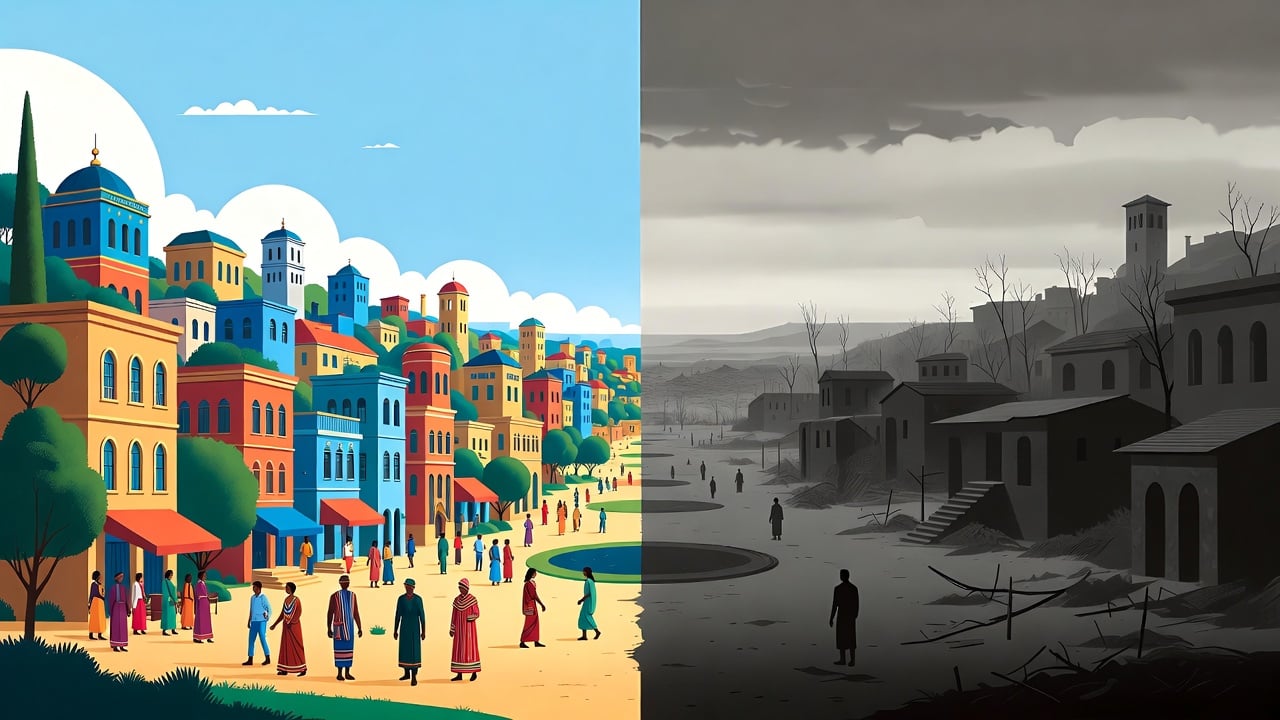
Multiculturalism in Australia, with its almost religious-like status, did not collapse slowly, and it did not collapse by accident.
It collapsed because too many powerful institutions and politicians, especially those on the left, made the same calculation: silence was safer than truth, and optics mattered more than cohesion.
Or put another way, being seen to be ‘virtuous’ and ‘kind’ (whatever that means in this particular context) was far more preferable to these cowards than standing up for what was right for the country and for the local community.
That silence was finally shattered at Bondi, at 6:47 on a hot and sticky summer evening in a place designed to symbolise acceptance and belonging, when 15 Jewish Australians were savagely gunned down with high-powered rifles designed for hunting water buffalo.
The killers, father and son Islamists, achieved what all Islamists have long wanted in Australia (and across the world) – an Islamic monoculture to replace what many once described as the ‘world’s most successful multicultural democracy’. Sharia Law for them is far preferable to sharing.
I know this because I’ve seen this before, many decades ago, during another time, but not all that far from Bondi Beach.
Bondi was never just a beach. It was a civic altar. Sunburnt bodies, tourists, locals, migrants, accents, and overpriced fusion dishes all cobbled together in the one place we pointed to when explaining ourselves to the world. If multiculturalism worked anywhere, it was one of the places where it should have worked even better. Which is why its rupture mattered.
And ‘rupture’ is the perfect word, as it denotes revolutionary violence and not just opportunistic hate. The violence didn’t merely intrude—it invalidated a story we had been telling for years with increasing desperation.
The 1970s Australia I grew up in was a country that was not kind by our modern, ‘woke’ standards, but it was legible. It was Anglo-centric, blunt, and often indifferent to the hurt feelings of us ‘ethnics’ with our strange-sounding names.
As the son of Croatian immigrants whose family left the communist hellhole that was Yugoslavia, we came here to work on the then-new Sydney double-decker trains.
Growing up in the southern Sydney suburb of Arncliffe, I was one of 17 nationalities in a suburb that was 8 km from the city and 3 km from the beach.
Greeks, Italians, Macedonians, Germans, Maltese, Turks, Norwegians, Croats, Czechs, Serbs, Scots, Irish, Spaniards, French, Hungarians, Kiwis, and the ‘local’ Anglos all rubbed elbows and existed in each other’s spaces and realities.
In many ways, it was like Bondi before the modern version of Bondi emerged.
Weekend summer days, just like the one on December 14 last year, were particularly treasured, when we’d all go down to the local creek to build rafts, hunt water rats with our air rifles and catch crabs and turtles on the muddy shores and reedy banks.
Like some sort of Antipodean Huckleberry Finns, as the sun went down, we invaded each other’s houses, ate foods that most Anglos had never heard of and laughed until we couldn’t breathe while watching shows like Hey, Hey, It’s Saturday.
Then, in the later part of the decade, the ruling Liberal Party under the leadership of PM Malcolm Fraser, the closest thing Australia had to the late US President Jimmy Carter, thought it would be a great idea to dump hundreds of Lebanese Shiites fleeing the civil war in their country in our little piece of paradise Down Under.
Within 10 years, the halcyon days of my childhood were over.
The newcomers, with violence, force, ignorance and sheer cultural unsensitivity, tore our little multicultural enclave to shreds.
But by 1980, multiculturalism was politically anchored – set in stone, as one former PM would say – by an assumption that now feels radical: that Australia had a cultural (Anglo-Saxon) core, and that joining it required adaptation. Not submission, but adaptation. You adapted. You made room for yourself and others.
That expectation created some minor friction, resentment, and argument—but also, at the same time, convergence. And space. And eventual understanding and tolerance. People pushed back, but they pushed towards something greater.
That gravitational centre is now gone. That universe has now been shattered.
The Black Hole of uncompromising Arab-Islamic monoculturalism has now replaced the serene universe of the ‘many nations under one sun’ of my childhood.
If you don’t believe me, just look at the demonstration on October 8 at the Sydney Opera House more than two years prior to the Bondi slaughter. ‘Gas the Jews’, they cried. ‘From the river to the sea’, the Hamasniks screamed.
Two of those shouting these vile genocidal slogans were the Bondi Beach killers themselves.
What has replaced the multiculturalism of the past is not a new form of multiculturalism as lived reality, but rather a monoculturalism as an unwritten doctrine, lest you get labelled as being ‘Islamophobic’, or what Christopher Hitchens said was a word “created by fascists, used by cowards, to manipulate morons” – and in Australia’s case, administered by media, enforced by universities, and protected by a cowardly political class allergic to naming what is attacking it.
Each institution failed differently. Together, they hollowed the country out.
The media’s failure was cowardice dressed as balance.
Journalists, editors, and social commentators, many of them private school educated, a high number being white and Anglo, and also interestingly, disproportionately female from privileged, wealthy families with little or no experience of the real Sydney, learned quickly how certain facts generated outrage from the right, while other facts generated outrage from the left, and how only one of those outrage cycles threatened their careers.
Reporting on Islamist extremism was hedged, euphemised, displaced onto abstractions, or even hidden: “community tensions”, “youth alienation”, and “online radicalisation”.
Motive was blurred until meanings disappeared or simply no longer had any meaning. Pattern recognition was treated as moral contamination. The public was left with fragments and threads, if you will, and told not to assemble them.
Universities did something worse: they supplied the social theory. Campuses became factories for the idea that liberal democracy was merely one cultural expression among many—no more legitimate than any other, and certainly not worth defending.
Students were indoctrinated that asserting universal values was a form of ‘white domination’ and that judging belief systems was an act of inherent ‘violence’.
Islamist ideology, when it appeared at all, was reframed as resistance, grievance, or misinterpreted piety. The wolf had well and truly morphed into Grandma.
In the aftermath of the Bondi killings, the response of the political class has been abysmal; it seems to be the fashion to blame everyone else, to add to laws we already have but have failed to use, and to continue to conjure up a near-mythical creature known as the ‘far right’ as the ‘reason’ why 15 innocent people, including a 10-year-old girl, had their lives snuffed out on the famed golden sands of Bondi last December.
Islamist extremism is not a social misunderstanding. It is an ideological project with clear geopolitical goals. It is explicitly hostile to secularism, contemptuous of pluralism, and incompatible with the assumptions that allow multicultural societies to function. It does not seek inclusion; it seeks leverage.
It does not want coexistence; it wants submission. Treating it as a marginal distortion rather than a coherent worldview was not tolerance. It was strategic blindness, a category error of civilisational proportions.
This is not an argument against Muslims. It is an argument against the refusal to distinguish between faith and political absolutism. Every liberal democracy that has failed to draw that line has paid for it later, in blood or in silence.
Australia is not exempt from that history, no matter how many Lara Bingle-voiced ‘Where the hell are ya’ Ads we run on TV or shrimps Paul Hogan ‘throws on the barbie’.
Multiculturalism depended on a shared civic floor: freedom of expression, equality before the law, secular governance, and the non-negotiability of violence as a political tool.
Once our institutions, and more importantly, our leaders, stopped defending that floor—once they treated it as just another cultural preference—the structure above it began to buckle.
Bondi exposed an illusion that years of euphemism had concealed: that public space is only neutral if everyone agrees it is.
That illusion died quickly. Illusions always do.
But the real tragedy is that the version of multicultural Australia that worked was never utopian. It was argumentative, bound, and occasionally unfair. But it was honest. It is understood that cohesion requires expectations and that not every difference can be harmonised without cost.
We abandoned that realism for a fantasy of endless accommodation—and called dissent cruelty.
Australia will continue to be diverse. That is irreversible. But the beautiful, fragile idea that diversity alone would bind us—that is finished. That died with the 15 Bondi victims celebrating Chanukah, something that should have been a part of what we once called multiculturalism.
What comes next depends on whether we are willing to say so out loud, without flinching, and without blaming the wrong people.
US-style calls for ‘thoughts and prayers’ do not suffice here.
We did not lose our country overnight.
We dismantled it carefully—editorial by editorial, lecture by lecture, news story by news story, and bad law by bad law—until one evening made the damage impossible to deny.
Australia has always been good at myths. We are a country of myths and mythmakers.
However, we are not so good at endings.
And speaking of endings, what comes next will not be decided by slogans, or feel good vibes or guilt peddling from the Chattering classes.
It will be decided by whether we are willing to say, plainly and without apology, that some ideas do not belong here—and that refusing to say so was the most dangerous choice of all.