
How Benjamin Netanyahu eroded Israel’s bipartisan support in America
On May 2, 1951, David Ben-Gurion paid his first official visit to the United States as prime minister of Israel. Historians of Israeli foreign policy generally regard this visit as a defining moment, for it firmly anchored Israel within the democratic Western camp and, above all, helped lay the foundations of Israel’s modern strategic relationship with the United States. In the decades that followed, the relationship grew steadily closer as successive Israeli governments came to regard American support as one of the cornerstones of Israel’s national security.
For decades, support for Israel was one of the few issues that united Democrats and Republicans alike, making it an unusually stable component of American foreign policy.
The special relationship between the two countries rested not only on shared strategic interests but also on broad political and public support across the American spectrum. Beginning in the early 1980s, particularly in the aftermath of the First Lebanon War, however, a widening gap emerged between Israel and its two principal pillars of support in the United States: the American political establishment and the American Jewish community. At first glance, no Israeli leader seemed better positioned to repair that growing divide than Benjamin Netanyahu.
Netanyahu’s reputation was no accident. In My Brother’s Keeper, Ari Harow famously described Netanyahu as “Israel’s first American prime minister,” marveling at his flawless English and his remarkable ability to captivate American audiences. Yet one question remains: How did the very leader who appeared uniquely equipped to strengthen Israel’s relationship with the United States preside over a period in which Israel’s relationship with the United States became a source of growing strategic concern? How did Netanyahu become, more than any other Israeli leader, a figure who inspires not merely criticism but, in many quarters, outright hostility in America? The New York Times described him as the man who had made Israel “radioactive.” Former president Joe Biden reportedly referred to him as an “asshole,” who was “doing more harm to Israel than good,” while the current president has often treated him with barely concealed condescension.
This erosion was neither the product of isolated crises nor merely the consequence of changing administrations in Washington. It reflected a consistent strategic outlook. Just as Netanyahu consolidated his political power in Israel through an alliance with religious parties and the conservative right, so too in the United States, he sought to replace Israel’s long-standing bipartisan consensus with an alliance centered on the American conservative camp. For many years that strategy appeared successful. Today, however, it is becoming increasingly clear that it weakened the foundations of Israel’s standing in the United States.
From the beginning of his first term in the 1990s, Netanyahu adopted a confrontational approach toward Democratic administrations. While genuine policy disagreements certainly existed, they were compounded by political choices that deepened the divide. His troubled relationship with President Bill Clinton was shaped in part by disputes over the implementation of the Oslo Accords. But policy disagreements alone do not explain the deterioration. Netanyahu also cultivated Clinton’s domestic political opponents, including the evangelical leader Jerry Falwell and Republican Speaker Newt Gingrich.
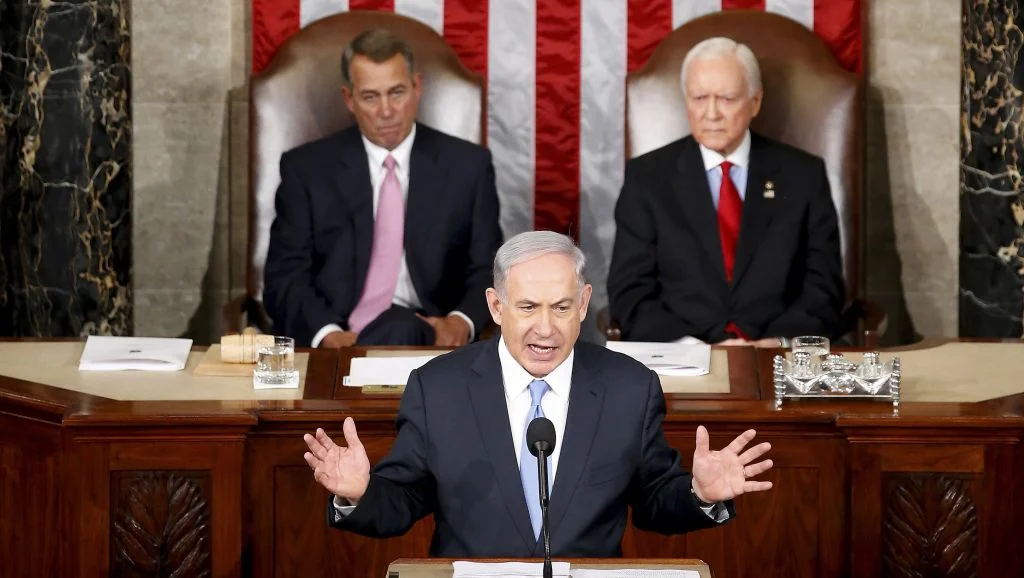
The same pattern reappeared during Barack Obama’s presidency. Amid profound disagreements over Iran’s nuclear program, Netanyahu not only publicly challenged the president in his controversial address to Congress but also openly aligned himself with Republican presidential candidate Mitt Romney. Over the course of three decades, Israel gradually ceased to be a bipartisan cause in American politics and became increasingly identified with one political camp. For the first time in Israel’s history, support for Israel in American politics was transformed from a bipartisan consensus into a partisan issue.
The relationship between Israel and American Jewry also suffered a profound rupture during Netanyahu’s years in office. The Wall Street Journal described it as “a rupture in the Jewish people,” while the New York Times called it “an ugly split between the world’s two largest Jewish communities.” The confrontation began in early 1997 with proposed legislation that would have granted the Orthodox establishment exclusive authority over religious conversion in Israel. The proposal was accompanied by inflammatory rhetoric directed at the non-Orthodox movements. Sephardic Chief Rabbi Shlomo Amar, for example, referred to them as “Holocaust deniers,” while ultra-Orthodox members of Netanyahu’s coalition accused them of bringing about “the destruction of Judaism.” Among large segments of American Jewry, a growing perception took hold that the State of Israel questioned the legitimacy of their Jewish identity. In response, the Council of Jewish Federations redirected funding toward promoting religious pluralism and tolerance in Israel.
Beyond the religious dimension, Netanyahu’s broader policies further deepened the sense of alienation felt by large segments of the American Jewish community, particularly among younger and more educated Jews. During his years in office, Israel increasingly came to be viewed as an obstacle to peace and as an occupying power that relied increasingly on military force. Images of settler violence in Palestinian communities, together with harrowing reports from Gaza, intensified this estrangement. Public criticism of Netanyahu and his governments grew correspondingly sharper. Henry Siegman and Robert Jay Lifton, both former leaders of major American Jewish organizations, urged the Biden administration to help “save Israel from itself.”
For years, Netanyahu and his supporters could argue that the costs of alienating Democrats and much of American Jewry were offset by an increasingly close alliance with the American right. Yet it is precisely here that the greatest irony emerges. Cracks have now begun to appear within the very political camp upon which Netanyahu increasingly relied as Israel’s principal base of political support in the United States. Vice President J.D. Vance, one of the leading figures of the Republican Party’s new generation, has openly criticized both Israeli policy and Netanyahu himself, warning Israel against taking President Trump’s support for granted.
Even deeper fissures are becoming visible among influential conservative opinion-makers. Tucker Carlson, long one of the most influential voices on the American right, argued that Netanyahu had drawn the United States into conflicts that did not serve American interests and contended that Israel had lost its “moral compass.” Other conservative commentators, including Megyn Kelly, have described Israel under Netanyahu as “the villain of the world” and called for an end to unconditional American support. What was once largely confined to progressive circles on the American left has increasingly spread into the populist right under the slogan: “America First, not Israel First.”
The historical verdict on Netanyahu is becoming increasingly clear. For more than 70 years, broad American support for Israel was one of Israel’s greatest strategic assets. During Netanyahu’s lengthy tenure, that asset steadily eroded. First came the growing estrangement of the Democratic Party, then the alienation of much of American Jewry, and now visible cracks have begun to appear within the conservative camp upon which Netanyahu sought to build his strategy. If Ben-Gurion anchored Israel’s security in an American alliance that transcended parties and communities, Netanyahu leaves behind an alliance that is more polarized, more fragile, and considerably less resilient. This represents more than a shift in Israeli foreign policy; it marks the weakening of one of the foundations upon which Israel’s national security rested for generations.
The irony is difficult to ignore. The man who was long regarded as the Israeli leader who understood America better than anyone else – and who was famously described as “Israel’s first American prime minister” – may ultimately be remembered as the leader who oversaw the erosion of the bipartisan American consensus on which Israel’s security had rested for more than seven decades.