


How Far Right Is Too Far for J.D. Vance?
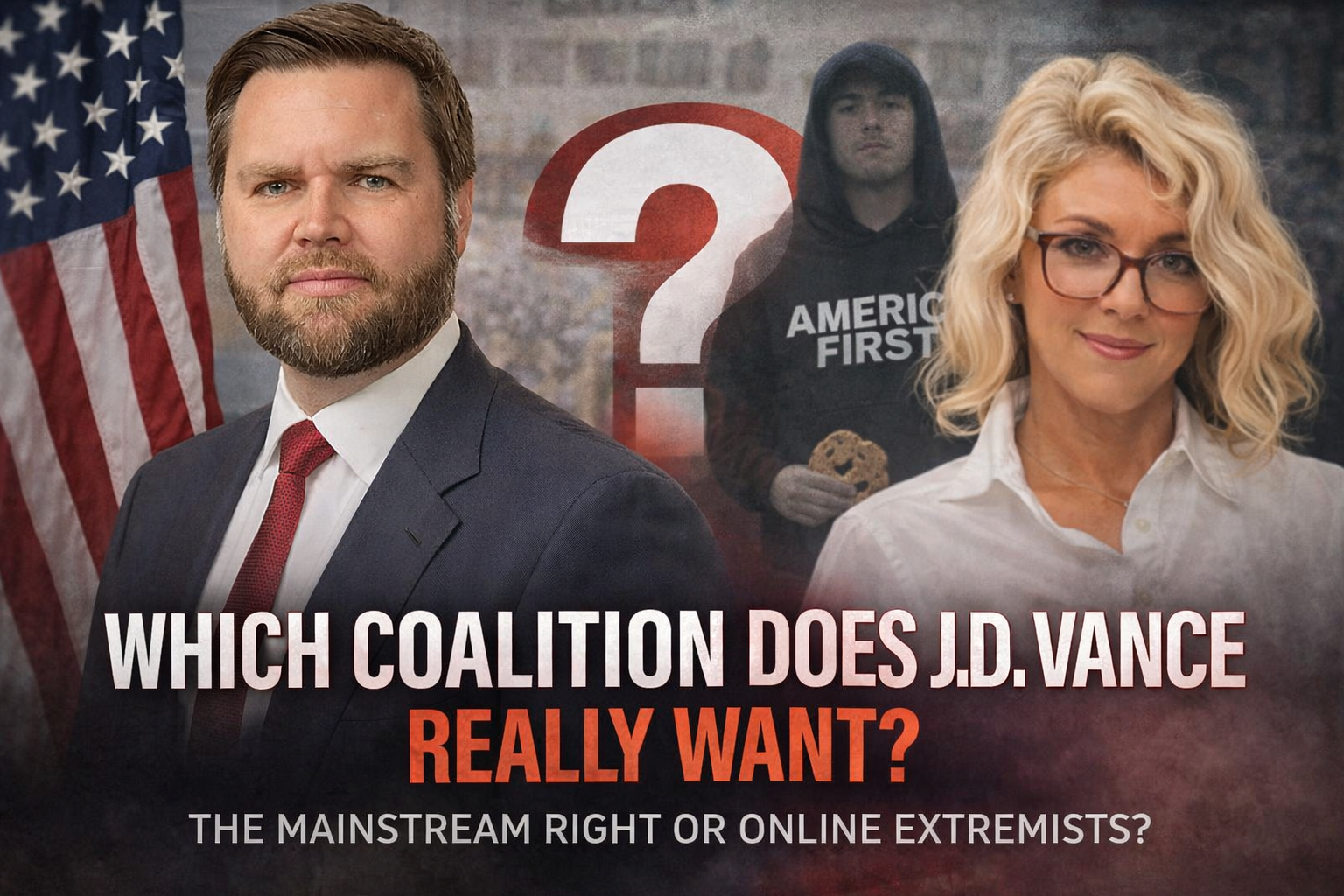
Few critics label J.D. Vance an antisemite. Instead, they fault his decision to align with figures who normalize anti-Jewish and Holocaust-revisionist ideas and point to his tendency to reserve his sharpest criticism for those who call out that drift within his coalition. Those decisions do not operate in isolation; they shape the direction, tone, and moral boundaries of the Republican Party in real time.
At Turning Point USA’s AmericaFest, Vance distilled his coalition-first approach into a single line, arguing that President Trump “did not build the greatest coalition in politics by running his supporters through endless, self-defeating purity tests.” But coalitions do not grow in neutral space. They expand toward something. And every expansion has a cost.
The pressure point sits at the intersection of three figures: Tucker Carlson, Turning Point USA, and the constellation of activists orbiting the far right. Carlson’s decision to host Nick Fuentes, a figure widely known for racialist and misogynistic rhetoric, forced a reckoning. The interview was not a passing controversy. It tested whether mainstream conservative leaders would draw a bright moral line or reinterpret the moment as an internal dispute.
Vance chose the latter path. When asked about Carlson, he declined to repudiate outright. “Tucker’s a friend of mine,” he said, adding that “the idea that his views are somehow completely anathema to conservatism, that he has no place in the conservative movement, is frankly absurd. And I don’t think anybody actually believes it.”
The remark stops short of endorsement, but it works to preserve the tent—even at the risk of stretching its fabric thin. By declining to draw a bright line, Vance shields the ecosystem that launders extremist rhetoric and recasts boundary-setting as overreaction rather than responsibility.
Optics reinforce the message. Carlson visited the White House twice in January 2026, joined a lunch with President Trump and Vance, and appeared in photographs with senior officials despite not appearing on the public calendar, according to reporting from Jewish Insider.
The asymmetry sharpens when measured against Vance’s rhetoric toward Jewish critics. His language toward figures such as Sloan Rachmuth, Laura Loomer, and Ben Shapiro has proven more heated and sustained than anything he has directed at Nick Fuentes — the white nationalist who publicly called him a “race traitor” and used a racial slur against his wife.
The contrast emerged most clearly in Vance’s exchange with Sloan Rachmuth, a Jewish investigative journalist. Rachmuth raised questions about Buckley Carlson — a senior aide to Vance and the son of Tucker Carlson — in light of public reporting about extremist rhetoric within Carlson’s extended family. She asked whether the administration had adequately addressed concerns about antisemitism connected to individuals within its orbit.
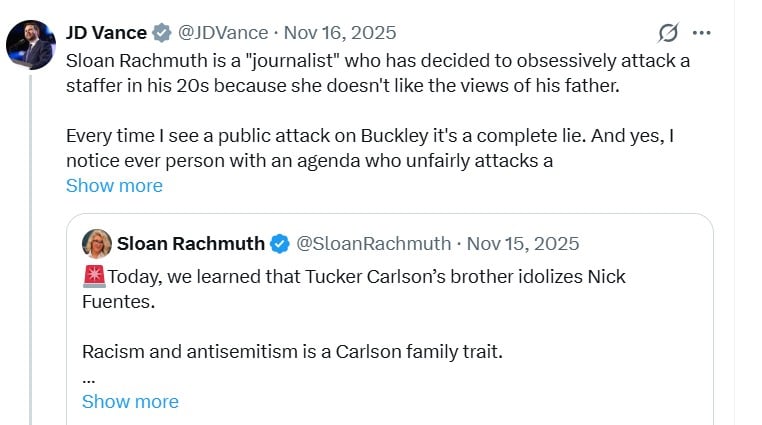
Vance responded not by engaging the substance of the question, but by attacking the questioner. “I have an extraordinary tolerance for disagreements and criticisms from the various people in our coalition,” he wrote. “But I am a very loyal person, and I have zero tolerance for scumbags attacking my staff.”
Rachmuth replied that Buckley Carlson serves as one of Vance’s top advisers and receives taxpayer funding. She argued, “defending Judeo-Christian values entails speaking out against the antisemitism that’s tearing our nation apart. It also involves questioning those at the highest level of government about their hires, and speaking truth to power when needed. Sir, shall I remain quiet while Jews like me are being targeted by massive media platforms, and while our country is being destroyed by hate?? Or can I continue to ask questions and fight against injustices without being unfairly questioned about my loyalty to my country? I look forward to hearing back from you.”
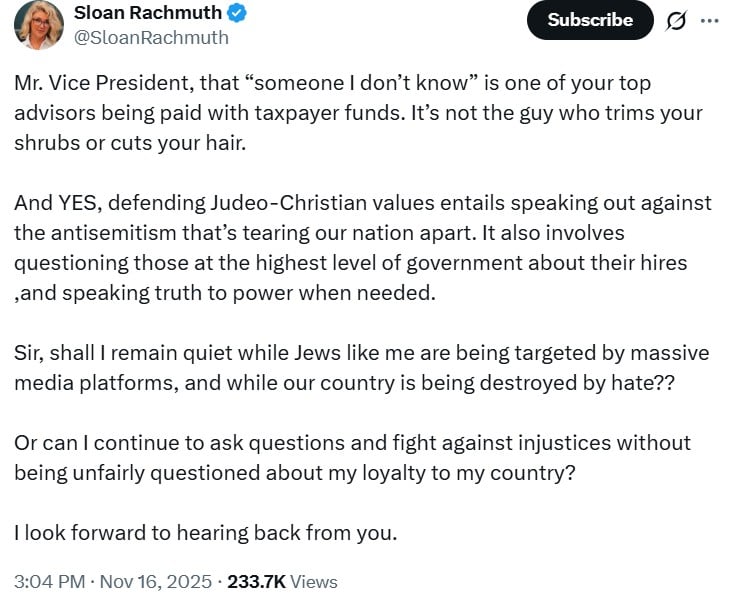
Buckley Carlson is not a junior intern. He is nearly 30 years old and occupies a senior advisory role. Yet Vance directed his harshest language at the journalist who raised the concern, not at the extremist figures whose rhetoric prompted it.
Rather than addressing Fuentes’s conduct directly, Vance folded the criticism into a broader denunciation that included left-wing figures such as Jen Psaki, reframing the episode as a generalized partisan controversy rather than one rooted in the right. That comparison collapses under scrutiny: Psaki never attacked his children’s Indian heritage or accused him of being a “fat race-mixer.”
In doing so, Vance recast criticism itself as the central threat to the Republican Party and suggested that silence is the appropriate response to white supremacists. The imbalance shifts responsibility away from those who traffic in racially charged bombast and instead places it on those who defend themselves and others—casting resistance as the cause of rising anti-Jewish sentiment. That logic has been echoed by figures such as Megyn Kelly, who argued that it is Jewish thought-leaders like Ben Shapiro and Bari Weiss who have created antisemitism, insisting that “Tucker Carlson is not making antisemites. They are.”
In this framework, Vance’s fiercest words fall on figures inside the coalition who threaten its cohesion, not on those at its edge who threaten its moral credibility.
Turning Point USA now serves as the staging ground for this tension. The organization does not operate on the fringe. It functions as the youth pipeline for modern conservatism. What it normalizes today becomes campaign infrastructure tomorrow.
At AmericaFest, Jack Posobiec, a TPUSA contributor, posed for a photograph with the far-right figure Myron Gaines, who wore a sweatshirt referencing a Nick Fuentes clip that compared Jews to cookies in an oven. Smaller accounts on X and rank-and-file conservatives condemned the image, while many prominent influencers remained silent. Gaines did not stand outside the event protesting; he gained entry and benefited from the institutional legitimacy that access confers.
Erika Kirk’s endorsement of Vance sharpens the stakes. On the opening day of the conference, she declared, “We are going to get my husband’s friend, J.D. Vance, elected for 48 in the most resounding way possible.”
The problem is not that the tent is expanding. The problem is that tents cannot grow without shifting. When the right slides its center of gravity to accommodate people who flirt with Holocaust denial or treat antisemitic rhetoric as based, it narrows the space for others. Suburban moms, Jewish voters, and minority communities watch the recalibration and vote accordingly.
Vance appears to believe that unity requires silence about extremist allies. That instinct misreads coalition math. Movements fracture not because they enforce standards, but because they refuse to articulate them.
If the party keeps shifting its tent rightward in the name of unity, it risks losing voters whom Trump persuaded to believe they had a place inside it. The Republican Party still has time to decide what kind of coalition it wants to be.
J.D. Vance stands at the center of that choice, whether he acknowledges it or not. He must decide what kind of coalition he intends to lead: a governing party that seeks durable national power or an online movement that trades institutional credibility for digital applause. One path builds a majority broad enough to win the White House. The other wins engagement metrics on X.