A Moroccan Journalist
How fusing Zionism with Judaism endangers the very people it claims to defend
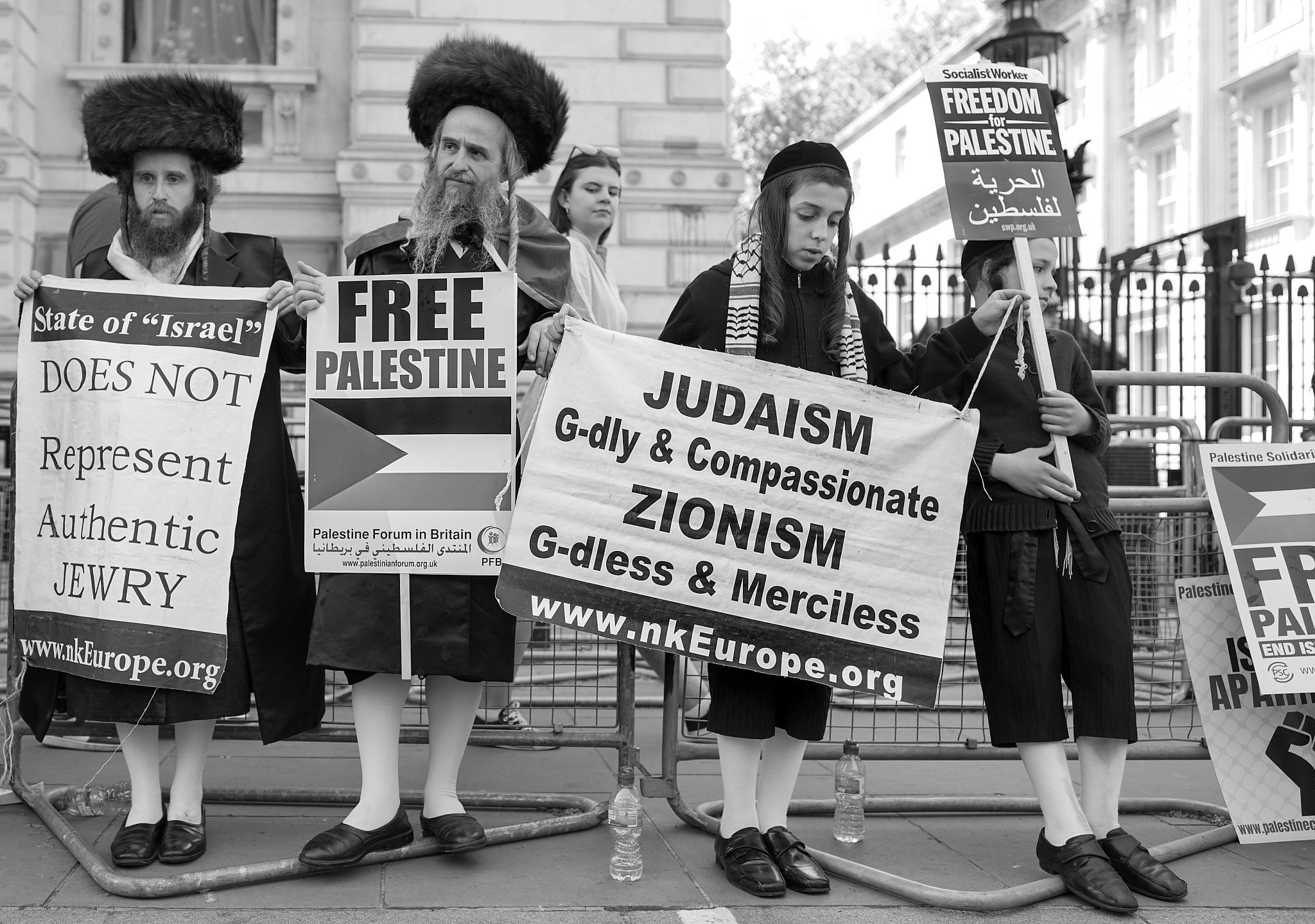
Orthodox Jews outside Downing Street protesting in solidarity with Palestine. On May 14, 2022, thousands assembled in London, both to commemorate the Nakba and also to protest the murder by the Israeli army of the veteran Al Jazeera journalist Shireen Abu Akleh. Alisdare Hickson / Wikimedia Commons.
For decades, the sentence you heard across the Arab and Muslim world was: we have no quarrel with Jews; our quarrel is with Zionists. Israel was the Zionist entity. The formula was often a fig leaf – I will not pretend otherwise. Plenty of men said it while meaning the older, uglier thing, and the distinction let them keep their reputations. It was a load-bearing fig leaf: imperfect, sometimes cynical, yet consequential. But embedded within it was a distinction that mattered.
A distinction that survives in a language leaves a door open in the mind, and people walk through doors that are left open. It was the difference between a politics and a hatred. It was, in the strict sense, the thing that protected Jews in our streets. It separated a faith and its adherents from a political project and its policies. That distinction is now collapsing, and the chief architects of its demolition are not the antisemites of the far right or the street protesters of the Global South. They are the very institutions that claim to speak for Jewish safety.
Israel’s systematic conflation of Zionism with Judaism – the insistence that the two are inseparable, that to criticize one is to assault the other – is not protecting Jews. It is painting a target on their backs.
Consider the parallel that Muslims know all too well. Islam is a faith practiced by nearly two billion people. Islamism is a political ideology embraced by a fraction of them. When Western governments, media outlets, and populist demagogues collapsed the distinction between the two after September 11, the consequences were catastrophic.
Sikh men were murdered for wearing turbans. Mosques were firebombed in Arkansas and Birmingham. A fourteen-century-old civilization was reduced to a security dossier. Muslims understood, viscerally, the cost of conflation: when a religion is made synonymous with its most politicized expression, every believer becomes a suspect.
Jews are now enduring a version of this same lethal logic – only this time, the conflation is being engineered not by their adversaries but by those who claim guardianship over their heritage. When Israeli officials declare that Israel is the Jewish people, when Western legislatures adopt definitions of antisemitism that treat opposition to Israeli policy as hatred of Jews, they do not shield Jewish communities in Paris, Buenos Aires, or Brooklyn. They expose them. They hand every aggrieved individual on earth a rhetorical shortcut: if the state says it acts in the name of all Jews, then all Jews become answerable for the state.
One might argue that Zionism, in its most elementary definition – the belief that Jews have a right to self-determination in their ancestral homeland – is inseparable from Jewish identity. Perhaps. But Zionism as lived, as practiced, as legislated into settlement blocs and siege warfare, bears little resemblance to that textbook abstraction. I have no quarrel with the idea of a refuge for a people hunted across Europe. My quarrel has never been with the idea. It is with what has been built in its name: the occupation, the dispossession, the ruin of Gaza. Ideas are not answerable for their consequences. States are.
The question was never whether Jews deserve safety and sovereignty. It was always about the means, the cost, and whose dispossession the project would require. Islam’s core tenets of justice and compassion are not discredited by the brutality of ISIS. Judaism’s profound ethical tradition should not be held hostage to the conduct of any government. To insist otherwise is not devotion. It is conscription.
I write from Morocco, a country where Jewish life is not a relic exhibited in museums but a living thread woven into the national fabric – in the mellahs of Fez and Essaouira, in the hilloula pilgrimages that draw thousands, in a constitution that enshrines the Hebraic tributary as a component of national identity. Before October 7, 2023, the sight of Jewish visitors in Marrakech’s medina drew little more than the curiosity one extends to any traveler. Social media posts featuring Moroccan Jews attracted comments about shared heritage, about coexistence, about the country’s pluralist tradition.
Then the war in Gaza began, and the conflation completed its work.
Today, scroll through any Moroccan social media post featuring a Jewish person – a tourist, a pilgrim, a citizen – and the comments are flooded with a single refrain: Free Palestine. Not because Moroccans have abandoned their historical tolerance, but because the rhetorical infrastructure erected by Israel and its allies has made it nearly impossible for ordinary people to see a Jewish face without seeing a political flag behind it.
The incident at Bab Doukkala in April this year crystallized this perfectly: a group of Hasidic Jewish visitors from New York, caught by the hour of prayer, performed their afternoon devotion beside the 12th-century gate of Marrakech’s medina. It was an act of religious obligation, nothing more.
Within a day, the video had crossed the country. It went viral, interpreted not as worship but as provocation, not as Judaism but as Zionism. Young men arrived with soap and water to scrub the stones, saying the site had been defiled. Protesters gathered carrying Palestinian flags, while others denounced the event as a deliberate affront and a form of political infiltration.
Some warned that Morocco could increasingly be drawn into Israel’s settlement-driven vision, invoking the Palestinian experience and fears that Moroccans could one day face claims to their homes based on ancient religious narratives. A wall that had stood for nine centuries, belonging to no faith and all faiths, was suddenly conscripted into the same geopolitical binary that Israel itself had built.
I want to be precise about what happened there, because I think it is happening everywhere, and because I think it is a catastrophe – not primarily for Morocco’s reputation, though it is that, but for Jews. Ten years ago, that prayer would have produced nothing. Not applause: nothing. Moroccans have lived beside Jews for two thousand years and beside the memory of Jews since most of them left. Nothing in April changed about the men or the wall. What changed was the reading – the reflex that now converts a Jew at prayer into a political act requiring a response.
This is the tragedy. Not that antisemitism exists – it has existed, monstrously, for millennia. But that a new pipeline has been constructed to manufacture more of it, and that the engineers are the very people who invoke Jewish suffering as their mandate. Every time an Israeli spokesperson says “an attack on Israel is an attack on the Jewish people,” a young man in Casablanca or Cairo or Dearborn who might once have distinguished between a synagogue and a settlement loses one more reason to bother.
Ezra Klein, the American commentator, put it with uncomfortable precision: “If you keep telling people that if they oppose the Jewish state then they must hate the Jewish people, eventually, they will believe you.” This is not a warning. It is a description of what is already happening.
Israel has spent these years insisting on the very fusion its enemies have always wanted. It declares itself the nation-state of the Jewish people. Its prime ministers claim to speak for all Jews everywhere. It maintains a ministry that folds the affairs of the world’s Jews together with the fight against antisemitism – the Jews of Sydney and Manchester filed as a portfolio of a state in which they do not vote. Every time Jerusalem says we act in the name of all Jews, it hands the antisemite the syllogism already assembled, and asks him only to supply the violence.
The cruelest irony is that Jewish communities around the world – many of whom hold vigorous, diverse, even anguished opinions about Israeli policy – are left to absorb the consequences of a conflation they never endorsed. Anti-Jewish hate crimes have surged worldwide since October 2023. Synagogues are vandalized not because congregants voted for any Israeli government, but because those governments have spent decades claiming those congregants as constituents.
A faith that has survived exile, inquisition, and genocide should not be reduced to the foreign policy of a single state. Jews deserve better. And the world – particularly the Muslim world, which has its own bitter experience with the cost of conflation – should be the first to say so.
Related Topics