
Middle East Analyst
How Hamas Gained Control of Gaza
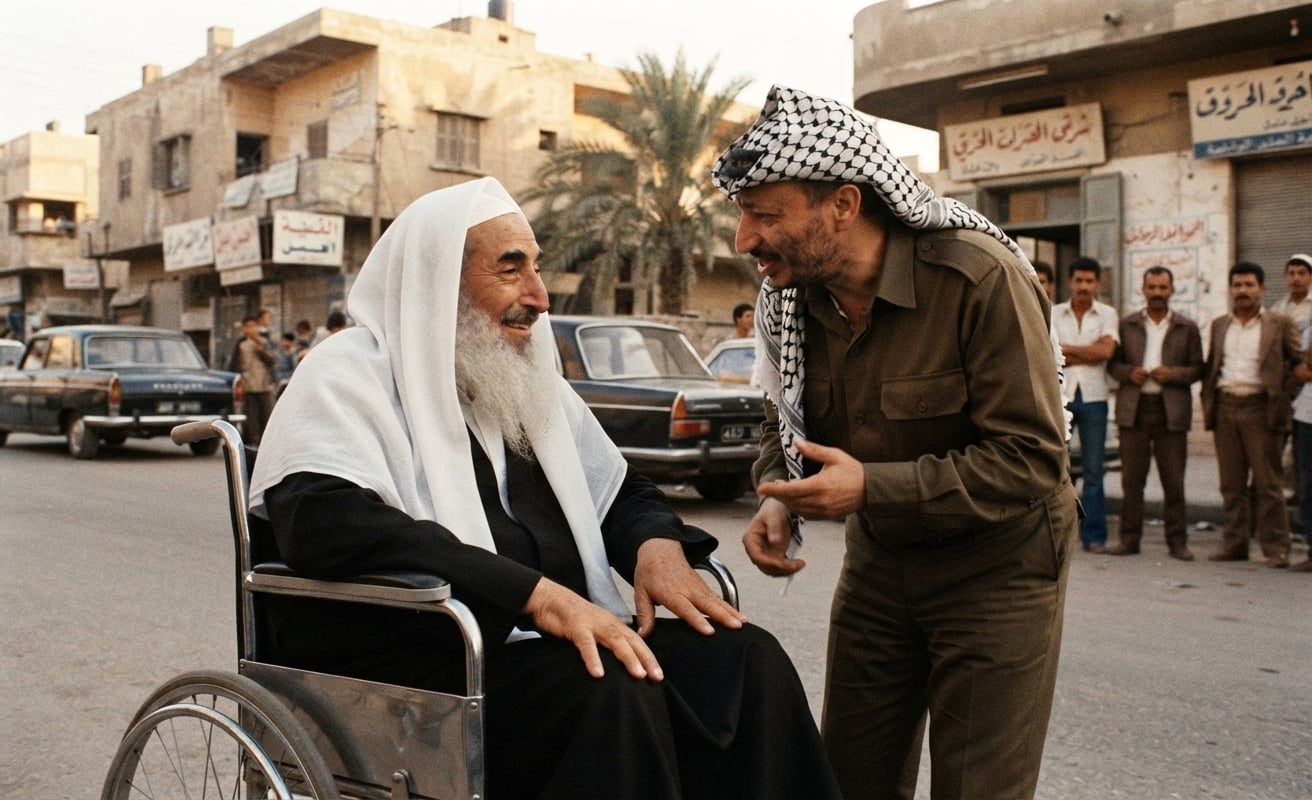
Sheikh Ahmed Yassin and Yasser Arafat (circa 1980) by author (AI)
From Charitable Network to Governing Power: The Legacy Infrastructure
Hamas did not appear in 1987 as a new organization improvising its way to relevance. It inherited a two-decade head start, and the officials responsible for building that head start are on the record about it. The Mujama al-Islamiya network that Israel’s military administration had licensed, financed, and shielded from PLO-style crackdowns since the late 1970s had already built the schools, clinics, mosques, and charitable committees that would become Hamas’s institutional skeleton. Yitzhak Segev, the Israeli Brigadier General who served as military governor of the Gaza Strip in the early 1980s, developed a personal friendship with Sheikh Ahmed Yassin, arranged Yassin’s medical treatment inside Israel, and later admitted to a reporter that he had helped finance Islamist movements specifically as a counterweight to the PLO and to communist factions active in Gaza at the time. Segev is the single most direct on-record source for Israeli financial facilitation of the network Hamas would later absorb.
The leniency extended beyond funding and into active operational cover: in 1986, IDF general Shalom Harari, who also served in Israeli military intelligence roles concerning the Palestinian territories, authorized Mujama-aligned students to engage Fatah-aligned students in a violent clash at Birzeit University, reportedly telling colleagues that if the two sides wanted to burn each other, they should be allowed to. When Yassin and his colleagues formalized Hamas at the outbreak of the first intifada the following year, they were not building a social base from nothing; they were relabeling and politicizing one that a serving Israeli military governor had helped finance and an Israeli general had helped protect from its rival. Israel’s strategic logic at the time was narrowly framed: a religious social movement focused on charity and education looked less dangerous than a nationalist movement organizing strikes and armed cells under PLO discipline. What that calculation failed to weight was the long-term time horizon. The PLO’s threat was immediate and visible. The Islamist network’s threat was structural and cumulative, and structural threats don’t register on a governor’s tour or an annual threat briefing the way a riot does — particularly when the governor himself was one of the people underwriting it.
Parallel Legitimacy Under Oslo
The 1993 Oslo Accords and the creation of the Palestinian Authority might have been expected to marginalize Hamas, which rejected the agreement outright and refused any role in the new PA structures. In practice, Hamas’s refusal to participate became an asset rather than a liability. The PA under Yasser Arafat, and later Mahmoud Abbas, absorbed the burden of governance, and with it the burden of governance’s failures: patronage networks that rewarded loyalty over competence, security services widely seen as serving factional and even Israeli-coordinated interests rather than Palestinian ones, and a visible gap between PA officials’ living standards and those of the population they governed. Hamas, sitting outside that system entirely, was free to keep running its parallel charitable network without owning any of the compromises Oslo required of the PA — coordination with Israeli security services, acceptance of a transitional rather than sovereign status, and the appearance, fair or not, of managing occupation rather than ending it. Every corruption scandal or security-coordination controversy that damaged Fatah’s standing did so without touching Hamas, because Hamas had structurally exempted itself from the arrangement that produced those scandals. This is the period in which Hamas’s popular legitimacy was actually built — not in a single election, but in a decade of comparative institutional performance where the PA’s compromises became liabilities and Hamas’s abstention became a form of credibility by default.
The Lebanon Precedent
Camp David’s failure in July 2000 is conventionally explained as a bilateral collapse between Barak and Arafat over Jerusalem, refugees, and territory. That account leaves out an event from seven weeks earlier that reshaped the political ground both men were standing on. Israel’s unilateral withdrawal from southern Lebanon in May 2000, driven by Barak’s own campaign pledge after the collapse of parallel talks with Syria, was received across the Arab world, and inside the Palestinian territories specifically, as vindication of Hezbollah’s armed resistance strategy rather than as an Israeli policy choice made on its own logic. Hamas moved immediately to claim that vindication as its own argument, not Hezbollah’s: if resistance had just forced an Israeli withdrawal without a single negotiated concession, then Arafat’s decade-long investment in a negotiated process looked, by direct comparison, like capitulation rather than strategy.
Dennis Ross, who led the American negotiating team at Camp David and has since characterized Hamas in multiple public interviews as having a sustained pattern of undermining Palestinian-Israeli breakthroughs at critical moments, places this episode in that broader pattern. Whatever the precise internal calculus inside Arafat’s delegation at Camp David, the negotiating team arrived already operating inside a Palestinian political environment that Hamas had actively reframed in the weeks prior, from one in which negotiation was the only credible path to statehood, to one in which the Lebanon precedent had just supplied a competing, and freshly successful, model. This is the mechanism that gets lost when Camp David’s failure is told purely as a story about maps and settlements: Hamas did not need a seat at the table to shape the summit’s outcome. It needed a rival Arab success story to point to at the exact moment Arafat was being asked to formally close the door on struggle, and Hezbollah had just handed it one.
Disengagement and the Vacuum
Israel’s 2005 unilateral withdrawal from Gaza, formulated under Ariel Sharon, was framed publicly as a security and demographic decision, removing settlers and soldiers from a strip of land that had become strategically costly to hold. Analytically, it also removed the PA’s central organizing rationale in Gaza specifically: the claim that only negotiation and security cooperation with Israel, conducted through the PA, could end the occupation. Once Israel left unilaterally, without a negotiated PA role in managing the transition, the PA’s model of incremental diplomatic gain looked less like a strategy and more like an approach Israel had simply bypassed. Hamas, by contrast, could and did claim the withdrawal as vindication of resistance rather than negotiation — an argument that required no diplomatic apparatus to make, only the fact of Israeli soldiers leaving, and one that echoed almost exactly the argument it had already made successfully once before, in Lebanon five years earlier. The vacuum this created was not primarily military. It was narrative. Gaza’s population had just watched an occupying power leave without the PA’s negotiating framework producing that outcome, at the exact moment Hamas’s competing model, now validated twice, offered a simpler causal story.
The 2006 Election and Its Misreading
Hamas’s victory in the January 2006 Palestinian Legislative Council election is the moment most retrospectives treat as the takeover itself, and this is where the standard narrative introduces its central distortion. The vote was substantially a referendum on Fatah’s governance record — corruption, factional patronage, and the compromises of security coordination — filtered through an electoral system that translated Hamas’s roughly 44 percent of the popular vote into a decisive legislative majority. It was not, by the available evidence, a mandate specifically for armed confrontation with Israel or for unilateral Gaza rule; polling and analysis from the period suggest a meaningful share of Hamas’s vote came from anti-corruption sentiment rather than ideological alignment with the Charter’s rejectionism. Israel and the international community responded to the election result with financial and diplomatic isolation of the new PA government, a response calculated to pressure Hamas toward moderation or collapse. What it produced instead was a year of unresolved dual authority — a Hamas-led legislature and cabinet operating alongside a Fatah-controlled presidency and security apparatus, each with genuine constitutional claims and neither willing to cede functional control. This is the strategic dynamic that gets lost when the election is treated as the takeover: 2006 conferred legitimacy without conferring control, and it was the attempt to resolve that gap, not the vote itself, that determined what came next.
The 2007 Seizure
The mechanism of actual control was not the ballot but the June 2007 armed conflict, in which Hamas’s Executive Force and allied militias moved against Fatah-aligned Preventive Security and National Security personnel across Gaza in a matter of days, seizing PA installations, weapons depots, and administrative infrastructure. This was a military and organizational operation, not a political one, and it succeeded for reasons distinct from anything the 2006 election explains. Fatah’s Gaza security apparatus had been degraded by years of factional rivalry, uneven training investment, and the perception among its own rank and file that they were being asked to enforce an unpopular and compromised authority. Hamas’s Executive Force, by contrast, had been built deliberately as a loyal paramilitary instrument in the year of dual authority preceding the takeover, giving it cohesion Fatah’s security services had lost. For Israel and the PA both, the strategic miscalculation was treating the 2006-2007 standoff as primarily a political negotiation to be managed through international pressure and funding leverage, when Hamas had already concluded, correctly as it turned out, that the dispute would be settled by whichever side controlled force on the ground in Gaza specifically. The result split the Palestinian national project geographically and institutionally in a way that has never been repaired: a Fatah-run West Bank operating under a very different security and diplomatic logic than a Hamas-run Gaza, each claiming to represent Palestinian national interests while unable to exercise authority in the other’s territory.
The Distinction That Matters
The conventional shorthand, that Hamas won an election and took over Gaza, compresses two decades of institution-building, a psychological rupture supplied by Hezbollah’s own example, and a discrete military campaign into a single event that never actually happened as such. Legitimacy accumulated gradually, through a comparative advantage Hamas never had to work hard to earn since it was largely conferred by Fatah’s own governance failures and, further back, by named Israeli officials who financed and shielded the network in its infancy. That legitimacy was decisively reinforced by two successive demonstrations, Lebanon and then Gaza itself, that unilateral withdrawal without negotiation was not only possible but repeatable. Control was seized suddenly, through an armed campaign against a rival Palestinian security apparatus, not through anything resembling constitutional process. Conflating the three obscures the actual lesson of Gaza’s political history: a movement can be financed into existence by the state it would later fight, spend decades acquiring further legitimacy by default, have that legitimacy validated by a neighboring proxy’s battlefield success at the precise moment its rival is being asked to renounce struggle for negotiation, and still require force, deployed at the right moment against a weaker rival, to convert all of it into actual governing control. Neither Israel nor the PA fully priced in that combination until it had already happened.
Related Topics