How Ideas Become Identities: From Radical Chic to Jihad Chic
Author’s Note: This essay has been brewing in my mind for months. It’s a little wonky, I’ll admit, but I hope it’s readable and maybe even relatable. Mostly, it’s an attempt to understand how ideas become convictions, and how convictions can quietly become part of who we are.
The older I get, the less interested I become in winning arguments.
I’m much more interested in understanding how reasonable, compassionate people can look at the same events and arrive at profoundly different conclusions.
We like to think we form our opinions by carefully weighing evidence and reasoning our way to a conclusion. Sometimes we do. More often, especially on complicated issues, the process is far messier. We inherit ideas from people we respect, institutions we admire, and communities we trust. Most of the time, that’s not only reasonable, it’s unavoidable.
But every so often, I find myself wondering whether that same process can also lead thoughtful people to conclusions they might never have reached if they had started with a blank slate.
Over the past year, one conflict has repeatedly drawn me back to that question: Israel and Gaza. The reason isn’t that I expect Israel to get every military decision right. Democracies rarely do. Nor is it because I doubt the reality of Palestinian suffering. I don’t. Anyone who can look at the images of dead children, grieving parents, and neighborhoods reduced to rubble without feeling a profound sense of sadness has lost something essential.
The question that keeps nagging at me is something else.
How can so many thoughtful, compassionate, well-educated people come to embrace ideas and movements whose values they would reject in almost any other context?
I don’t expect everyone to become a Middle East historian. I certainly haven’t become an expert on every issue that matters. The modern world doesn’t allow that. Every day brings another crisis demanding our attention and, apparently, our judgment. Ukraine. Artificial intelligence. Immigration. Climate change. Iran. Public health. Israel and Gaza.
No one has the time to master them all. So we do what every complex society has always done. We outsource much of the work of understanding the world. I trust my cardiologist to read an EKG. I trust TurboTax to understand the tax code. I trust the engineer who designed the bridge I drove across this morning.
Public life works the same way.
Most of us are never going to read original historical documents, military doctrine, academic journals, or competing legal analyses before forming an opinion. We have jobs, families, aging parents, grandchildren, mortgages, and lives to lead.
So we depend on others to help us make sense of an increasingly complicated world. We notice Pulitzer Prizes, prestigious universities, respected historians, newspapers with long-established reputations, and friends whose judgment has proved reliable over time. We don’t do this because we’re lazy. We do it because no one can become an expert in everything.
For much of the twentieth century, the list of trusted guides was relatively short. Newspapers. Universities. Historians. Journalists. Authors. The evening news.
Today that landscape is almost unrecognizable.
Those institutions still matter, but they now share the stage with podcasts, documentaries, think tanks, advocacy organizations, Substack writers, YouTube channels, TikTok, Reddit communities, influencers, and whatever happens to appear in our social media feeds.
The sources have multiplied. Time hasn’t. That simple reality has changed the way ideas move through our culture.
A few months ago, while thinking about all of this, I found myself remembering a book I first read in a Journalism 101 class more than forty years ago.
Tom Wolfe’s Radical Chic.
Published in 1970, it was Wolfe’s hilarious account of Leonard Bernstein hosting an elegant fundraiser for the Black Panthers in his Park Avenue apartment. Wealthy Manhattan elites sipping cocktails while entertaining self-proclaimed revolutionaries in black berets and paramilitary garb was almost too perfect for satire.
Most readers remember the Panthers. Wolfe’s real subject was the people pouring the cocktails. He understood that the Panthers simply happened to be the fashionable revolutionaries of the moment.
I remember laughing at Wolfe’s wit. What I didn’t appreciate at the time was that he was describing a social process that feels even more recognizable today. He wasn’t really writing about revolutionary politics. He was writing about how ideas acquire social status. Half a century later, I found myself wondering whether the phenomenon had simply found a new object. The fashionable causes have changed. The social process has not. In some circles, Radical Chic has given way to what I can only describe as Jihad Chic. The black berets have largely given way to keffiyehs, but the social incentives Wolfe described remain surprisingly familiar.
And that observation reminded me of another book from a completely different world.
In Crossing the Chasm, marketing maven Geoffrey Moore asked why some new technologies remain niche products while others “cross the chasm” to suddenly become mainstream. Moore was interested in products. Wolfe was interested in culture.
I found myself wondering whether they were really describing different parts of the same phenomenon. Different subject. Similar question. How do ideas cross the chasm? Not simply how they spread, but how they move from one opinion among many to something that feels almost beyond question.
How do they become our moral assumptions?
The easy answer is social media. But I don’t think that’s the right answer. Social media accelerated the process. It didn’t invent it. Wolfe saw the same phenomenon more than fifty years ago, long before algorithms, influencers, or viral videos. Certain political commitments had already become socially valuable. They communicated something about the people who embraced them.
Eventually, I realized I wasn’t really asking whom we trust. I was asking how ideas become legitimate in the first place.
Most of the time, that system works remarkably well. Serious historians generally know more history than I do. Experienced military analysts usually understand warfare better than I ever will. Most respected journalists care deeply about getting the facts right. A healthy society depends on people with expertise.
I eventually found myself picturing that process as a kind of journey. Ideas don’t simply spread. They move through a series of stages that gradually transform them from one viewpoint among many into something that feels like part of who we are. For some people, they don’t stop there. They become moral assumptions.
Perhaps this is just the consultant in me. I have a habit of thinking in PowerPoint. So this is the model that eventually emerged from all my wonky thinking:
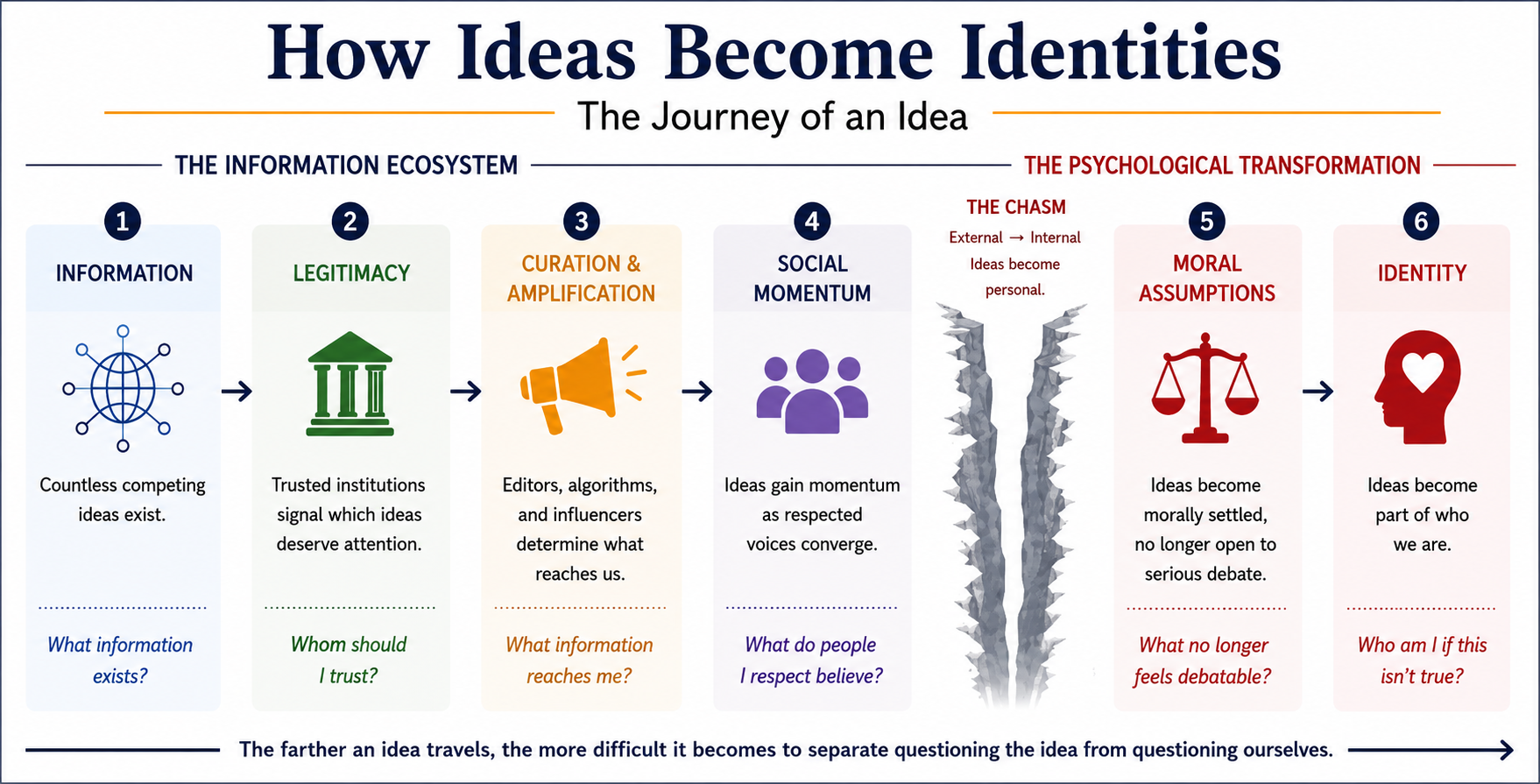
Ideas begin in a vast ecosystem of competing information. History, scholarship, journalism, legal analysis, military doctrine, eyewitness accounts, books, interviews, and countless competing interpretations all contribute to our understanding of the world.
No individual can absorb all of it. Before we can even begin deciding what is true, we first have to answer a more practical question:
Whom should I trust?
That is where legitimacy enters the picture. Trusted institutions help us answer that question.
Scholars write books. Journalists investigate and interpret. Universities teach. Think tanks analyze. Documentary filmmakers, podcasters, and public intellectuals translate specialized knowledge for a broader audience. That is not a bug in the system. It is one of civilization’s greatest strengths.
When a renowned Holocaust historian publicly concludes that Israel is committing genocide, many readers understandably assume the question has largely been settled. They have neither the expertise nor the time to independently evaluate military law, operational realities, intelligence assessments, or competing historical interpretations. The system is doing exactly what it was designed to do. It has answered the question before we’ve had the chance to do the homework ourselves. Whether that conclusion ultimately withstands careful scrutiny is a separate question entirely.
Of course, no information ecosystem is perfect. Bad-faith actors exist, and history is full of propagandists, political operatives, governments, and ideologues who deliberately manipulate information for their own purposes. They matter, and they deserve to be exposed. But they are not the focus of this essay. I’m interested in the much larger number of thoughtful, well-intentioned people who are trying to make sense of an overwhelmingly complicated world.
The journey doesn’t end with legitimacy. Once trusted institutions have helped us decide whom to trust, another process begins. Some ideas receive greater attention than others. Some voices become more influential. Others quietly fade from view. The interpretations that remain become more familiar than their competitors.
For most of us, however, the challenge is different. We are trying to make sense of a world that contains far more information than any one person can possibly absorb.
Today, another powerful filter has been added. Human judgment now works alongside algorithmic curation and amplification. Editors ask what is important. Algorithms ask what is engaging. Together they quietly answer another question:
What information actually reaches me?
By the time an idea arrives in front of us, it has already passed through several layers of human judgment and technological selection.
Over time, some ideas gather social momentum. We begin noticing them everywhere. They are repeated by institutions we respect, by people we admire, and by communities we value. Without quite realizing it, we begin answering another question:
What do people I respect believe?
That, I think, is how ideas cross the chasm.
The transition is subtle but profound. An idea no longer feels like one viewpoint among many. It begins to feel like the moral starting point for any reasonable person.
Tom Wolfe understood part of this process. His targets were largely performative. They embraced fashionable causes because those causes elevated their cultural standing. His satire landed because he recognized the social incentives at work.
Today’s world feels more complicated. Certainly there are still performers, and social media rewards them every day. But I do not think most people are performing. I think they are trying to make sense of an overwhelmingly complicated world by relying on institutions and individuals they have good reason to respect.
That is precisely why the process is so powerful. Most people are not trying to embrace falsehoods. They are trying to be good.
And that is where the real transformation occurs. The question is no longer:
What do people I respect believe?
It becomes:
What kind of person am I if I no longer believe this?
Once a belief begins answering that question, changing our mind no longer feels like learning. It feels like losing a part of ourselves. That is the moment an idea stops functioning as an opinion and becomes part of our identity.
We do not simply defend an opinion…..we defend ourselves.
Now let’s return to the war in Gaza.
Some readers may have been thinking throughout this essay, “You’re making this far too complicated. I don’t need to read stacks of books to know that thousands of innocent civilians, including women and children, have been killed in Gaza. Israel is the stronger power. Whatever happened on October 7, this has to stop.”
I understand that reaction. In many ways, it is the most human reaction imaginable. Empathy is exactly where we should begin.
It just should not be where we stop.
Compassion tells us that suffering is real. It does not tell us why it happened. It does not tell us what choices produced it. It does not tell us what alternatives existed. And it does not tell us which decisions today are most likely to produce less suffering tomorrow.
Those are different questions. They require inquiry. Consider one small example.
Twenty-five years ago, the image of bloodstained hands belonged to one of the most horrifying moments of the Second Intifada. Two Israeli reservists accidentally entered Ramallah, where they were beaten to death by a mob. One of the killers appeared at a window triumphantly displaying his blood-covered hands to the cheering crowd below.
Today, a stylized version of that image has appeared on protest signs, social media, and even at celebrity events as a symbol of moral commitment. I found myself wondering how a symbol could travel so far while becoming so detached from the history that gave it meaning. It also made me wonder why so many people who are deeply sensitive to the historical wounds of other communities seem unaware that this symbol carries profound historical trauma for Jews.
None of this should be understood as placing Israel beyond criticism. It isn’t. Democracies make mistakes. Military operations deserve scrutiny. Governments should be held accountable. Civilian suffering should never be minimized or ignored.
Nor am I suggesting that empathy for Palestinians is somehow misplaced. It isn’t. If our hearts are not broken by the suffering in Gaza, something important has been lost. My concern is different.
Too often, empathy becomes the destination rather than the starting point. The images become the argument. The casualty count becomes the conclusion. Questions that might complicate the moral narrative begin to feel unnecessary, or worse, morally suspect.
Inquiry insists on asking different questions:
Who started the war?
What objectives does each side seek?
How does each side wage war?
What incentives shape their decisions?
What would happen if Hamas laid down its weapons tomorrow?
What would happen if Israel did?
Those questions do not diminish anyone’s suffering. They are the questions that responsible people ask precisely because suffering matters.
If I’ve learned anything from wrestling with this question, it’s that forming an opinion and understanding a problem are not the same thing. One can happen in an afternoon. The other may take years.
I still rely on experts. I still depend on institutions. I still trust people who have devoted their lives to understanding subjects I’ll never fully master. I don’t think there’s another way to live in a world this complicated.
What has changed is not whom I trust. It’s how tightly I hold my own conclusions. If questioning one of my beliefs begins to feel like questioning who I am, I’ve probably crossed the very chasm this essay describes.
Empathy and inquiry are not competing virtues. They need one another. Empathy reminds us that suffering deserves our attention. Inquiry asks why that suffering exists, how it came to be, and what choices might reduce it in the future. Without empathy, inquiry can become detached. Without inquiry, empathy can become certainty before understanding.
If wrestling with this question has persuaded me of anything, it is that the greatest challenge is not learning new information. It is remaining willing to reconsider old conclusions.
Empathy should be the beginning of inquiry…
not the end of it.