
Urban Planning and Environmental Design Scholar
How Iran’s Hidden Military Footprint Is Draining the Water Resources
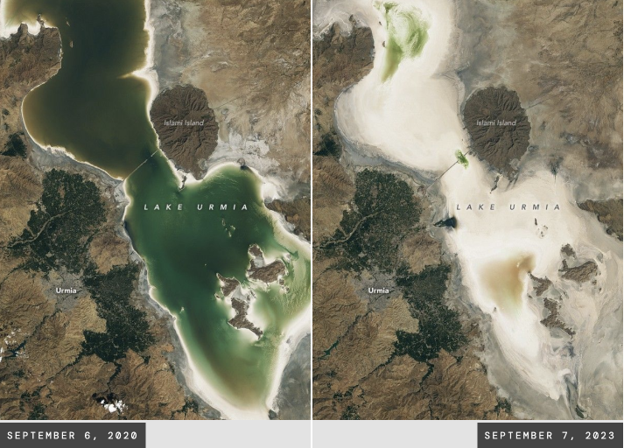
Lake Urmia shriveling ( NASA Earth Observatory)
Coverage of Iran’s strategic ambitions has focused heavily on missiles, nuclear capabilities and military infrastructure. Far less attention has been paid to the rivers, groundwater and wetlands on which millions of people depend. For over four decades, the Islamic Republic has framed its severe water crisis around civilian overconsumption and climate change, placing much of the responsibility on how people use water. This narrative leaves less room to scrutinise how water resources are managed.
From an environmental planning perspective, the crisis is also linked to decades of landscape mismanagement and the expansion of large-scale, military infrastructure. One study estimated that Iran lost roughly 74 km³ of groundwater between 2002 and 2015, due to overextraction. The subterranean vacuum left behind has triggered a visible structural collapse, with a nationwide satellite survey mapping 56,000 km² affected by land subsidence, including 3,000 km² sinking above 10 cm annually.
Nowhere are these consequences more visible than in Isfahan, where urban water resources and strategic infrastructure occupy the same vulnerable landscape. The Zayandeh-Rud River flows through the city toward the Gavkhouni Wetland, sustaining the entire landscape along its course. The Zayandeh-Rud and its wetland are severely affected by Iran’s water crisis; if they dry out completely, the entire basin will destabilize. This ongoing crisis directly correlates with the severe annual subsidence already observed in Isfahan Plain from 2015 to 2022. The consequences are now visible at street level through repeated road collapses and large sinkholes. While officials attribute these incidents to aging pipeline leaks, seismic data reveal that regional ground sinking is damaging underground networks, exposing the metropolis and its 3.3 million residents to direct hazard. Open-source data reports that this unstable landscape overlaps with strategic military infrastructure, most notably Esfahan North Missile Base near Najafabad, which are both part of the Aerospace Force facilities of the Islamic Revolutionary Guard Corps (IRGC). The Base itself cannot be identified as the sole cause of the subsidence; however, water-intensive activities associated with missile production clearly have contributed to groundwater depletion and, consequently, to the land subsidence observed in the surrounding area.
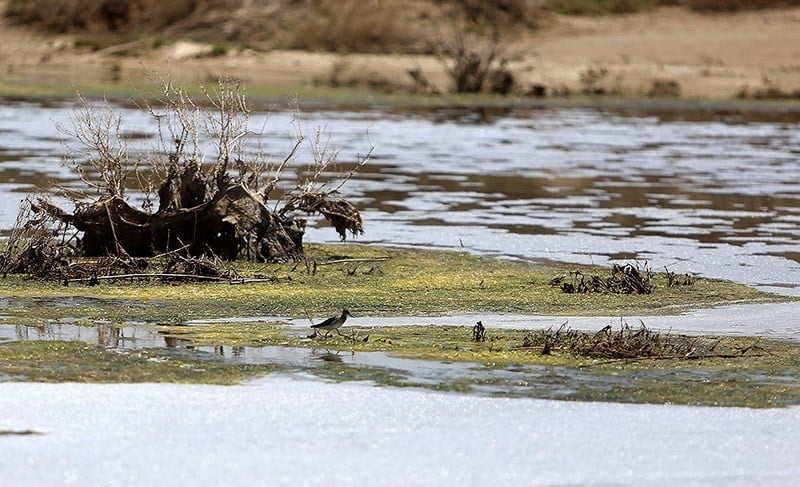
Further north, the Lake Urmia collapse presents another dimension of Iran’s water crisis: how a centralized water system management can fail an entire basin. Far from an isolated water body, the lake forms a wider landscape connected to seasonal rivers, regional wetlands and nearby cities. As the lake has declined, the effects have spread across the basin, changing its environmental conditions. Satellite imagery clearly documents the dramatic reduction in Lake Urmia over recent years. Tabriz, a city near the lake, also contains major underground missile infrastructure, including the Amand and Southwest Tabriz Missile Bases . Open-source assessments also identify both sites as IRGC Aerospace Force facilities associated with ballistic-missile storage and launch operations. Their water-intensive activities represent an additional pressure on the basin’s already depleted water resources, contributing to the wider decline of Lake Urmia.
The Karaj basin offers a third example of the crisis, showing how the Islamic regime’s mismanagement has exacerbated the country’s worsening water problems. Its basin is part of the water-supply system serving metropolitan Tehran. The B1 bridge, which crosses the Karaj River, was struck by U.S. forces in April 2026 as part of an operation aimed at disrupting a reported supply route for IRGC missiles to launch sites. Beyond the military operation itself, the incident exposed a broader vulnerability: civilian and military infrastructure share corridors that are also integral to major water systems, the vital lifelines sustaining over 16 million in the capital area.
These cases illustrate the deterioration of Iran’s water resources under decades of environmental mismanagement, a trend underscored by the Department of Environment’s August 2026 report that 70 percent of the country’s wetlands face severe water shortages. This ecological tragedy marks a stark reversal of Iran’s past. During the Pahlavi era, Iran was a global leader in protecting nature, famously hosting the historic 1971 Ramsar Convention. This milestone created the world’s very first international agreement to protect wetlands. Back then, Iran pioneered a forward-thinking approach that treated water systems not as targets for military or industrial exploitation, but as a part of the country’s heritage and long-term economic survival. Today, healing this environmental crisis requires putting ecological planning at the center of the country’s survival. However, carrying out such a massive rescue plan is impossible under the current regime. A government whose survival depends on hidden military projects, widespread corruption, and total environmental neglect cannot be trusted to protect the nation’s dying landscapes.
Only a fundamental political transformation can open the door to transparent water accounting, science-based spatial planning, and advanced technical solutions. Alongside Iran’s environmental crisis, devastating economic and political crises have fueled several nationwide uprisings over the past decade. These pressures have also contributed to the emergence of a strong opposition movement outside Iran. Under the leadership of Crown Prince Reza Pahlavi, son of the late Shah of Iran, the opposition has worked systematically with experts in the diaspora to develop the Iran Prosperity Project (IPP), a detailed plan for addressing these crises and rebuilding the country. In April 2023, Crown Prince Reza Pahlavi also made a historic visit to Israel, delivering a message of peace and friendship between the people of Iran and Israel. Beyond its diplomatic resonance, the visit carried a strong practical focus on environmental sustainability, highlighted by his tour of the Sorek desalination plant. This vision aligns with the IPP, which outlines a comprehensive regional blueprint for sustainable water management, infrastructure modernization, and ecological restoration across the country. The survival, sovereignty, and democratic rebirth of Iran cannot be separated from the physical liberation of the land itself. Restoring Iran’s water landscapes secures the foundation of its democratic future.
–
By Soma Alikhani and Shabnam Nikbakhsh
Related Topics