
How Israel is Leading the Charge Against SaaS Sprawl
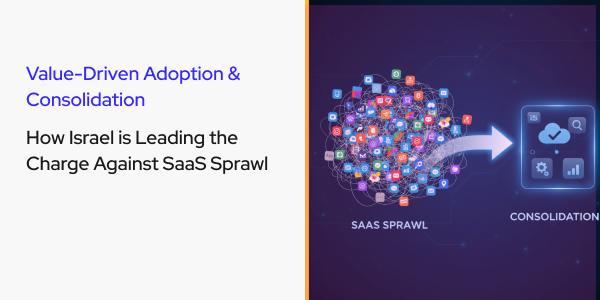
In the 3rd decade of the 21st century, global business has largely been defined by digital transformation, but amid the recent deluge of automation and AI-driven tech, especially, the transformation imperative has taken on greater urgency. For fear of missing out on the next big thing and losing ground to competitors, many companies have applied an “adopt first, ask questions later” approach, seeking to implement new software tech at virtually every opportunity.
This has given rise to one of the biggest operational challenges facing enterprises today “SaaS Sprawl”. In fact, research indicates that as much as 48% of enterprise apps go unmanaged, meaning that things like usage, licenses, renewals, and compliance aren’t properly monitored. Aside from the elevated risk from third-party threats, something I discussed in a recent piece, this sprawl comes with considerable cost in the form of revenue leakage. It seems enterprises have reached a critical inflection point in their digital transformation journeys; however, attitudes have begun to shift.
The shift to value-driven adoption
With operating costs consistently rising, stakeholders are becoming more concerned about revenue leakage. Those tasked with overseeing digital transformations – CIOs, CISOs, and CTOs – are being asked to justify their choices with a clear value proposition for the tools they implement. The narrative around digital transformation has shifted, with sustainability becoming integral to how enterprises think about it.
Rather than getting carried away with thoughts of what a new tool can do, smart companies are asking, “What tangible value will this tool yield, and is it worth it?” Companies now know from experience that the economics of digital adoption run far deeper than just SaaS subscriptions. Decision-making frameworks are taking factors like implementation, onboarding, and ongoing maintenance and support into account to understand the total cost of ownership over each tool’s lifetime.
The result of this evolving mentality is that enterprises are becoming more cautious and taking a more tentative approach to bringing new tech on board. That is not to say that digital transformation spending has slowed down – in fact, it’s still on the rise and projected to reach $4 trillion globally by 2028 – but spending is undoubtedly becoming more strategic and considered.
From complexity to clarity
At a time when everyone has access to cutting-edge software, forward-thinking organizations recognize the true cost of scattergun adoption and are focusing on building lean tech stacks that yield maximum ROI. Superfluous tools are being cut out, and vendor and tech consolidation are trending.
Amid all this, Israeli tech leaders have stood out in how they have adapted to the shifting enterprise landscape. Take Monday, for instance. What started out as a project management tool has evolved dramatically with maturity, such that it is now an all-in-one operating system for enterprise-level businesses.
Rather than requiring clients to integrate their project management tools with tools for other functions resource planning or approvals, Monday has consolidated all of those functionalities within their platform. This has fundamentally changed its value proposition by transforming its offering into one that enhances productivity and cuts costs simultaneously. Decision-makers at Monday clearly recognized which way the wind was blowing, and the value of their insight is reflected in the company’s strong year-on-year growth.
Another strong example is Wiz. Driven by Israeli innovation, Wiz has become a powerhouse in the cybersecurity sector. With a reported ARR of $500 million, stakeholders turned down a $23 billion offer from Google in July, with the CEO announcing that sights are set on an ARR of $1 billion before an IPO. This is by no means beyond the realms of possibility. The company has enjoyed rapid growth of late, and it’s no coincidence that it has done so on a platform of tool consolidation, providing an offering that unifies and centralizes cloud security management for clients.
SAP’s acquisition of WalkMe highlights a similar recognition of evolving priorities. By incorporating WalkMe’s market-leading digital adoption platform into its offerings, SAP will provide clients with enterprise-grade solutions with intuitive, high-grade onboarding capabilities integrated from the get-go. That means less time and money spent on implementing different tools and getting them to work together, and a single point of contact for support and maintenance.
At a time when IT sprawl has become a real concern for enterprises, value-driven adoption has emerged as the way forward. More and more, organizations are looking to streamline their stacks by consolidating tools and vendors, and Israeli tech is at the heart of that movement.
Israeli identity at play
Amid the great tech reset that has swept the world over the past couple of years, Israeli tech has remained resilient. In response to more cautious spending across the global market, Israel has solidified its place at the top table of enterprise tech, and much is owed to the inherent outlook of our tech innovators.
Coming from a small nation with a strong start-up spirit, Israeli tech entrepreneurs have always had a knack for building things that provide tangible solutions to real-world problems. Moreover, they’ve always understood the importance of value-first thinking, resource efficiency, and the importance of staying lean. Small teams, short timelines, and narrow margins – these are all obstacles that Israeli tech companies have excelled in overcoming, succeeding where others would fail. So, it makes sense that Israeli tech should be setting trends in the current climate.
In the aftermath of the initial digital transformation rush, enterprises the world over are coming to the realization that more tech, or even more sophisticated tech, isn’t always better. What matters is having tech that actually delivers tangible benefit. This is something that Israeli innovators have long since understood, so they have naturally emerged as leaders amid this recalibration of enterprise thinking.
Final thoughts
Enterprises have become inundated with tech, and they’re quickly realizing that the cost is unsustainable. Looking ahead, the companies that dominate their markets won’t be the ones with the biggest digital toolkits, but those with the most efficient ones. We are entering a new era of digital transformation, one in which complexity is seen as what it truly is – a needless cost multiplier – and where value-driven adoption is prioritized. If the previous decade was characterized by technological expansion, the next will almost certainly be defined by consolidation, and Israeli innovation is sure to be at the forefront of developments.