

Philosophy, kabbalah, screenwriting...
How Long Does Solidarity Last After the Tragedy in Venezuela?
Being an influencer who explains mathematics seems impossible. Hannah Fry has managed to do it. If you teach at the University of Cambridge, are invited to deliver TED Talks, serve as a BBC anchor, and possess charisma, you’ve already won half the battle. But if your favorite subject happens to be the mathematics of love, you will be truly blessed by the algorithms.
Hannah Fry posits that we fall in love through biological optimization algorithms seeking the best possible partner. The brain evaluates risks and measures initial relationships as a benchmark before choosing a love that exceeds that average, calculating probabilities to ensure stability and reproductive success. Love endures thanks to constant calibration and a low tolerance for negativity—when a couple communicates and immediately addresses minor daily friction before a destructive inertia can build up.
Mutatis mutandis, a mathematical model for loving thy neighbor and showing solidarity with earthquake victims in Venezuela appears in evolutionary game theory, in “reciprocal altruism,” and in “Hamilton’s rule”: help flourishes if the collective benefit outweighs the individual cost. Robert Axelrod and Martin Nowak explain that solidarity during a crisis—such as in Venezuela—is a collective survival strategy. However, this initial outpouring drops exponentially toward social fatigue if it is not institutionalized to mitigate wear and tear.
Solidarity is easy to preach, but so far, no models exist to make it economically sustainable over the long term; its sustainability threshold is very low. The curve of public and private assistance and reconstruction must rapidly outpace the decline in public expectations, under penalty of severe unrest, social upheaval, or total anomie.
Suppose we are not in Venezuela and that the response from the State, citizens, and politicians is remarkably efficient; that despite political transition turbulence, articulated reconstruction agreements are reached; that the Marshall Plan led by Trump and his successor Marco Rubio works seamlessly; and that multilateral, national, and international private investment is abundant.
Even under those ideal conditions, Ricardo Hausmann, Oxford Economics, the World Bank, and the IDB estimate a window of 2 to 3 years just to rebuild basic emergency services, and 12 to 18 years to recover pre-crisis productivity, industry, and sustained consumption.
Solidarity cannot hold out that long, even if led by the Catholic Church. And perhaps that is precisely the problem: viewing solidarity merely as charity—where the giver is promised heaven, and the suffering recipient is promised a better life, also in heaven. But in this harsh world, the giver eventually runs dry, and the receiver ends up a permanent refugee within their own homeland.
Can solidarity be converted into social capital, into new models for generating national wealth? Can volunteers transform their hours of dedication into assets that offset burn-out? Could those with nothing left but their hands in shelters and neighborhoods invest hours into paid volunteer work? That would make long-term volunteering truly worthwhile.
In 1980, Edgar S. Cahn, a Jewish scholar from New York, conceived the Time Dollar System (TDS) at the London School of Economics—a bank where you accumulated volunteer hours valued at $1 per hour, exchangeable for hour-dollars from any other volunteer. You could provide an hour of pediatric care and receive an hour from a gardener or eldercare provider in return. In Chicago, the experiment functioned into the 1990s, but its scale remained small and fragile due to a lack of reliable validation mechanisms. There were no smart contracts or tokens back then, only Excel spreadsheets and the word of volunteers.
To make it work today, the model would need to be scaled up using organizational networks with high levels of social awareness and trust, turning TDS into a viable local and national alternative accessible via a mobile phone app, much like instant digital payments. A mother in the neighborhood sweeping street pavements or a mason repairing a school wall could accumulate hours redeemable for food or medicine. As John Lennon famously sang, “Imagine.” At this point, what else do we Venezuelans have to lose? If anything, we could help build a new world.
The Diplomacy of Action and the Water Bottleneck
Nevertheless, the mathematics of altruism also register extraordinary moments of sudden breakthrough. When the earth shook in Venezuela, altruism crossed international borders in its purest form. The arrival of Israeli search, rescue, and support teams became one of the most moving demonstrations of loving thy neighbor in our country’s recent history.
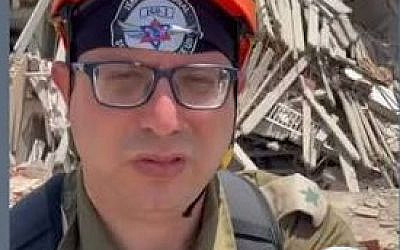
Seeing Major Roni Kaplan, acting as spokesperson for the Israel Defense Forces (IDF), coordinating field logistics alongside the spiritual guidance of Rabbi Cohen brought far more than technical expertise and operational capacity—it brought hope. The symbolic impact was immeasurable: the Central University of Venezuela (UCV)—which for decades operated as a political stronghold of anti-Israeli and pro-Chavista rhetoric—swung its doors wide open to extend a warm institutional and academic welcome. Human reality and the urgency of saving lives shattered years of ideological prejudice in a matter of hours. On the battered streets of La Guaira, the public’s response was unmistakable: the people love them. Not because of geopolitics, but because of the humanity shown in our darkest hour.
Yet here we return to the core of the mathematical dilemma: solidarity has an expiration date.
The initial emergency phase has passed, and applause fades before the pressing demands of daily survival. Today, the real enemy in La Guaira is thirst. The traditional water infrastructure and pipelines have collapsed; relying on water trucks or waiting years for obsolete conduits to be repaired is simply not enough.
For solidarity not to expire, it must evolve into sustainable engineering solutions. We must shift the paradigm: stop trying to channel water down from the mountains and start generating it where the people are—on the coast. La Guaira sits directly on the Caribbean Sea, and the definitive answer lies in the large-scale installation of state-of-the-art desalination and water purification plants.
This is where the equation points right back to its origin. Israel is the undisputed global leader in water technology, desalination, and smart water management under extreme scarcity. If the first phase was rescue among the rubble, the second phase must be the reconstruction of life through technology.
Once again, we need Israel. Not only to save lives in the aftermath of an earthquake, but to sustain them day after day. We waited for you, we applauded you at UCV, we love you in La Guaira, and today, with our eyes fixed on the sea, we continue to call on you.