North Carolina Jewish Writer Exploring Antisemitism, Israel and Faith
How (not) to award a Nobel Peace Prize: A satire in 4 acts
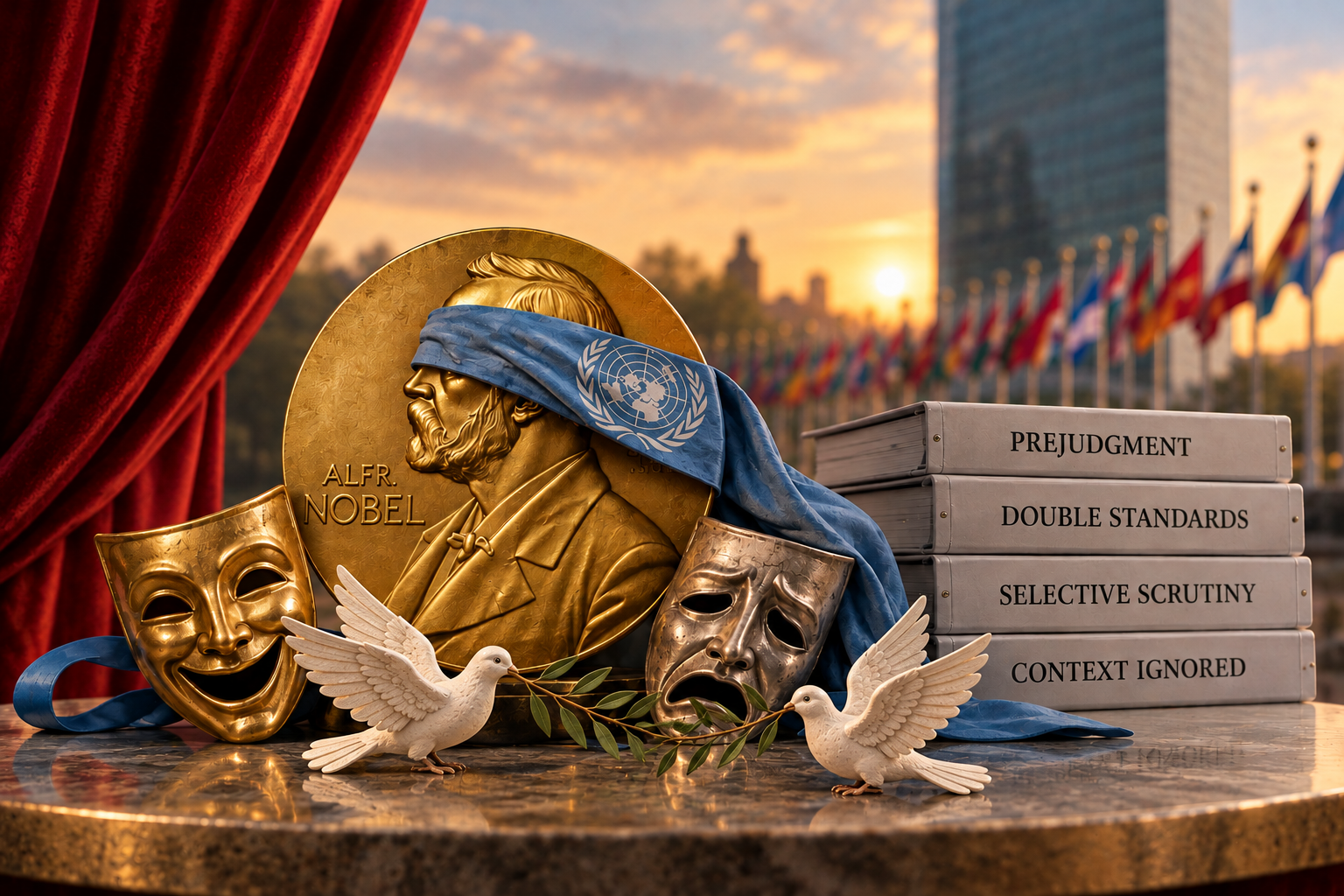
Nobel Peace Prize judgements vs what it actually means to make peace (Image AI generated)
Act I: An Education in Impartiality
For nearly four decades, I have practiced medicine, conducted research, reviewed scientific manuscripts, and taught students that evidence should precede conclusions. I have insisted that investigators disclose conflicts of interest, consider competing explanations, and remain willing to revise their judgments when new evidence emerges. These principles have sometimes made research frustratingly slow. The Norwegian Nobel Committee’s decision to award the 2026 Nobel Peace Prize to Navi Pillay has now introduced me to the possibility that I have been unnecessarily complicating my professional life.
Pillay had a distinguished history in international law, including contributions to human rights and international criminal justice. Long before chairing the UN Commission of Inquiry into Israel though, Navi Pillay also had an established public record of advocacy against Israeli policies. In 2017, she publicly supported the Boycott, Divestment, and Sanctions (BDS) movement; in 2020, she signed a statement calling for sanctions against Israel. Her previous accusations against Israel, including comparisons with apartheid South Africa, prompted a formal request for her recusal in 2022. Israel subsequently refused to cooperate with the inquiry, citing concerns about bias. I had previously assumed that an investigator’s public advocacy concerning the subject of an inquiry would warrant particularly careful scrutiny of potential bias. Apparently, I may have misunderstood the qualifications for impartiality.
Consider the implications for medical research. Rather than spending years designing clinical trials, enrolling participants, analyzing outcomes, and examining alternative explanations, I could announce that a particular medication is dangerous, publicly campaign against its manufacturer, and then volunteer to lead an independent investigation of its safety. My advocacy would demonstrate commitment, while my familiarity with the desired conclusion would make the investigation considerably more efficient. Contradictory evidence could receive respectful acknowledgment, perhaps in a supplementary appendix, without unnecessarily disturbing the findings.
This approach could also transform peer review. University grievance committees might recruit chairs who had already advocated for the dismissal of the faculty members under investigation. Federal judges could welcome cases involving companies they had spent years campaigning to close. Each institution would benefit from appointing decision-makers whose views were already well established.
Of course, strong prior opinions do not automatically make impartial judgment impossible. Scientists and judges inevitably bring experience, values, and hypotheses to their work. The question is whether those commitments receive appropriate scrutiny when the stakes are high. That distinction has guided much of my professional life, although it may explain why I have never been considered for the Nobel Peace Prize.
Act II: The Advantages of Institutional Specialization
Having reconsidered the value of prior commitments, I began examining how international institutions organize their investigations. Here, too, I discovered innovations that academic medicine has been slow to adopt.
The United Nations Human Rights Council maintains Agenda Item 7, a permanent agenda item devoted specifically to Israel and the occupied Palestinian territories. No other country has a comparable standing agenda item. According to UN Watch, the General Assembly adopted 173 country-specific resolutions concerning Israel between 2015 and 2024, compared with 80 concerning all other countries combined. These figures reflect UN Watch’s classification rather than an assessment of individual resolutions, but they illustrate a remarkable concentration of institutional attention.
While some might legitimately describe this as demonization or a double standard, I prefer to consider its administrative advantages. Imagine a hospital establishing a permanent committee devoted to investigating one physician, while allegations involving every other physician were handled through broader procedures. The committee would develop extraordinary expertise, its agenda would require little revision, and its members would rarely struggle to identify subjects for their next report. The physician might object, but the institution could point proudly to the impressive volume of oversight it had produced.
There is a revealing irony in the very name of the commission Pillay was chosen to chair: the Commission of Inquiry on the Occupied Palestinian Territory, including East Jerusalem, and Israel. Notice the admirable economy. Israel gets named. Hamas does not. Neither does the Palestinian Authority. Israel is a democratically elected state; Hamas is committed to its destruction and deliberately attacks civilians; and the Palestinian Authority has managed for more than two decades to avoid the inconvenience of another presidential election. Yet somehow only Israel earns the distinction of being named. This is especially impressive because the commission’s mandate officially covers violations by all parties. Apparently, “all parties” need not include all parties in the title. Perhaps this is simply good editing. Why clutter the name of an international inquiry with every major actor whose conduct it is supposed to investigate?
In medicine, we have traditionally regarded such simplification with suspicion. When a patient arrives with multiple diseases, a complicated medication history, and a recent deterioration, we are expected to consider several possible causes. It would be considerably more efficient to identify the physician who last treated the patient and organize the entire investigation around that individual. The report would certainly be easier to write, although the patient might wonder whether we had understood the illness.
The conflict in Gaza offers an extraordinary opportunity to test this approach. Hamas’s October 7 attacks, the murder and abduction of Israeli civilians, its extensive tunnel network, and its military operations within densely populated areas all introduce complications into an investigation of the war. A conventional investigator might insist on examining these factors, distinguishing the conduct of armed groups from that of civilians, and considering competing evidence before reaching legal conclusions. But that requires the inconvenient recognition that a war can involve more than one responsible actor.
The accusation of genocide presents a further challenge. Unlike a general finding that a war has caused terrible suffering, or even that serious violations of international humanitarian law have occurred, genocide requires establishing a specific intent to destroy a protected group, in whole or in part, as such. This is an unfortunately demanding standard. The distinction resembles the difference between observing a devastating medical outcome and determining precisely what caused it. The worse the outcome, the greater the temptation to regard the diagnosis as self-evident.
But requiring proof of the diagnosis can take time, introduce uncertainty, and, worst of all, leave open the possibility that the evidence might point somewhere else. For a Nobel Committee eager to recognize the pursuit of international condemnation of Israel, such uncertainty is particularly inconvenient. After all, it is considerably easier to award a Peace Prize for an alarming diagnosis than to ask why anyone should trust the doctors who made it, particularly when they had announced their diagnosis of the patient long before examining the evidence.
Richard Goldstone offers an instructive example. He chaired the United Nations fact-finding mission examining the 2008–2009 Gaza conflict. In 2011, he publicly reconsidered a central conclusion that Israel had deliberately targeted civilians as a matter of government policy. Of course, his reconsideration came after the original accusations had circulated around the world. In 2014, The Lancet editor Richard Horton expressed deep regret over the letter his journal had published condemning Israel’s conduct in Gaza. He then condemned the divisive antisemitic material circulated by two authors, but there was no article correction.
Even the United Nations has occasionally discovered the virtues of reconsideration. In 1991, it repealed its own 1975 resolution declaring that “Zionism is a form of racism and racial discrimination”. I can now better appreciate the inconvenience of such institutional reconsideration. If investigators, editors, and institutions such as the United Nations must revisit confident judgements whenever new evidence complicates their initial accusations, reaching definitive conclusions may become an endless enterprise. Worse still, reconsideration risks undermining the very demonization and delegitimization that the original declarations had so efficiently accomplished.
Perhaps academic journals should adopt a more practical policy: Additional evidence will be considered, provided it does not materially inconvenience the original conclusion. Research productivity would undoubtedly improve.
Act III: An Independent Investigation of the Nobel Committee
The Nobel Committee has considerable experience navigating the uncomfortable relationship between moral judgment and political controversy. In 1994, it awarded the Peace Prize to Yasser Arafat alongside Yitzhak Rabin and Shimon Peres, despite Arafat’s long history of terrorism, corruption, and political violence. The decision was so controversial that a committee member resigned. Yet the committee could at least explain that the three men were attempting to negotiate peace between longstanding adversaries.
The 2026 award to Pillay suggests an intriguing evolution in the committee’s understanding of peacemaking. Where the earlier prize recognized an effort to bring adversaries together, the newer one recognizes a figure whose most consequential recent work involved investigating and condemning one of them. I had previously thought the Peace Prize concerned the difficult business of making peace. Apparently, I have been taking the name too literally.
I believe the Nobel Committee’s judgment deserves an independent investigation, and I am prepared to offer my services. I have read numerous articles about the committee, developed strong opinions concerning its decisions, and identified several conclusions that I would expect a thorough inquiry to reach. Under the standards I have recently discovered, these commitments should make me exceptionally well qualified.
I would assemble a distinguished panel of individuals who share my concerns, conduct hearings to establish the relevant facts, and produce a comprehensive report confirming the conclusions I had announced at the outset. Dissenting views would receive respectful consideration, preferably in an appendix that would not interfere with the principal findings.
Should the Nobel Committee dispute our conclusions, I would gladly lead a second investigation into its resistance to independent scrutiny. My previous leadership would provide valuable experience, while my public disagreement would demonstrate the depth of my commitment. I would, of course, disclose these prior positions. Transparency is important, particularly when it does not require changing one’s mind.
Some readers may question whether I possess the necessary qualifications. Although I have never negotiated an international ceasefire, I have repeatedly called for peace, avoided starting any wars, negotiated with three adult children, and successfully concluded numerous faculty meetings without casualties. I have even persuaded specialists from different medical departments to agree on a treatment plan, an achievement anyone familiar with academic medicine will recognize as an extraordinary exercise in diplomacy.
If these accomplishments do not qualify me for a Nobel Peace Prize, perhaps they will at least qualify me to investigate the people who award it.
Act IV: Beyond the Satire
My proposed investigation of the Nobel Committee may be imaginary. The questions it raises about impartiality, institutional authority, and accountability are not. When an organization confers extraordinary moral authority on an investigator whose views about the subject were publicly established long before the investigation began, questions about independence deserve serious answers. And when that institution is the Nobel Committee, we should be willing to ask who is judging the judges.
For nearly four decades in medicine and research, I have learned how easily conviction can become an obstacle to discovery. We develop hypotheses because we believe they may be correct, but the integrity of our work depends on our willingness to find otherwise. A physician who mistakes an initial impression for a diagnosis may harm a patient. A researcher who dismisses contradictory evidence may mislead an entire field. The danger arises when an investigation ceases to be a search for answers and becomes a means of validating conclusions already reached.
This is what troubles me about the Nobel Committee’s decision. Pillay’s public advocacy against Israel preceded her appointment to lead an investigation whose conclusions would carry enormous political and moral consequences. The committee has now placed the prestige of the Peace Prize behind her work while praising her independence and integrity. Yet who scrutinizes the committee’s own judgment? Who asks whether it adequately examined the appearance of prejudgment, applied consistent standards of impartiality, or sufficiently considered Hamas’s independent agency and responsibility for the conflict?
Hamas was not merely a circumstance surrounding the war, much less a neutral actor within it. Its decisions, including initiating the October 7 attacks, murdering and abducting civilians, operating from densely populated civilian areas, storing weapons and rockets in or near civilian facilities, and pursuing military strategies that shaped the conflict, are themselves major parts of any serious account of responsibility.
They are also indispensable to understanding why any accusation of genocide so profoundly distorts the nature of this war. Israel did not enter Gaza in pursuit of the destruction of the Palestinian people; it entered Gaza after Hamas invaded Israel, massacred civilians, took hostages, and then continued fighting from within a densely populated civilian environment. The catastrophic suffering of Palestinian civilians is real and demands moral attention, but it cannot simply be converted into evidence of an Israeli intent to destroy Palestinians as a people while the actions, objectives, and methods of the armed organization Israel was fighting are pushed to the margins. Hamas’s tactics and objectives, including its commitment to Israel’s destruction, must remain front and center in any truthful account of this war.
The Nobel Committee may confer prizes, but it cannot confer impartiality by declaration. Nor should its international prestige place its decisions beyond examination. An institution entrusted with judging the contributions of others must itself remain open to judgment.

Finally, a larger question exists about the purpose of the Peace Prize. International justice and accountability can contribute to peace, but condemning wrongdoing is not the same as reconciling adversaries. I think of people such as Israeli renewable energy entrepreneur and my friend Yosef Abramowitz, who has reportedly been nominated multiple times for the Nobel Peace Prize. Yosef’s work has brought solar electricity and economic opportunity to underserved nations across Africa and even in Gaza, while fostering cooperation among Jews, Arabs, Bedouins, and others. Such efforts rarely command the attention given to international investigations and sweeping accusations. Yet they create relationships, shared interests, and practical reasons for communities to imagine a future together.
Perhaps my years in medicine have left me with an overly clinical understanding of peace. We are trained to distinguish diagnosis from treatment because identifying what is wrong, however essential, does not itself make a patient better. Treatment requires an additional commitment to recovery, often through difficult and sustained work whose results are less dramatic than the original diagnosis. The same distinction matters in international affairs.
Justice demands that we get the diagnosis right. Peace demands that we do something to heal the patient. And perhaps the most important question is not simply who receives the Nobel Peace Prize, but who is willing to hold its judges to the same standards they claim to honor.
–
**The views expressed here are entirely my own and do not represent those of any institution or organization with which I am affiliated.
Related Topics
Related Posts