How Not to Raise Jewish Children
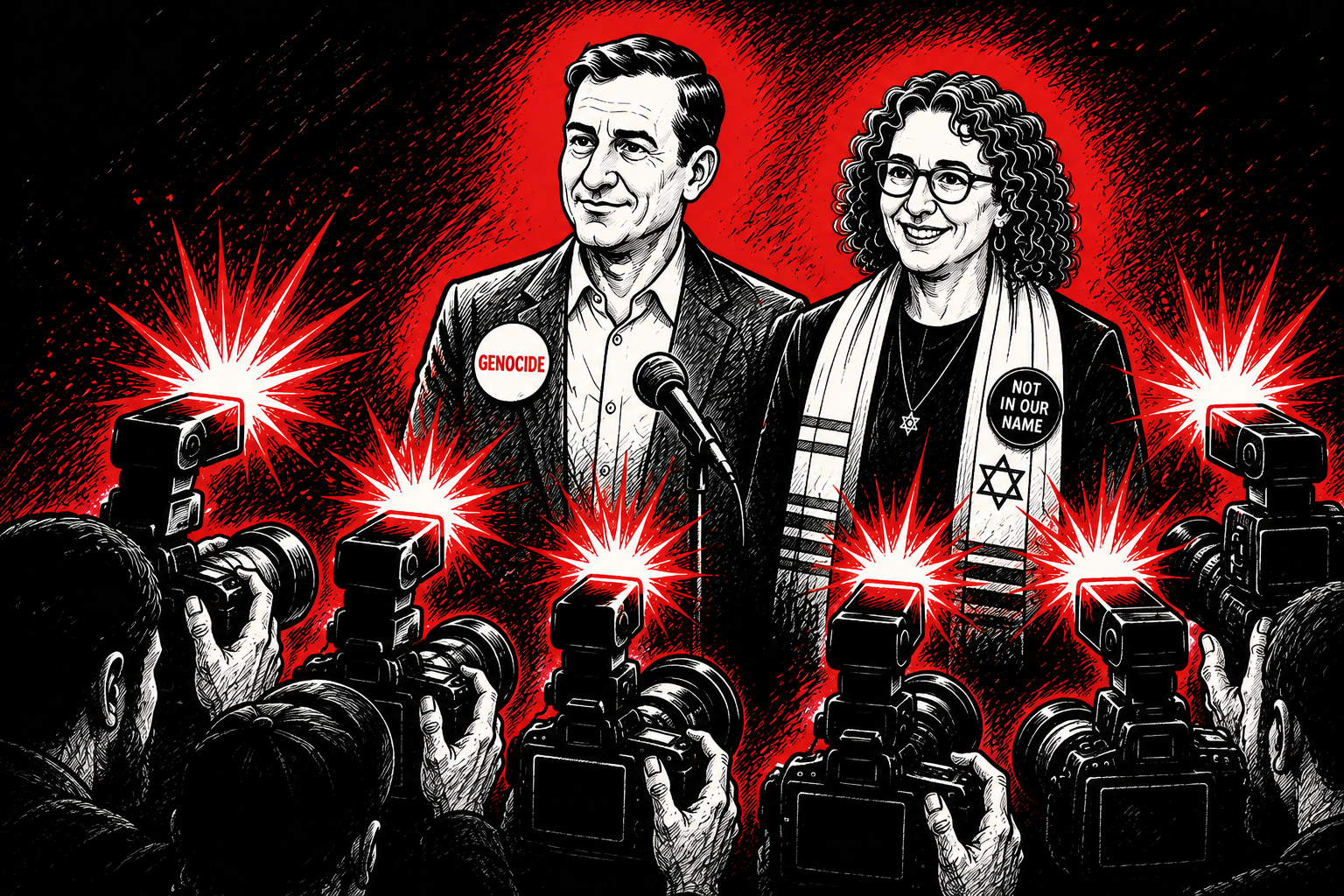
You could hear the cameras clicking before the blessing even began.
The Shehecheyanu—long, loud, and painfully out of tune—lingered awkwardly through the room as photographers fought to capture every angle. The millennia-old blessing, recited by generations of Jews to mark moments of gratitude and continuity, echoed through the bar, its low ceilings brightly lit for the occasion. Beneath the stage lights stood an antizionist Jewish politician beside an antizionist transgender rabbi. They smiled. The photographers kept shooting. The campaign got the image it was looking for.
The cameras weren’t photographing a prayer. They weren’t photographing a Jewish celebration. They were photographing Jews saying what non-Jews wanted them to say.
Who were these Jews? Where did they come from? And how did they come to stand on a stage turning Jewish identity into political theater?
Though it is tempting to dismiss antizionist Jews as simply “self-hating Jews,” the reality is both more complicated and more revealing. Believing they know better than more than 95 percent of the world’s Jews, they convince themselves that they are smarter than generations that endured exile, persecution, and expulsion. Thinking they are somehow wiser than Jewish history itself, they convince themselves that they are the exception to it. Placing their political identity above their Jewish identity, they separate themselves from the Jewish people even as they continue to speak in the Jewish people’s name. Some do so knowingly. Others have convinced themselves they are acting in the name of justice. The anti-Jewish ideology benefits either way.
Jewish history has seen this misplaced confidence before. Every generation had its Jews who thought the forces of history somehow no longer applied to them.
From the Hellenized Jews who rejected Jewish distinctiveness in antiquity, to the Jewish members of the Yevsektsiya who helped dismantle Jewish communal life in Soviet Russia, to the American Council for Judaism, which rejected Jewish nationhood in the twentieth century, history is littered with Jews convinced they had finally become the exception. Different centuries. Different ideologies. The same conviction: this time was different.
The rules of Jewish history, however, never stop applying. The Hellenized Jews were ultimately exiled alongside the very people from whom they had tried to distinguish themselves. The Jewish members of the Yevsektsiya were imprisoned or murdered once they were no longer useful to the regime they had served. Across the Middle East, Jewish antizionists were persecuted and expelled together with the rest of their communities. Time and again, history refuses to recognize the distinction antizionist Jews keep trying to draw between themselves and the Jewish people.
American Intellectual Antisemitism—the latest variation of this centuries-old anti-Jewish hatred, and the subject of my forthcoming book—did not invent the antizionist Jew. It merely found a new use for one. Unlike older forms of antisemitism, which primarily targeted individual Jews, it targets Jewish collective existence. It portrays Jewish peoplehood as morally suspect, Jewish self-determination as uniquely illegitimate, and the world’s only Jewish state as uniquely unworthy of existing. It elevates the tiny minority of Jews willing to reject Jewish peoplehood, transforming them into false moral witnesses against their own people and using their Jewish identity to legitimize an anti-Jewish ideology.
For American Intellectual Antisemitism, a token Jew is worth a thousand non-Jews.
Ideologies like this rarely recruit the people who think they are susceptible to them. They recruit people convinced they are too intelligent, too moral, and too independent ever to be manipulated. They recruit people searching for meaning, certainty, and moral purpose. They recruit people who look remarkably like your children.
If your child attends an elite university, there is a good chance they will encounter these ideas. They may already have.
American Intellectual Antisemitism has found its strongest foothold in education exactly because it understands something many parents forget: whoever teaches children how to interpret the world usually gets to shape how they understand themselves. By the time many students arrive on campus, years of ideological assumptions have already taken root. Universities often reinforce them, but they rarely plant them from scratch.
Which is precisely why the conversation cannot begin during first-year orientation. It cannot begin after an encampment appears on campus. It cannot begin after your child starts apologizing for belonging to the Jewish people. You cannot wait until your child is defending bad ideas to start teaching them better ones.
For generations, Jewish families have asked themselves how to raise Jewish children. The existence of antizionist Jews forces us to ask a second question: How do we make sure we don’t raise antizionist ones? What can we learn from antizionist Jews who allowed themselves to become tokens against their own people?
The answers are neither new nor complicated. They are the same lessons that have allowed the Jewish people to survive for thousands of years.
Don’t outsource your children’s Jewish education. Don’t assume they’ll naturally feel connected to the Jewish people. Don’t expect them to learn Jewish history on their own. Don’t let someone else teach them what it means to be Jewish. Don’t let politics become the foundation of their Jewish identity.
Most importantly, don’t tell them what to think. Give them all the tools they need to think for themselves. Teach them how to recognize bad ideas when they encounter them—even when those ideas come wrapped in the language of justice, compassion, or progress. Teach them that they belong to a people whose survival has always depended on remembering who they are. Teach them honestly about Israel’s mistakes, but also about how Israel has confronted them, corrected them, and grown from them. Teach them that they, their people, and their state will never be perfect—but that striving to be better is part of what it means to be Jewish. Tell them the truth, then trust them to reach the right conclusions.
If you don’t teach your children who they are, someone else will. And if your children are good students—as I am sure they are—they may become exactly what someone else wants them to be.
Once the cameras start clicking, it may already be too late.
*
American Intellectual Antisemitism: The Anti-Jewish Movement Tearing Through Our Universities (Wicked Son/Post Hill Press) is now available for pre-order.