

How Qatari Sovereign Wealth Purchased the Infrastructure of Western Thought
On October 29, 2019, the United States Department of Education launched a series of formal administrative inquiries into several of the nation’s premier research universities. The target of the federal probe was not accounting fraud or admissions bribery, but rather a systemic, multi-billion-dollar opacity surrounding foreign financial flows. At the epicenter of the investigation sat a sovereign state smaller than the state of Connecticut, possessing a population of under three million, yet operating as the single largest foreign financier of higher education in the United States: the State of Qatar.
Between 2001 and 2024, federal transaction registries under Section 117 of the Higher Education Act document that the Qatari government, acting primarily through its state-controlled proxy, the Qatar Foundation for Education, Science and Community Development (QF), funneled between $5.0 billion and $6.6 billion into American academic institutions.
This financial infusion was neither an exercise in international altruism nor a standard corporate sponsorship. Forensic analysis of international contracts, federal enforcement filings, and sovereign wealth allocations reveals a calculated, two-stage institutional capture. By migrating from an initial mid-1990s strategy of outbound media projection to a high-yield strategy of inbound institutional integration, Qatari sovereign capital succeeded in embedding its strategic interests directly into the training grounds of America’s future diplomatic, journalistic, and policy elites.
Stage I: The Airwaves and the Limitations of Pure Media (1996–2000)
The structural origin of Doha’s influence apparatus began in 1996, when the newly enthroned Emir, Sheikh Hamad bin Khalifa Al Thani, issued an executive decree capitalizing the Al Jazeera Satellite Channel with a $150 million state loan. The network was created to break the narrative dominance of Saudi-backed media outlets across the MENA region and establish Qatar as an indispensable regional power broker.
Al Jazeera offered an innovative, high-production broadcast model that mirrored Western newsroom aesthetics while providing an unrestricted platform to regional dissident movements, non-state armed actors, and Islamist ideologues, most notably the Muslim Brotherhood. The strategic utility of the network was immediate: it gave Doha an outsized regional megaphone and forced global powers to negotiate directly with Qatari leadership to navigate Middle Eastern crises.
However, state strategists quickly identified a hard operational ceiling to broadcast media.
While a satellite television network could shape daily news cycles and sway regional public opinion, it remained subject to external friction. It was vulnerable to signal jamming, diplomatic expulsion, and intense domestic counter-pressure from Western governments. Media could influence what citizens thought about today’s events; it could not shape how future analysts, intelligence officials, and diplomats framed geopolitical reality ten years down the line. To achieve structural immunity, Qatari wealth had to move upstream—from the newsroom to the university campus.
Stage II: The “Education City” Beachhead and the Contractual Trap (1998–2010)
The vehicle for this institutional pivot was the Qatar Foundation, established in 1995 under the leadership of the Emir and his consort, Sheikha Moza bint Nasser. In 1998, QF broke ground on “Education City”—a 3,000-acre enclave on the outskirts of Doha designed to house satellite operations of elite American faculties.
Rather than building domestic universities from scratch, Qatar deployed its natural gas revenues—derived from the massive North Field—to contract established Western brands. Between 1998 and 2008, QF secured binding agreements with six major U.S. universities:
- Georgetown University (School of Foreign Service – Qatar): Training in international affairs, diplomacy, and governance.
- Northwestern University (Medill School of Journalism): Training in communications, media strategy, and news production.
- Cornell University (Weill Cornell Medicine): Medical and biological research facilities.
- Carnegie Mellon University: Computer science, business, and artificial intelligence.
- Texas A&M University: Engineering and energy sector research (operation slated for closure following 2024 Board of Regents action).
- Virginia Commonwealth University: Fine arts and design.
The financial terms were extraordinary. QF covered 100 percent of all construction, operational, and administrative costs, while allocating substantial management fees back to the parent institutions’ domestic accounts.
However, forensic audits of these institutional agreements reveal a crucial structural mechanism: the creation of absolute financial dependence. By tying tens of millions of dollars in annual overhead subsidies directly to sovereign state disbursements, the domestic administration of these universities became structurally reliant on maintaining operational harmony with the host regime.
Stage III: Capital Retracing and Stateside Infiltration (2010–Present)
Once the institutional infrastructure was anchored in Doha, the capital pipeline reversed direction. Foreign capital began flowing directly into parent campuses on American soil through targeted grants, funded research projects, and endowed faculty chairs.
Federal enforcement reporting conducted by the Department of Education between 2019 and 2020 revealed that U.S. higher education institutions had systematically under-reported billions of dollars in foreign gifts and contracts. A substantial portion of these unreported or opaque transactions traced directly to Qatari state entities. For instance, Cornell University alone was linked to approximately $1.9 billion in foreign funding arrangements connected to Qatari programs over a multi-year period.
The Mechanics of Soft Capture
The deployment of state capital across domestic U.S. campuses operates through three main mechanisms:
- Curricular and Pedagogical Interventions: Through entities such as Qatar Foundation International (QFI), state funds are channeled into American K-12 public school systems and undergraduate departments. QFI provides fully funded instructional materials, teacher training seminars, and language grants. The resulting curricula systematically present Middle Eastern regional history through a curated, highly favorable lens, insulating the state’s domestic policies from critical academic inquiry.
- Chair Endowments and Faculty Selection: By endowing specific centers, such as Georgetown’s Center for Contemporary Arab Studies, state money directly funds faculty salaries and research fellowships. In academic environments dependent on limited institutional grant funding, researchers whose work aligns with donor interests secure tenure, publishing priority, and media exposure, while critical voices are filtered out through funding scarcity.
- Institutional Self-Censorship: Direct censorship by a foreign power is unnecessary. When a university administration relies on foreign sovereign capital to balance its operational budget, an unspoken policy of risk avoidance takes hold. Panels on regional human rights abuses, state-sponsored proxy funding, or financial transparency are quietly sidelined to prevent jeopardizing multi-million-dollar funding pipelines.
The Strategic Balance Sheet
The institutional migration of Qatari capital represents a clear case of asymmetrical leverage. By spending a fraction of its annual natural gas revenues, the State of Qatar achieved what traditional military power or overt lobbying could never accomplish.
By capturing both ends of the policy spectrum—the media outlets that inform today’s public (Al Jazeera) and the university programs that educate tomorrow’s foreign service officers, intelligence analysts, and journalists (Georgetown, Northwestern, and the Ivy League)—Qatari sovereign wealth successfully neutralized Western institutional critique.
The open nature of the Western university, designed to foster independent thought, was turned into its primary vulnerability. The checks cleared, the campus infrastructure expanded, and the intellectual framework of Western foreign policy was quietly acquired, one grant at a time.
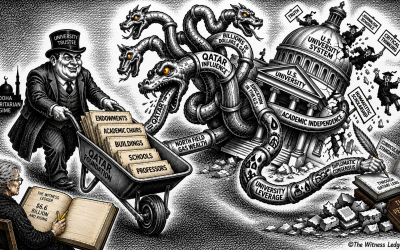
-Image with permission and courtesy of The Witness Ledger
-for further reading see https://steventeplitsky.substack.com/