
Grammy and Emmy nominated singer-songwriter, author, essayist
How Soviet Anti-Zionism Outlives the Soviet Union
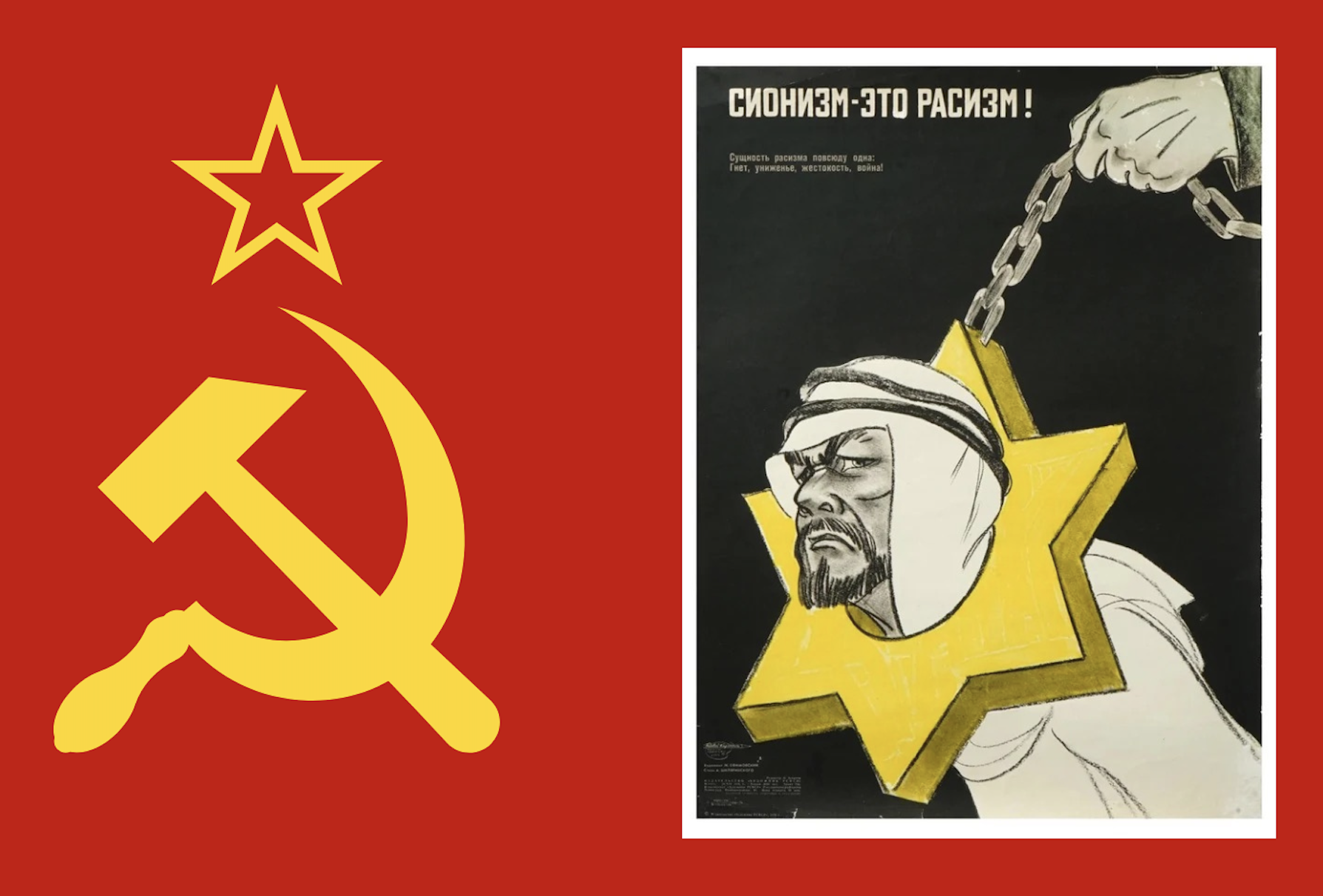
Collage by the author
I must have been in seventh or eighth grade when my older cousin Jill came to Hebrew school carrying a sign that read, “Zionism Is Not Racism.” Busy with my guitar and girls, I had little idea what my more politically astute cousin was so passionate about.
As it turns out, she was decades ahead of the curve.
The slogan she carried was not a response to some passing controversy. It was a response to one of the most successful propaganda campaigns of the twentieth century.
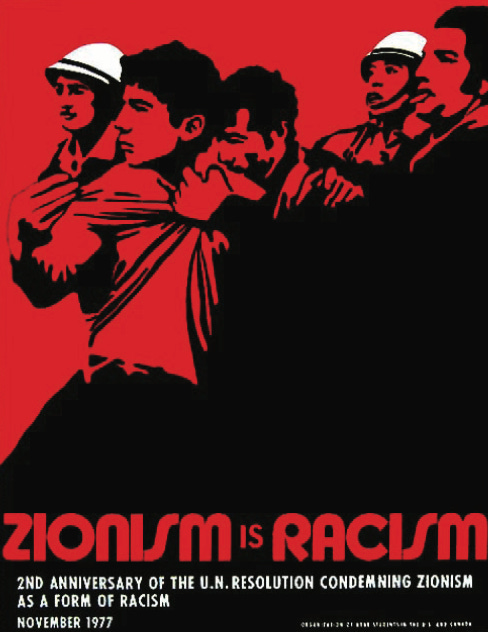
That resolution was the culmination of a decades-long Soviet campaign to redefine the terms of international political discourse—to take the national liberation movement of the Jewish people and rebrand it, systematically, as an ideology of oppression. Understanding that campaign, and where its vocabulary went after the Soviet Union collapsed, seems to me one of the more important and neglected questions in contemporary political analysis.
The Soviet Union was not always Israel’s enemy. In 1948, Moscow was among the first governments to recognize the new Jewish state. Soviet leaders initially saw potential in Israel’s labor movement, its kibbutz socialism, and its capacity to weaken British influence across the Middle East. Israeli founders like David Ben-Gurion were careful not to burn the relationship early.
History, as it usually does, had other ideas.
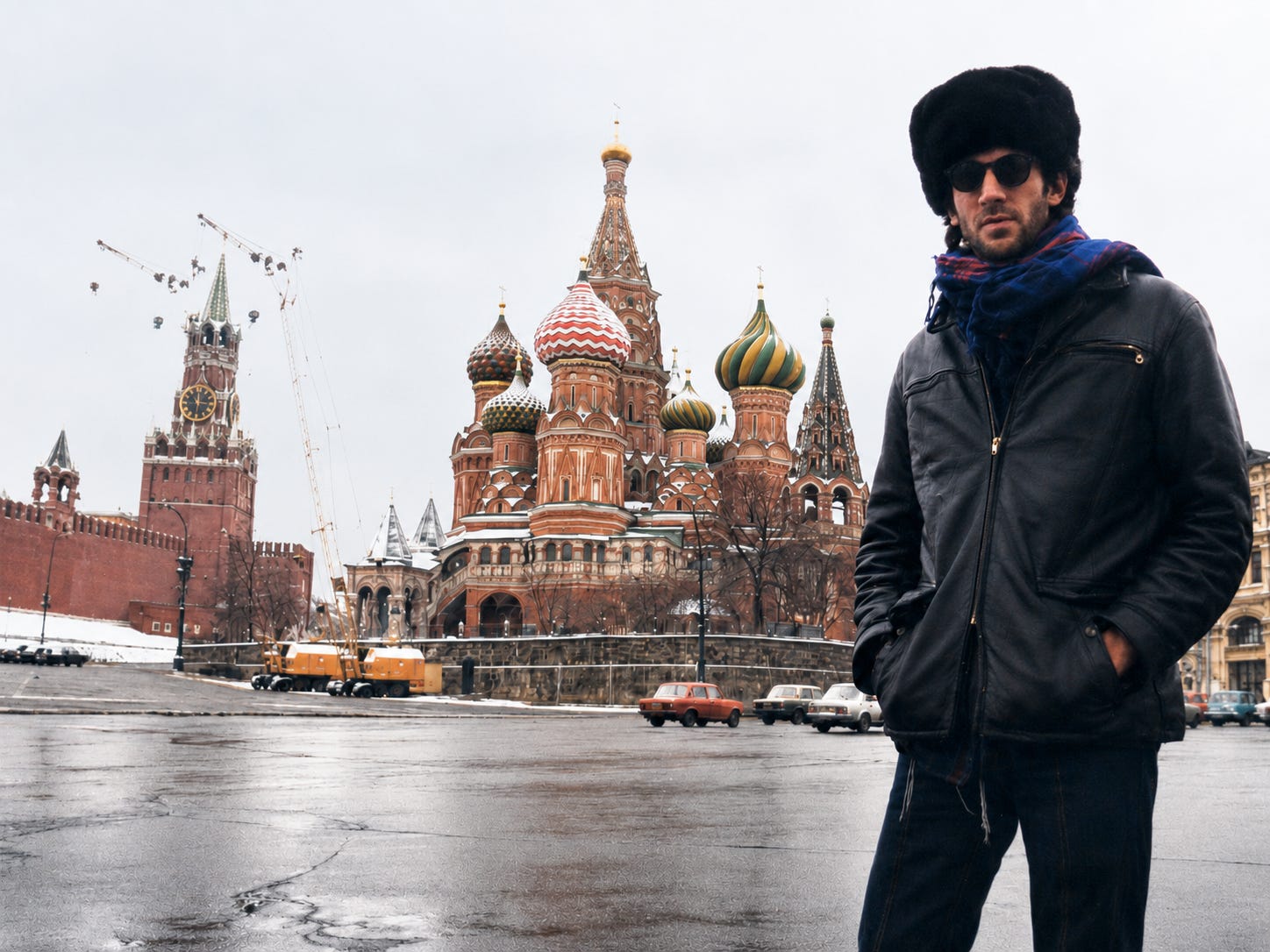
Military rivalry alone, however, cannot explain what came next.
Beginning in the late 1960s, the Soviet Union launched a political campaign of remarkable ambition and sophistication. Its goal was not merely to arm Israel’s enemies or to block Israeli interests in international forums. It was to transform how the world understood Zionism itself—to detach the word from its actual history as a movement for Jewish self-determination and reattach it to a cluster of concepts already condemned by postcolonial and leftist political thought.
The campaign ran through multiple channels simultaneously: Soviet state media, the Communist parties Moscow supported across Europe, Africa, and Latin America, sympathetic academics and intellectuals, and eventually the United Nations itself, where the Soviet bloc, Arab states, and much of the Non-Aligned Movement—a coalition of newly independent nations that sought to remain outside both Cold War power blocs—often voted together on Middle East issues.
The vocabulary it produced was carefully chosen. Much of it has become strangely familiar: colonialism. Imperialism. Racism. Apartheid. These were not random accusations. They were the most charged political concepts of the era—words that, by the 1970s, carried the accumulated moral weight of anticolonial movements, the American civil rights movement, and international opposition to South African apartheid. To attach those words to Zionism was to place it, rhetorically, in the company of history’s condemned causes.
Resolution 3379 was the campaign’s institutional high-water mark. But the resolution was, in an important sense, less important than the vocabulary itself. A UN resolution can be repealed. It was, in 1991. Political language is harder to rescind. It takes root in universities, journalism, activist movements, and eventually in the ordinary assumptions people carry into political life without ever examining where those assumptions originated.
The Soviet Union formally ceased to exist in December 1991. The Berlin Wall had already fallen. Communist governments collapsed across Eastern Europe. It was natural, in that moment, to assume that Soviet political programs had collapsed with them. Ideas, however, do not obey political calendars. They migrate. They find new foot soldiers.
By laundering its rhetoric through the Non-Aligned Movement and targeting decolonization struggles in the Global South, the Soviet apparatus built an ideological bridge to the West. This lexicon was eagerly absorbed by the nascent postcolonial academic frameworks growing in Western universities during the 1980s and 90s. There, the core Soviet themes laid the foundation for later, more specialized academic lenses. Over time, these ideas lost their original context and acquired new ones. They became so familiar that their genealogy became invisible—assumed rather than argued, inherited rather than discovered.
This is not a conspiracy theory. It does not require secret coordination. Ideas spread through universities, through political movements, through the books people read and the assumptions those books carry. The Soviet campaign helped embed this vocabulary in leftist and postcolonial discourse, where it would continue to circulate long after the Soviet state itself disappeared. In that ambition, it appears to have succeeded.
None of this settles the actual political and moral questions at stake in the Israeli-Palestinian conflict. Those questions are real, they are difficult, and they deserve serious engagement on their merits. A critique of an idea’s origins is not a refutation of the idea itself.
What the genealogy does is something more limited but still important: it invites scrutiny.
When those concepts appear together, consistently, as a package, applied to one country and almost no other, it is worth asking why and how that particular vocabulary arrived. It is worth asking whether those concepts, however legitimate in other contexts, are functioning here as tools of analysis or as elements of a propagandistic portrait fashioned by a regime whose legacies of repression and mass murder are well known.
The Soviet Union is gone. Its archives have been partially opened. Its propaganda campaigns have been documented by historians. Its strategic calculations are, at this point, reasonably well understood. For decades, its political language gestated beneath the surface of Western political culture.
What remains, more than three decades later, is a language of denigration directed at the Jewish state.
With the support of New York City Mayor Zohran Mamdani, two DSA-backed candidates won Democratic nominations for the United States House of Representatives in New York City’s June 2026 primaries and made Israel a defining issue of their campaigns. Not incidentally. Centrally.
Claire Valdez, the Democratic nominee for New York’s 7th Congressional District covering Brooklyn and Queens, challenged Antonio Reynoso during a Spectrum NY1 debate for only having called Israel’s actions a genocide after launching his congressional campaign. “I and many others have been in the streets,” she said, “calling for a ceasefire, calling for an end to U.S. complicity in that genocide, but I never saw you there.” In her victory speech she declared: “I will continue to call for Palestinian liberation. We will stand up to the genocide. We will refuse to abide by apartheid.”
Darializa Avila Chevalier, the Democratic nominee for New York’s 13th Congressional District covering Upper Manhattan and the Bronx, accused Israel of committing “genocide” and described it as an “apartheid state.” In an interview with the New York Editorial Board, she defined Zionism as “an ideology that is looking to create a political system where one group of people has more standing before the law than another group of people.” Both candidates are now virtually certain to win their general elections in November and enter Congress in January 2027.
Read those statements carefully, then read Resolution 3379 again. The resolution established precisely that moral framework, portraying Zionism as an ideology of supremacy—of one group holding more standing than another. Nearly fifty years later, candidates on their way to the United States Congress are using language that maps onto that framework with striking precision.
That is what successful propaganda looks like at full maturity. It presents itself as moral clarity. Repeated often enough, it becomes a beacon of ideological correctness.
The origin of these arguments matters for this reason: the Soviet campaign was not designed to produce accurate analysis. It was designed to delegitimize a state by associating it, permanently, with the most condemned concepts in the political vocabulary of its time. The specific words were chosen not because they were the most accurate descriptions available, but because they were the most damaging. They were chosen to end conversations, not to open them.
When those same words are now deployed with confidence by candidates heading to the United States Congress—candidates who almost certainly believe they arrived at them through their own ethical reasoning—it is worth pausing to ask how those words got there, what journey they made, and whose purposes they originally served.
The Soviet Union wanted Zionism to mean racism. It wanted the false charge of apartheid to become the permanent stain. It wanted those associations to become so deeply embedded in progressive political culture that they would require no argument—only invocation.
Thirty-five years after the Soviet Union’s collapse, that project appears, in significant measure, to have endured. Dangerously. May it endure no longer.
Nearly half a century later, the words on my cousin Jill’s sign still need to be carried.
Related Topics