
How to Actually Hold Universities Accountable for Campus Antisemitism
Disparate Enforcement Demonstrates Unlawful Discrimination
The MIT plaintiffs had the winning facts in their complaint. They said the right things, but they didn’t say them in the right way.
In the post–October 7 campus environment, Jewish students watched crowds accuse the only Jewish state of genocide, and they thought their universities would offer the support routinely available to minorities under attack. Instead they were told that nothing could be done — that this speech, uniquely, was untouchable.
The natural response was to go to court and argue that this was illegal discrimination against Jewish students. But that strategy ran directly into the brick wall of the First Amendment. Speech about a war, a government, or whether a country should exist sits at the very top of what the First Amendment protects, and it is protected most of all when it is offensive. A court cannot order a university to suppress it, or punish a university for declining to. The harder we press on how unbearable the chants were, the more securely we place them in the category courts will not touch.
We have been staring at the trees. Step back and there is a valid claim in plain view, one that will force universities to treat Jewish students equally — and it rests on the university’s own conduct instead of the conduct of other students.
What Disparate Enforcement Is
A university that takes federal money is free to permit all the offensive speech it likes. What it may not do is apply its own rules one way to Jewish students and another way to other minorities. That is disparate enforcement, and the university’s inconsistent enforcement decisions — not the protesters’ message — are the discriminatory acts. If a Jewish student reports harassment and the university opens no investigation, while a comparable complaint from another minority group draws an investigation, the unequal handling is itself the violation.
Nothing here asks a court to decide whether antizionism is discriminatory or to suppress a single word. The protesters are not even parties. It is a comparison between how an administration treated two sets of students, and courts make that comparison every day.
MIT Enforced Its Rules Only Against Jews
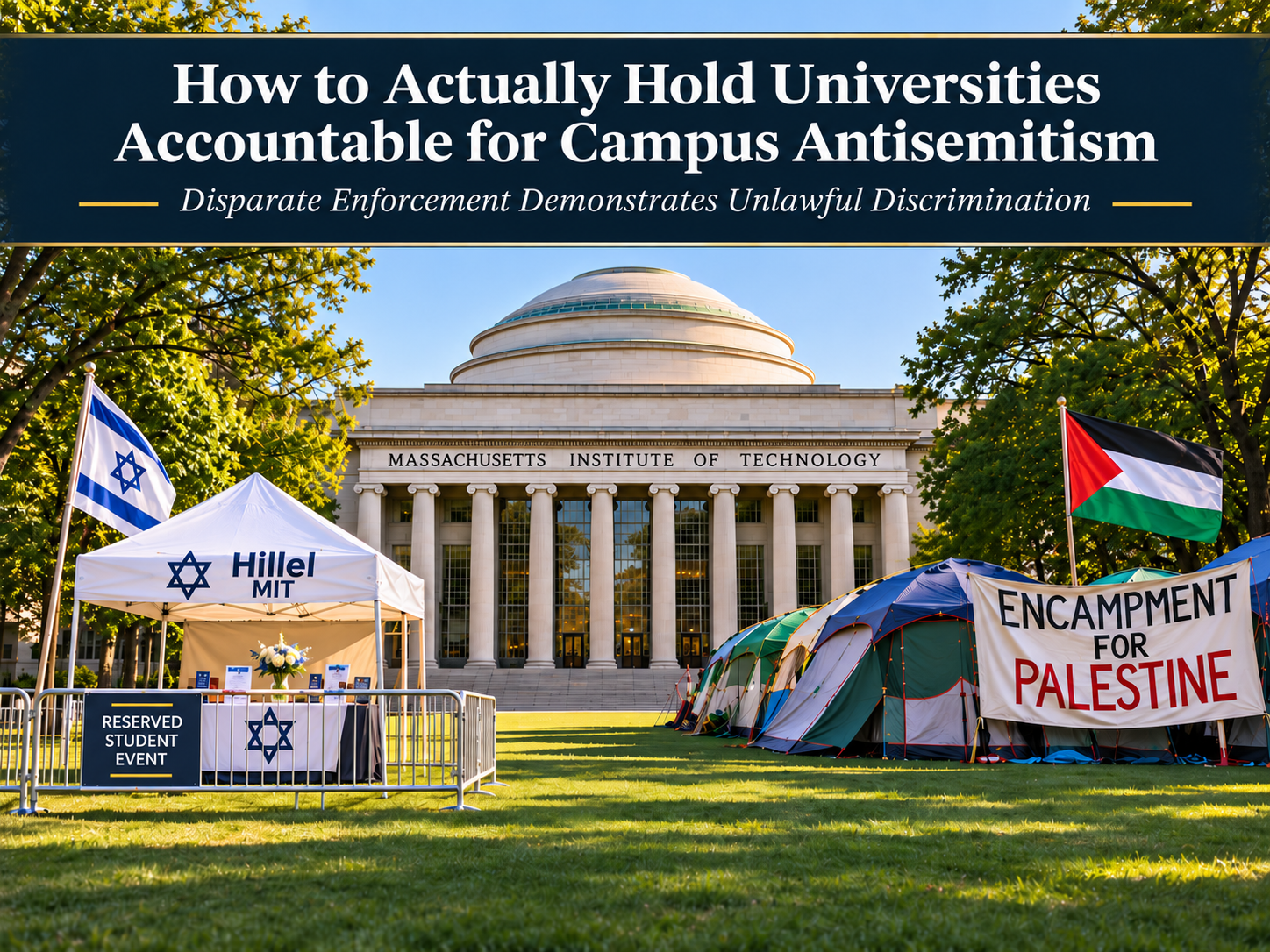
There were sufficient facts to argue disparate enforcement in the MIT antisemitism case, but the plaintiffs did not make that argument. Three incidents in the complaint show MIT enforcing its own written rules one way against Jewish students and another way against everyone else — rules about hanging posters, flying flags, and reserving campus lawn space.
MIT permitted posters for other causes but required pro-Israel posters to come down. Protesters taped posters across lecture halls and campus buildings in plain violation of MIT’s postering policy, and nobody was asked to take anything down. When Jewish students put up posters about October 7, they were ordered to remove them. A Belgian flag hung from an office for roughly three years and Palestinian flags went up and stayed up, but when students flew Israeli flags, administrators told them to take them down and warned that facilities staff would be sent to do it for them.
MIT Failed to Enforce Its Rules in Favor of Jews
MIT also favored the anti-Israel encampment’s use of lawn space over Hillel’s reservation. Hillel reserved the Kresge lawn for Israel Day three months in advance, through the process MIT requires. The encampment never obtained a reservation, and MIT’s president called the encampment a “clear violation” of the rules “from the start.” MIT nonetheless failed to honor Hillel’s reservation and required that Hillel’s event be moved.
An institution that can enforce its rules when it wants to, and does not when Jews are the beneficiaries, is not being measured. It is choosing.
The One Concession Standing in the Way
Seeing it requires the step most advocates have refused to take: concede the antizionist chants were protected by the First Amendment, set them aside entirely, and ask what is left. In this complaint, what is left is a university that enforced its neutral rules against one group of students and not the others.
The Law Is Not the Problem
There is no antizionism exception to the civil rights laws. Title VI reaches discrimination against Jewish and Israeli students as fully as it reaches discrimination against anyone else, and the protection it offers is robust. What it requires is a proper showing — that the university itself treated Jewish students worse than it treated others, in decisions it actually made.
Make that showing and these cases win. Ask a court to hold that offensive political speech is itself illegal, and they will keep losing. Not because the law has failed us, but because we brought the wrong claim.
Mark L. Javitch is a California civil rights attorney representing victims of antisemitic discrimination through the Jewish Community Advocacy Council.