
Welcome to the Ongoing Situation
How to Lose Your Reddit Account in One Simple Step
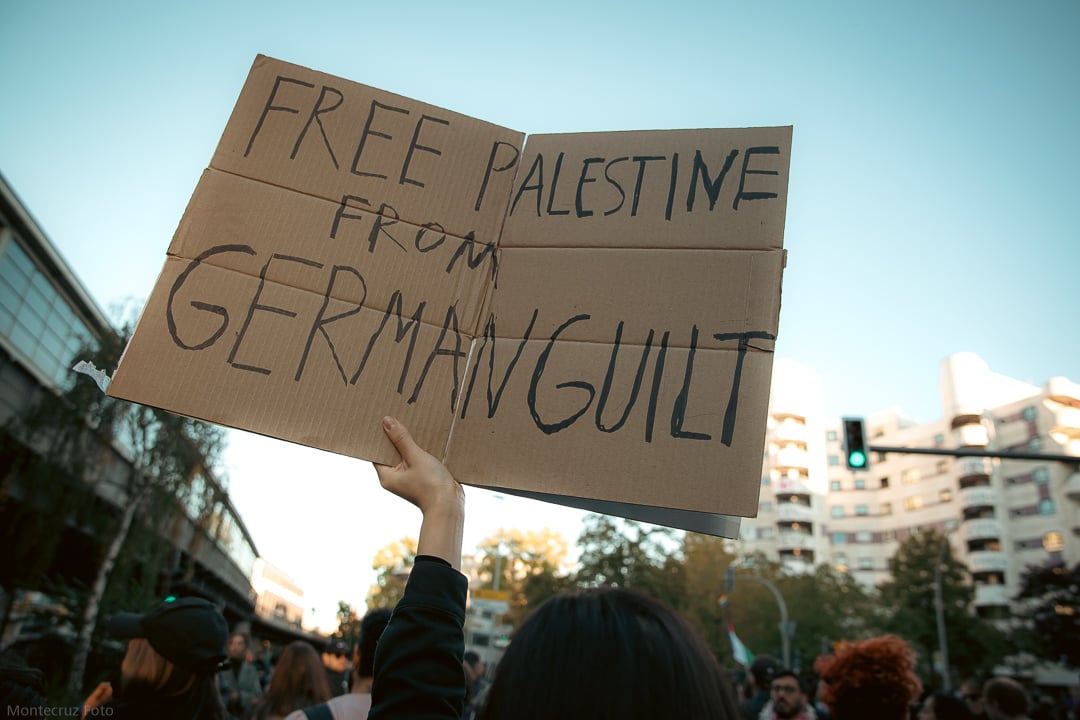
Protester displays Pro-Palestinian sign at rally (Photo from Wiki Creative Commons)
Reddit permanently banned my six-year-old account for hate speech last week.
My offense, as best as I can tell, was explaining that Jews are an ethnoreligious people.
I appreciate that this sounds improbable. Had someone told me this story a few years ago, I’d have assumed they were leaving something out. Surely there had been threats, slurs or some spectacular lapse in judgment buried deeper in the thread.
There weren’t.
The ban itself, however, isn’t the interesting part. Social media platforms make moderation mistakes every day, and anonymous accounts disappear with little fanfare. What has stayed with me is the conversation that came before it. Somewhere between debating Zionism and debating my DNA, the discussion stopped being about the history of a conflict or an ongoing war. It became a referendum on whether Jews constitute a people.
For nearly six years, Reddit occupied one of the least political corners of my life. I wasn’t there to defend governments or debate borders. Most of my time was spent in writers’ communities, where strangers workshopped opening chapters, dissected dialogue and argued quite passionately over punctuation. The rest belonged to the kinds of forums people only discover when life becomes unexpectedly difficult: depression, epilepsy, grief and, eventually, motherhood. They were communities built around vulnerability rather than ideology, places where anonymity made honesty easier.
Over time, my account became an accidental archive of my life. It watched me grieve my mother’s sudden death, recover from a debilitating depressive episode, survive a pandemic, move to Israel, grow as a writer and eventually become a mother.
Then, one afternoon, it disappeared.
By the time I appealed, the experience had become harder to dismiss with an everyday roll of the eyes. Reddit had already deleted the very comment it claimed violated its site guidelines. The automated suspension notice included a link to the offending comment, but clicking it led only to “[deleted].” It’s difficult to meaningfully challenge an accusation when you’re no longer able to review the evidence against you.
I hadn’t logged in looking for a political argument. Years of reporting on Israel have taught me that internet debates rarely resemble conversations. Most people aren’t trying to understand the other side. They’re performing certainty for an audience that already agrees with them.
Unfortunately, I happened to be sick in bed with far too much idle time when I stumbled across a post in r/sixwordstories. The premise of the subreddit is charmingly simple: every story must be told in exactly six words.
This particular title read:
“Zionism Makes Me Sick As F*ck.”
Curious more than combative, I replied with what I assumed was a pretty unremarkable question.
“Out of curiosity, what’s your reasoning for that belief?”
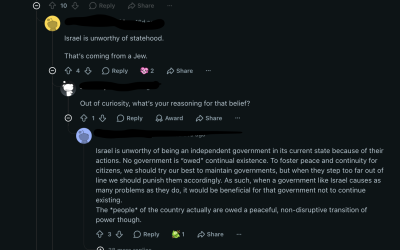
That was apparently an unforgivable offense.
Not because I defended every action of Israel’s government or denied Palestinian suffering. I did neither. Throughout the discussion, I repeatedly explained that I oppose Bibi’s government, oppose Ben Gvir and Smotrich, and support Palestinian self-determination alongside Israel’s continued existence. None of those positions altered the trajectory of the conversation. The moment I identified myself as Israeli, my actual politics became largely irrelevant.
I’ve begun noticing this progression online with unsettling frequency since October 7. Conversations rarely remain about Zionism for long. They begin there, then migrate to Israel, then Israelis, then Jews, then Jewish history, Jewish ancestry and, eventually, Jewish DNA. By the end, nobody is arguing about an ideology or government anymore. They’re arguing about whether Jews constitute a people at all.
The screenshots from that thread read almost like satire.
One commenter informed me that Jews are “not an ethnicity” because people can convert to Judaism. Another insisted Israel manipulates DNA testing because otherwise Israelis would discover they aren’t actually indigenous to the Middle East. Someone else reminded me that Jews already have a homeland. Not Israel, of course. Birobidzhan—Stalin’s failed Jewish Autonomous Oblast.
For more than two thousand years, Jews have ended the Passover Seder with the promise, “Next year in Birobidzhan!” Actually, that doesn’t sound quite right. I’ll have to check my sources and get back to you…
Admittedly, by that point, the thread no longer resembled a political discussion. It resembled an anthropology seminar taught by my two-and-a-half-year-old son. The remarkable part wasn’t that people disagreed with me. Disagreement is hardly unusual online. It was the confidence with which strangers asserted authority over Jewish identity itself.
Eventually, after explaining for what felt like the tenth time that being Jewish is more than a religion, I responded with considerably less patience than I’d begun with.
“When will you all get it through your heads that Judaism isn’t just a f*cking faith? I’m as secular as they come.”
I stand by the substance of that statement, even if I’m not particularly proud of letting my frustration get the better of me.
I’m secular. I don’t keep kosher. I don’t attend synagogue. Judaism is a religion, but Jewishness has never been defined solely by religious belief. Like the Druze and Yazidis, Jews are an ethnoreligious people whose shared identity encompasses ancestry, history, language, culture, and, for many, religion. The reasoning was circular enough to make my head ache: because people can become Jewish, Jews aren’t a people.
None of this is especially controversial outside the likes of Reddit and other platforms that offer anonymity. Historians, anthropologists and geneticists settled the question long ago.
When commenters insisted Ashkenazi Jews were simply Europeans pretending otherwise, I mentioned that I’d undergone genetic testing three separate times. Once through an American ancestry service, once with an Israeli company and once during prenatal genetic screening while pregnant with my son. Three different laboratories. Two different countries. Public and private institutions. The same conclusion every time.
My family spent generations in Lithuania before fleeing to South Africa in the early 1930s. They left with Lithuanian passports, not Lithuanian ethnicity. Passports have never functioned as DNA tests. My great-grandparents didn’t become ethnically Lithuanian any more than I became ethnically South African.
It didn’t matter.
Instead, the conspiracy simply expanded. Israeli DNA testing, I was told, couldn’t be trusted because the Israeli government manipulates the results. At some point, facts ceased functioning as evidence. Every piece of information that complicated the prevailing narrative became proof that the conspiracy ran even deeper.
Facts weren’t losing to better facts. They were losing to narratives that had become emotionally indisputable.
Journalism has a way of freeing you from the illusion that people fit neatly into ideological boxes. Over the past several years, I’ve interviewed Palestinians, settlers, bereaved Israeli families, politicians, billionaires, aid workers and peace activists. I’ve agreed with some of them, disagreed sharply with others, and changed my own mind more than once.
Good reporting also requires a certain intellectual humility. You can challenge someone’s facts, scrutinize their conclusions and disagree with their politics. But please don’t assume you understand who they are better than they do.
It would never dawn on me to explain to a Palestinian that Palestinians are not really a people. I’ve never felt qualified to tell a Kurd that Kurdish identity is an invention or to inform a Druze Israeli that I understand Druze history better than he does. Not only because those arguments would be offensive, but because they would be absurd. Identity generally belongs to the people who live it. We may disagree about history, politics or competing national claims. We generally accept that members of a community know more about their own identity than strangers scrolling Reddit between meetings.
That instinct toward humility seems to disappear when the people in question are Jews.
Jews, and particularly Israelis, inhabit a peculiar place in today’s online discourse. Our history feels like an ongoing trial. Our ancestry is decided through consensus, but we aren’t allowed to cast ballots. Our collective memory is cross-examined by people who would never dream of applying the same standards to any other minority group.
So it wasn’t the hostility of Reddit that threw me. Hostility is hardly novel for an Israeli on the internet. It was the confidence. The confidence in their certainty.
Certainty about a history many commenters had clearly never studied.
Certainty about a people many had almost certainly never lived among.
Certainty that Jews themselves were the least reliable witnesses to Jewish identity.
That inversion, where outsiders presume greater authority over a people’s ancestry than the people themselves, is one of the most revealing cultural shifts I’ve witnessed since October 7.
For decades, debates about Israel largely revolved around familiar political questions like borders, settlements, occupation, peace negotiations, military strategy and international law. They could become heated, even ugly, but they remained recognizably political.
Today, those boundaries have all but dissolved.
A conversation begins with criticism of Israel’s government—a perfectly legitimate subject of debate.
It shifts to questioning Israel’s legitimacy, which is an entirely different argument.
Then, almost imperceptibly, the target shifts again.
If Israel shouldn’t exist, perhaps Jews aren’t really indigenous.
If Jews aren’t indigenous, perhaps Jewish peoplehood itself is suspect.
If Jewish peoplehood is suspect, perhaps Jewish ancestry is fabricated.
By the time someone is explaining that Israeli DNA tests are part of a conspiracy, we’ve drifted an astonishing distance from criticizing public policy. The conversation has stopped being about what Israel does, or even what Zionism means.
It has become about who Jews are.
That distinction matters.
Governments make choices.
Peoples inherit histories.
Confusing the two doesn’t clarify the debate; it erases it.
Criticizing governments is not only legitimate, it’s also necessary. I’ve built much of my career doing exactly that. Throughout the Reddit thread, I criticized Bibi, Ben Gvir and Smotrich. I expressed my support for Palestinian self-determination and never wavered in my belief that Palestinians deserve dignity, security and political rights no less than Israelis do.
None of those positions insulated me from becoming a stand-in for every grievance people held about Israel.
The moment I identified myself as Israeli, I ceased to exist as an individual. My politics became irrelevant. My criticism of my own government became irrelevant. My profession became irrelevant. Even my own understanding of my personal identity became negotiable.
I had become an avatar onto which strangers could project every stereotype they held about Jews and Zionism.
That’s the real cost of turning people into abstractions.
Once someone becomes an abstraction, curiosity disappears.
Abstractions don’t have biographies.
They don’t have nuance.
They don’t surprise you.
Real people do.
I don’t expect everyone to agree with my politics, my understanding of Zionism or my reading of history. Disagreement is healthy. What worries me is something else.
Increasingly, we seem to be losing the ability to distinguish between arguing with someone’s ideas and arguing with their identity.
Those are not the same conversation. In fact, they are so fundamentally different that there isn’t room in this essay to fully explore the distinction.
When criticism of a government becomes an argument that an entire people have fabricated their ancestry, we’re no longer engaged in political discourse.
We’re engaged in something much older. Something far more insidious.
I’m not suggesting that a Reddit ban is historically significant. Anonymous accounts disappear every day, and mine is hardly the first. What has stayed with me isn’t the loss of six years’ worth of comments. It’s the realization that, before I had written a single reply, I had already assumed I might one day need to defend my version of events.
Before I responded, I instinctively began taking screenshots.
I didn’t do it because I expected to win the argument. I had hoped to avoid one altogether. I did it because I had the uneasy feeling that simply identifying myself as Israeli while correcting factual errors about Jewish identity might carry some consequences.
That instinct turned out to be correct.
Looking back, that’s the part I have trouble sitting with. At some point over the past two years, documenting certain types of conversations became as instinctive as participating in them. Mentioning my nationality no longer feels like a neutral biographical detail. It feels like something that might require evidence. Or worse, something that might require concealing.
I’ll never know exactly what context the moderator reviewed or how they ultimately reached their decision. Perhaps they examined the entire thread. Perhaps they focused only on the reported comment. My default is no longer the benefit of the doubt; if I were a betting woman, I’d put my money on personal bias dictating the final verdict. I will never know for sure.
What I do know is that comments comparing Israelis to Nazis remained. Comments insisting Jews are merely European colonizers remained. Conspiracy theories about Jewish ancestry remained.
The comment that disappeared belonged to me.
Unless one’s cognitive dissonance has risen in lockstep with the rise of global antisemitism over the past three years, I struggle to believe that sincerity lies beneath the argument that Jews are simply crying wolf to preserve some imagined monopoly on victimhood.
People often insist they can distinguish between Zionists, Israelis and Jews. I believe many genuinely intend to. But I’ve watched those distinctions collapse with astonishing speed. A discussion begins with Israeli policy, drifts toward Israel’s legitimacy, then turns to Jewish indigeneity, until eventually Jews find themselves defending not a government’s actions, but their own identity.
Somewhere between debating Israel and defending my DNA, we stopped talking about Zionism.
We started talking about whether Jews are entitled to define themselves.
More than the ban itself, this is what unsettles me.
Not that people disagree with Israel.
Not that people disagree with Zionism.
What feels different is the growing assumption that Jews themselves have become unreliable narrators of Jewish identity and the Jewish experience.
That outsiders are somehow better positioned to explain our ancestry, our history, our peoplehood and our experiences than we are.
It’s an inversion I cannot fathom accepting.
One I struggle to imagine being applied so casually to almost any other minority community.
At the end of the day, my Reddit account can be replaced.
The unsettling sentiment buried in the depths of otherwise innocuous comment sections is considerably harder to dismiss.
Related Topics