Middle East Analyst
How Trump’s Tariffs Turned Macron into Europe’s ‘Strongman’
Graphic by author
The twenty-first century was supposed to be the era in which nuclear weapons faded into irrelevance. Instead, they have become something stranger: ever-present symbols of power whose actual use is either unthinkable or catastrophic. From Ukraine to the Middle East, the world has been reminded—again and again—that nuclear arsenals shape conflicts largely by what they prevent, not by what they achieve. They cap escalation, deter annihilation, and haunt decision-making. What they do not do is deliver sustainable political outcomes.
Because of that, the world’s major powers have quietly shifted toward a different toolkit. The decisive contests of influence are now fought less with missiles than with markets; less with firepower than with leverage. Supply chains, financial access, regulatory pressure, and tariffs have become the preferred instruments of coercion. The new victories are not measured in territory seized, but in pressure applied and options narrowed.
This is the strategic landscape in which President Donald Trump has elevated tariffs into his instrument of choice. In an era when kinetic force is either too dangerous to use or too blunt to be effective, tariffs function as the twenty-first century equivalent of the aircraft carrier: a visible projection of power that can be deployed without firing a shot.
Trump’s latest target is French President Emmanuel Macron, who has resisted two of Trump’s most controversial ambitions: the annexation of Greenland, and the creation of a new international structure—the so-called Board of Peace—that many observers view as an attempt to sideline or bypass the United Nations. Macron’s refusal to endorse either initiative has placed him squarely in Trump’s line of fire.
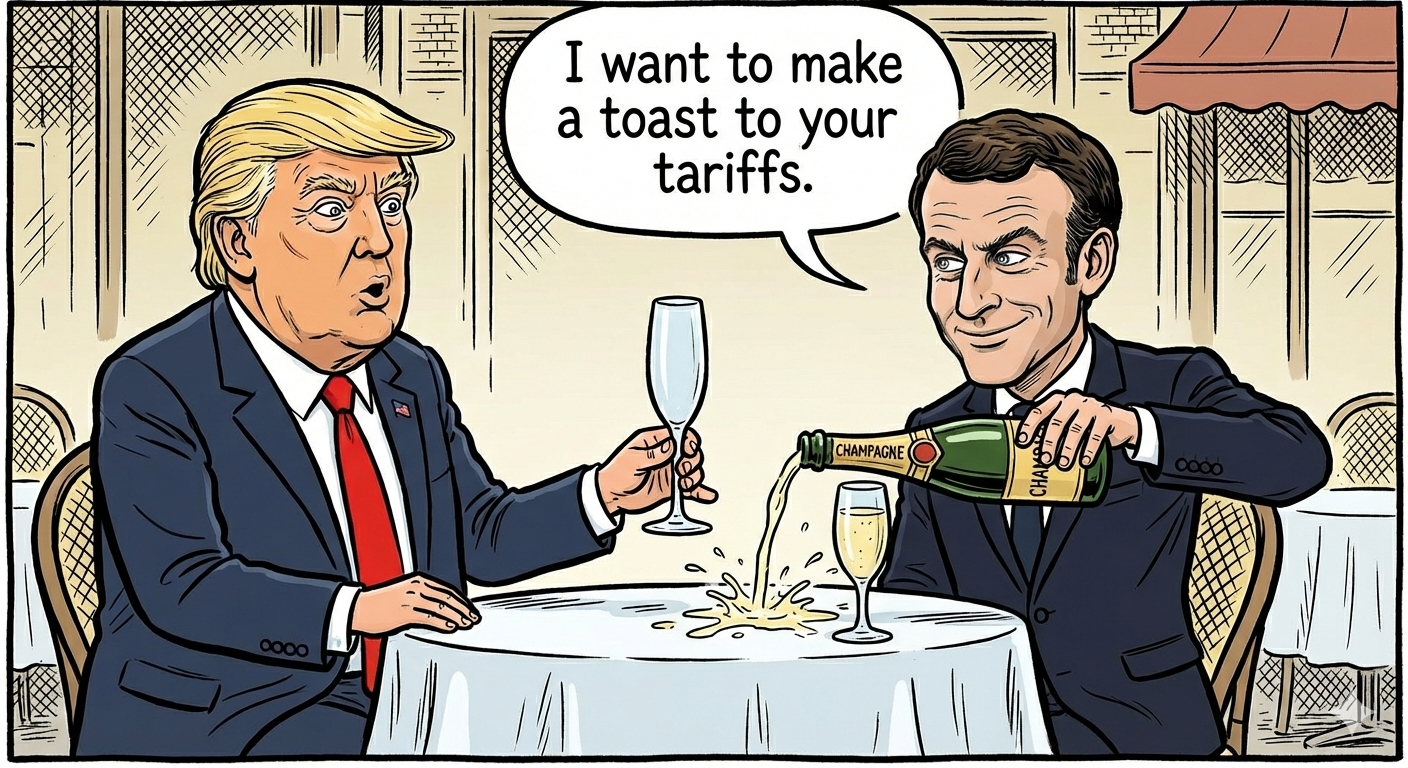
The response from Washington has been characteristically forceful. Trump has publicly threatened punitive tariffs—reportedly as high as 200 percent—on French champagne, a deliberately symbolic strike at one of France’s most iconic exports. These threats build on broader tariff measures applied to European states amid rising transatlantic tensions following the Greenland episode, which prompted unusually sharp political backlash and visible steps by Denmark and its partners to reinforce their posture there.
For Trump, tariffs are not merely economic instruments; they are political weapons. They punish without escalation, signal dominance without troop deployments, and allow confrontation without the risks of war. Just as importantly, they create public drama. They force foreign leaders into visible choices: bend, retaliate, or absorb the blow.
European leaders have often been on the receiving end of this approach. Trump has long portrayed Europe as bureaucratic, complacent, and overly reliant on American security guarantees. Macron, in particular, has served as a recurring foil—a young, articulate advocate of multilateralism and European sovereignty, embodying precisely the worldview Trump rejects.
Yet in this confrontation, something unexpected is happening. Trump’s pressure campaign may be doing for Macron what Macron himself struggled to do for years: turning him into Europe’s accidental “strongman.”
The term is metaphorical, not literal. Macron does not command Europe, nor does he dominate it. But he has become something just as important in this moment: a focal point. A figure around whom resistance, identity, and resolve can briefly coalesce.
For years, Macron argued that Europe must stand on its own feet—that it could not rely indefinitely on American protection or American restraint. He called for greater strategic autonomy, a more unified defense posture, and a Europe capable of acting as a geopolitical actor rather than a protected market. These arguments were often praised in theory and postponed in practice. Many European governments found them abstract, premature, or politically inconvenient.
Trump has changed that calculation.
By threatening Europe’s economic interests, by weaponizing tariffs, and by openly challenging norms of territorial and institutional restraint, Trump has supplied Macron with what he previously lacked: a tangible unifying external pressure. European governments may still disagree on budgets, migration, and regulation—but across much of the continent there is a growing recognition that Europe’s sovereignty is not a bargaining chip.
This is not because Europe lacks more severe threats. Vladimir Putin’s warnings and his war in Ukraine are far more dangerous, even existential. But existential dangers often narrow politics rather than animate it. Russia’s menace is familiar, historically embedded, and grimly expected — it drives preparation, discipline, and reliance on alliance structures. Trump’s pressure operates differently. It is immediate, personal, and humiliating. It comes not from a long-standing adversary, but from an ally. It feels less like an act of war than a betrayal, and therefore provokes something missiles do not: public anger, argument, and mobilization. In that sense, it is a modern form of soft war — fought not on battlefields, but in narratives, markets, and perceptions of dignity.
The champagne tariff threat, intended as a provocation, has instead become a rallying symbol. It is not just about wine. It is about the use of economic punishment to enforce political submission. The image has resonated far beyond France, reminding European publics that the issue at stake is dignity as much as trade.
As a result, Macron is increasingly seen not merely as the president who lectures Europe, but as one who is willing to absorb economic pain rather than capitulate on matters of principle. That perception matters. In politics, symbolism often precedes power.
None of this guarantees lasting European unity, nor does it ensure that Macron’s vision of strategic autonomy will prevail. Europe remains divided, cautious, and internally constrained. But momentum has shifted. Narrative ground has been gained. And in a geopolitical environment where legitimacy, resilience, and will increasingly matter more than raw force, those shifts are consequential.
In a world where nuclear weapons cannot be used and military force often backfires, the contests that matter are contests of pressure and endurance. Trump has chosen to escalate those contests through tariffs. Macron, by refusing to yield, has found himself unexpectedly elevated by the confrontation.
The twenty-first century may not belong to those who wield the biggest weapons, but to those who can withstand the sharpest pressures. And in this moment, Emmanuel Macron—intentionally or not—is showing how resistance itself can become a form of power.
Related Topics