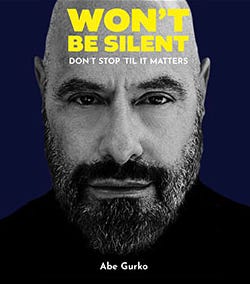
Won't Be Silent
How Will Our Stories Be Told?
And More Importantly, How Will You Fare?
This moment reminds me of the film title “Who Will Write Our History?” If you haven’t seen it, I highly recommend finding it.
The film tells a heartbreaking story about a group of intellectuals in the Warsaw Ghetto who understood how critical it was to document what was happening around them. They collected diaries, photographs, artwork, and pieces of everyday life, sealed them in tin boxes and milk cans, and buried them in basements across the ghetto. The hope was that when the nightmare ended, someone would dig deep enough through the rubble of Warsaw and find these precious gems to understand what they bore witness to — the unimaginable cruelty mankind was capable of.
It’s not like I’m comparing apples to apples, as we live in very different times. We have cameras in our pockets, social media platforms, the cloud, and countless ways to document what is happening around us in real time. Our challenge is not preserving history. Our challenge is what we do with all the information we have at our fingertips while we still have the ability to respond.
Information alone does not make history. People do.
And this is what has been weighing heavily on me.
As we watch the growing hysteria around antisemitism, antizionism, Jew hatred, and the constant battle over what is truth versus opinion, I find myself thinking about the future. Not mine. But what will my sisters’ grandchildren’s grandchildren learn about who we were during this moment?
We all know the power of storytelling and images — and how today’s legacy media has been corrupted by the Goebbels of our time. The films of Leni Riefenstahl showed the effects of propaganda and how it transformed ideology into emotion. What we have now are countless more content creators, many of whom are hell-bent on our destruction.
With the nonstop flood of images, videos, headlines, algorithms, and competing narratives entering our psyche, the challenge is trying to decipher what to believe. The question is: Can we build retaining walls strong enough to withstand the barrage of misinformation, rhetoric, and distortion?
The language designed to erase Jewish identity did and does not begin with violence. It begins with words. It begins when people convince themselves that an entire group of people no longer deserves understanding, empathy, or a place in the story.
This haunts me.
Will we be remembered as people who saw the warning signs and chose to act? Or will we be remembered for being part of the information age — with all the technology — yet many remained trapped inside our own echo chambers?
It’s why this question has become so personal for me.
It brings me back to the heart of Won’t Be Silent. After the events in Charlottesville, when Nazis marched openly on American streets carrying symbols of hate, I made a decision: I could not remain silent — being assimilated had taken its toll.
Silence in the face of hatred threatens all of us — the freedom to speak, the freedom to worship, the freedom to disagree, and the freedom to live openly and be loud and proud of who we are. This is the foundation of a free society.
We hear grumblings of a societal takeover from the most primitive of ideologies that threaten our very existence. This cannot stand.
History has shown how freedom is never guaranteed. It must be protected by each generation — fought for if necessary.
Won’t Be Silent is not only about my community. It is about the responsibility we all share to defend the values we believe in.
Someday, people will look back on this moment in time and wonder: How did this happen?
We all have a part to play in this story — the haves and the have-nots, the dids and the didn’t-dos, the hopefuls and the hopeless.
Question is: Will you be able to take a bow — or slither into the darkness for being cowardly and staying silent?