
Writer, Expat, Single Dad
How Would ‘Palestine’ Treat Its Citizens?
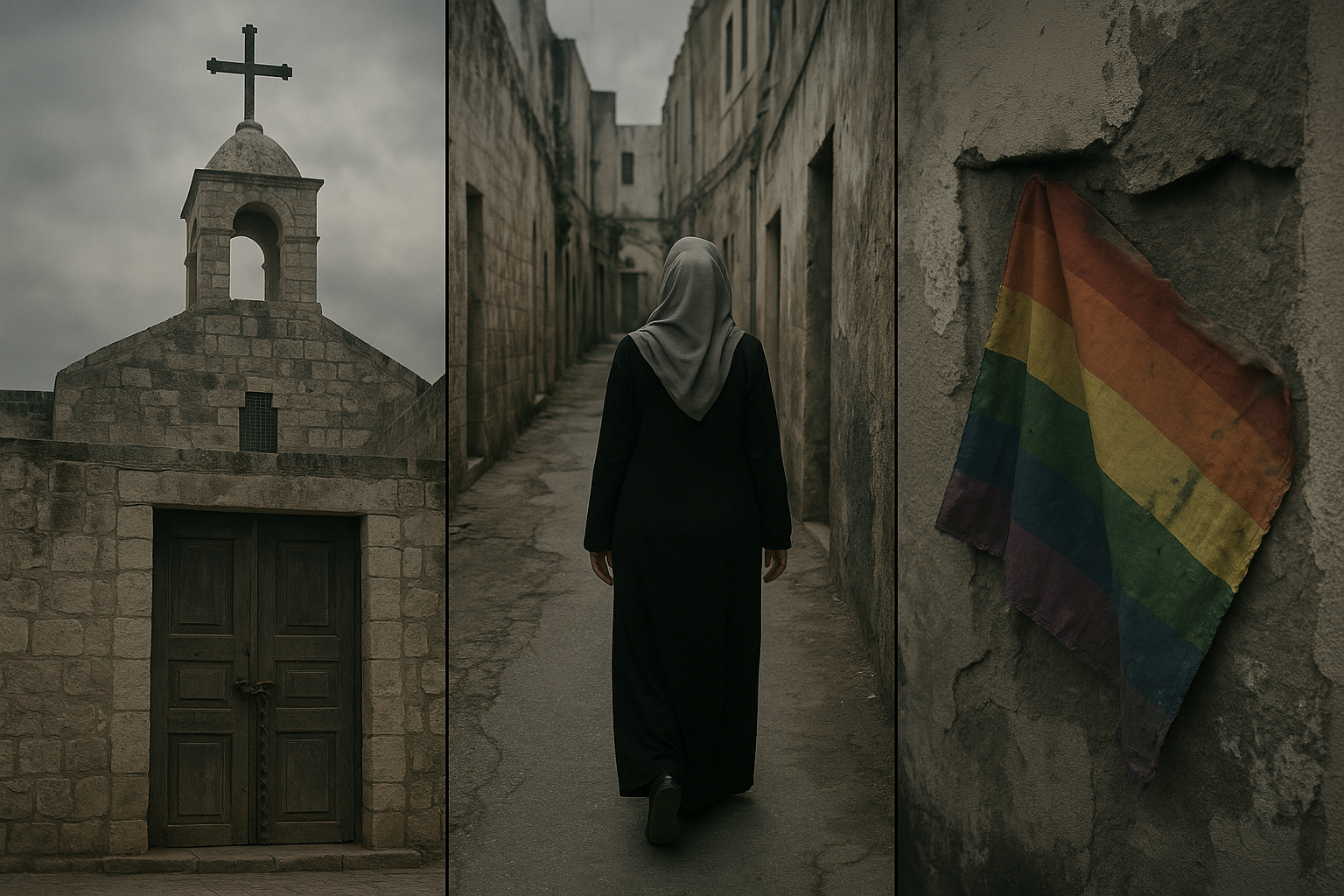
How Would the ‘State of Palestine’ Treat its Citizens? (ChatGPT)
The push for a Palestinian state — often accompanied by sadly misguided sympathy for the sadistic Hamas terrorist organization — has become a cause célèbre for many.
But if you take core liberal values seriously — equality, religious and personal freedoms, basic civil rights — you should think twice about championing a future Palestinian state under current conditions.
Here’s the thing: much of the West Bank and all of Gaza have been under Palestinian civilian control for decades. Israel controls security in these areas but is not involved in civilian governance.
This means we don’t have to guess how a nascent Palestinian state would govern – we can see it in practice.
Whatever your opinions and background, before cheering for Palestinian statehood, it’s worth taking a closer look at how Palestinian governing bodies actually treat their own people today.
Christians
In the Palestinian territories and Gaza, Christians are a dwindling minority. Palestine’s Christians are fleeing in large numbers – and not just because of the conflict with Israel.
A 2023 U.S. State Department report found overt bias against Christians in jobs, public services, and schools – where Christian history is often erased from textbooks. The Christian Broadcasting Network has reported extensively on systematic discrimination against Christians by both the Muslim majority and the ruling Palestinian Authority (PA).
Bethlehem, the very birthplace of Christianity, has long been a flashpoint for anti-Christian activity. In 2002, Palestinian Authority forces took control of the Church of the Nativity and held some 40 Christian clergy and nuns hostage for over a month. In 2016, Gaza’s Bishop Alexios warned that forced conversions of Christians to Islam there were occurring “under threats and violence.”
Since 2007, Christians in Hamas-controlled Gaza have also endured harassment, violence, and pressure to convert. That year, the director of the Gaza Bible Society was kidnapped and murdered. The next year, Islamic militants bombed Gaza’s YMCA. And in 2012, Greek Orthodox leaders reported a wave of kidnappings and coerced conversions to Islam.
If this is what life looks like today for Christians, would a Palestinian state reverse course? Without enforced legal protections and meaningful cultural change, Christians could all but vanish from the land they’ve called home for centuries.
Women
Women in the Palestinian territories live in a deeply patriarchal order. For this reason, the World Bank’s Women, Business and the Law 2024 ranked the West Bank and Gaza among the worst globally for legal gender equality. By way of example, family laws rooted in Islamic tradition still give Palestinian women half the inheritance of men and limit their property rights.
According to the UN Committee on the Elimination of Discrimination against Women, neither the Palestinian Authority in the West Bank nor Hamas in Gaza has enacted effective domestic violence legislation, and marital rape is not criminalized in either jurisdiction. The UN report also notes that “honor crimes” (killings or violent attacks against women by relatives for allegedly shaming the family) still occur, with courts often lenient towards perpetrators.
In pre-war Hamas-run Gaza, Human Rights Watch documented “morality” enforcement against women. This included harassment of women workers and restrictions on dress, beach access, and public behavior – sometimes enforced by Iranian-style “virtue police.”
Would an independent Palestinian state break this patriarchal pattern – or cement it? Without sweeping reforms and a deep cultural shift, Palestinian women could easily find themselves second-class citizens in their own country.
LGBTQ
Life for LGBTQ+ Palestinians in the West Bank and Gaza is brutal and nightmarish.
In the West Bank, same-sex relations aren’t banned outright in the penal code, but the PA’s own Office of Islamic Rulings has declared them a crime deserving harsh punishment.
According to the U.S. State Department’s 2023 human rights report, LGBTQ Palestinians face constant harassment, arbitrary arrests, and hate crimes – with no legal protections to fall back on. For transgender Palestinians, it’s even worse – there is no legal way to change gender markers on ID, and the hostility they face forces many to live completely in hiding.
In Gaza, the picture is even bleaker. Hamas enforces a British Mandate–era law making same-sex relations a crime punishable by up to 10 years in prison. That law has given cover to unchecked extortion, arrests, blackmail, torture, murder and abuse of anyone accused of being gay.
It’s no wonder that many queer Palestinians actually choose to live illegally in Israel – without papers, healthcare or social services – rather than risk their life under Palestinian rule.
If a future Palestinian state simply carries on with the same attitudes and laws, LGBTQ people wouldn’t just be marginalized – they’d be eradicated.
The Bottom Line
The record of the Palestinian Authority and Hamas is not hypothetical – it’s the lived reality of people under Palestinian civilian rule for decades.
I am vocally and actively critical of Israel’s flawed and counterproductive security policy in the West Bank and in pre-war Gaza. And I do recognize that there are progressive voices in Palestinian society that offer a glimmer of hope.
That said, there’s no denying that the treatment of women, Christians, and LGBTQ+ citizens reflects the core social values that currently shape Palestinian society. The Palestinian Authority (and certainly the Hamas) have no commitment to democratic norms, no history of significant state building, and no interest in minority rights.
Declared today, a Palestinian state would stand in direct conflict with the values most liberals claim to prize. Championing Palestinian statehood under the current political and social order isn’t a gesture of compassion or step towards restitution. It’s a choice to ignore decades of documented abuse and systemic discrimination. It’s not solidarity – it’s complicity. It’s the abandonment of the very principles many of its supporters claim to hold dear.
—
Originally published in the Fort Wayne Journal Gazette, Tuesday August 12, 2025.