Connecting Israel to the world through language, culture and technology
I Am the Etrog
For years, living in America, I have carried a quiet ache.
It comes from the persistent distance I have felt between the local Jewish community and the Israelis living right beside it. We walk the same streets, work side by side, celebrate many of the same holidays, and carry many of the same stories. And yet, too often, we seem to move through parallel Jewish worlds.
There is “them,” and there is “us.” American Jews and Israelis.
Sometimes I have wondered whether Israelis like me are seen as fully belonging to the Jewish communal story here, or as some slightly different kind of Jew, connected, certainly, but standing just outside the circle.
Then came October 7.
The massacre, the hostages, the war that followed, and the wave of antisemitism that spread across the world shook Jewish communities far beyond Israel. For a brief and powerful moment, it felt as though some of those walls had cracked. We reached for one another.
And I found myself thinking about the Four Species of Sukkot.
The Lulav (לוּלָב), Hadas (הֲדַס), Aravah (עֲרָבָה), and Etrog (אֶתְרוֹג) are different from one another. Jewish tradition has long used those differences as a metaphor for the diversity of the Jewish people. The mitzvah does not ask them to become identical. It asks us to bring them together.
That distinction matters to me. Unity does not require sameness. It does not require political agreement, identical religious practice, or the same relationship with Israel. It requires something much harder: the willingness to remain bound to one another despite those differences.
For a while after October 7, I felt that binding happening.
But time passes.
Three years after that terrible Simchat Torah (שִׂמְחַת תּוֹרָה), the solidarity I once felt has become more complicated. Debates about Israel, Zionism, the Israeli government, and the war have grown sharper. Criticism itself does not trouble me. Jews have never needed agreement in order to be Jews together.
What troubles me is something else. It is the feeling that political disagreement can become emotional distance. That criticism of a government can blur into a distancing from Israel itself, and sometimes from the Israelis who carry its pain personally.
I have felt the space between us beginning to widen again.
And perhaps because of that, I have also noticed something changing in me. Since October 7, I find myself reaching differently toward Jewish connection. Things I might once have passed by without much thought suddenly touch me. A Jewish symbol. A stranger saying Shabbat Shalom. A small ritual performed in public.
They feel different now. They feel like threads.
It was in the middle of this complicated emotional landscape, during Chol HaMoed (חֹל הַמּוֹעֵד) Sukkot, that something happened on an ordinary sidewalk.
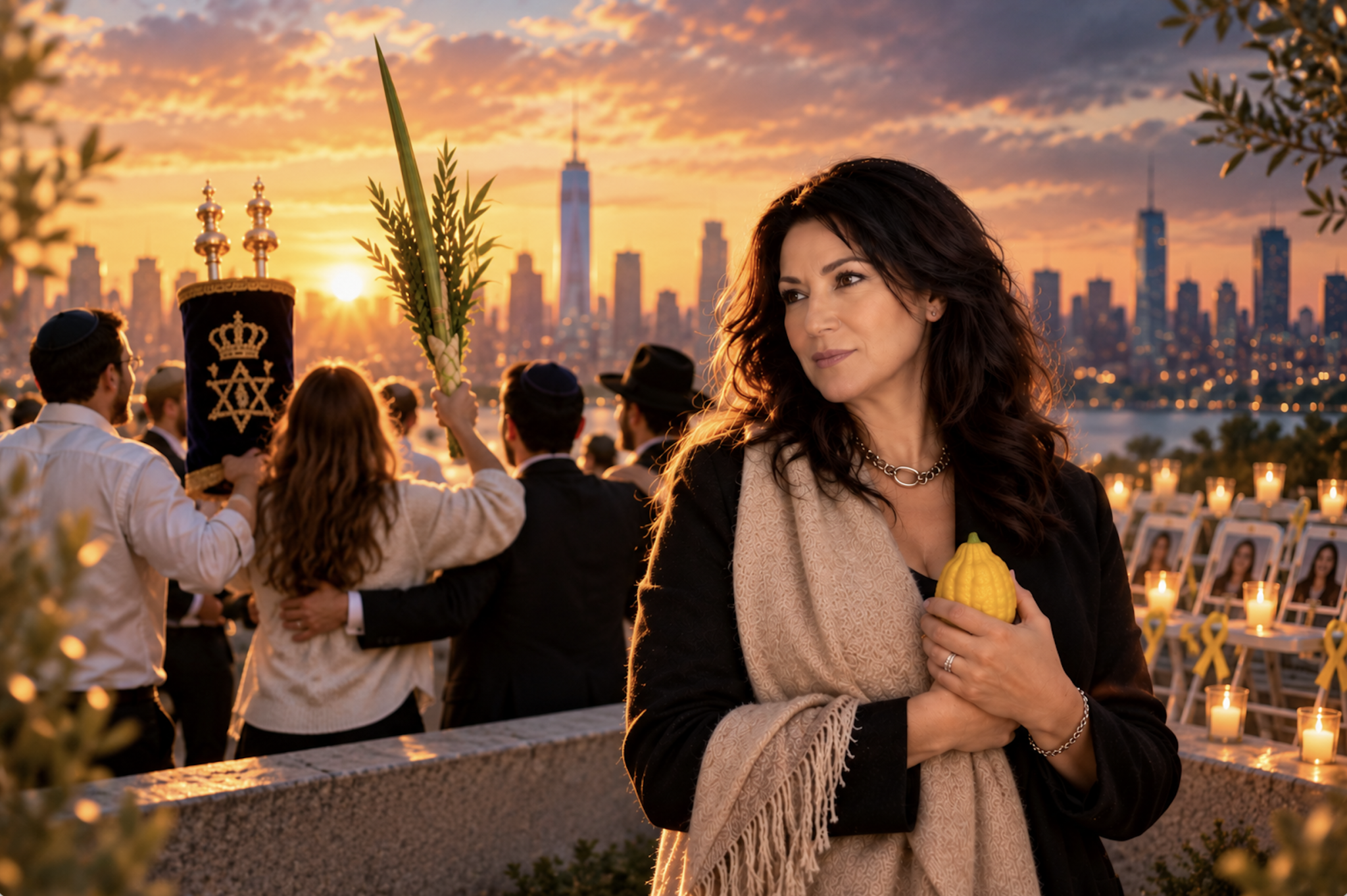
A lovely Chabad family stopped me and invited me to perform the mitzvah of taking the Four Species.
Something in me opened.
My heart expanded at the invitation in a way I am not sure it would have before October 7. I was unexpectedly moved, almost grateful. What might once have felt simply like a religious encounter suddenly felt like an invitation to belong, an invitation to step, even briefly, across an invisible line between our different Jewish worlds and meet inside something shared.
I smiled and said yes. And I meant that yes more deeply than I expected.
Then I realized something surprising. This might have been the first time in my life that I was performing this mitzvah entirely for myself.
When I worked at a Jewish day school in Los Angeles, I taught about the Four Species. I may have even held and waved them with students. But then I was the teacher. The ritual was something I was explaining, demonstrating, and helping others experience.
This time, there was no lesson plan, no students, no pedagogical purpose. There was just me, a secular Israeli Jewish woman standing on an American sidewalk, holding the Four Species because, at that particular moment in my life, I wanted to.
I wanted to participate. I wanted to come closer.
So I said the blessing and performed the mitzvah with intention.
And as I held the Four Species in my hands, a thought came to me with almost physical force:
I am the Etrog.
The thought felt almost too precise.
The Lulav, Hadasim, and Aravot are bound together in one bundle. The Etrog is not. It is held separately, on the other hand, close to the bundle. The Etrog is not outside the mitzvah. Without it, the mitzvah is incomplete. All four species are necessary.
And there I was.
An Israeli Jew in America. Close. Connected. Unquestionably part of the same people. And still, somehow, held separately.
Then the moment shifted.
As soon as I finished the mitzvah, the mother handed me Shabbat candles. With warmth and enormous enthusiasm, she urged me to light them on Friday night. She spoke passionately about the coming Shabbat, about Simchat Torah, about joy. She wanted me to understand how special this Shabbat would be.
I listened and waited. Because surely the next sentence would come. Surely Simchat Torah could not be spoken about without mentioning the Simchat Torah, 2023.
But October 7 was not mentioned. Not once.
Finally, gently, I brought it up myself.
She became quiet. For a moment, she looked at me as though she did not quite understand why I had introduced it into the conversation.
And something inside me dropped.
The same heart that had expanded only moments earlier suddenly contracted.
Because for me, as an Israeli, Simchat Torah can no longer exist untouched by October 7. I cannot hear the name of the holiday without being taken back to that morning. I cannot think about dancing with the Torah without remembering the images from that day. I cannot hear someone speak about the joy of Simchat Torah without also hearing the echoes of Simchat Torah, October 2023.
Perhaps she can.
Perhaps that does not mean she does not care. Perhaps October 7 lives somewhere completely different inside her Jewish consciousness than it does inside mine. One brief encounter on a sidewalk cannot tell me what another person carries in her heart.
I know that. And still, it hurt.
Because only moments earlier, I had opened mine. I had stepped toward her world. I had taken the Four Species. I had said the blessing. I had accepted the invitation not simply to perform a mitzvah, but, in my own mind, to cross some of the distance between us.
And suddenly I realized that the bridge I thought I was crossing still had a gap in the middle.
I was standing there holding a symbol of Jewish unity while feeling, with painful clarity, how differently we carried the same Jewish moment.
And then the Etrog took on another meaning for me.
In another Jewish teaching, the Four Species are compared to parts of the human body: the Lulav to the spine, the Hadas to the eyes, the Aravah to the lips, and the Etrog to the heart.
The Etrog is the heart.
Suddenly, the metaphor felt almost painfully complete.
Because that was exactly what I had brought into this encounter: my heart.
A heart that had expanded when a Jewish stranger invited me in. A heart that, since October 7, had become more sensitive to gestures of Jewish connection. A heart that wanted to move closer.
And a heart that, only minutes later, felt strangely alone.
Perhaps that is what is missing from some of our conversations about Jewish unity today. Not knowledge. Not arguments. Not statements of solidarity. Not political positions.
The heart.
The willingness to understand that another Jew may carry Jewish history differently in her body than we do.
For me, October 7 is not simply an event I remember. It lives inside my Israeli identity. It changed the meaning of Simchat Torah. It changed the meaning of being Israeli outside Israel. And, perhaps unexpectedly, it changed the way I experience being Jewish.
It made me want to reach toward things I once might have kept at a distance. Even the Four Species offered to me by strangers on a sidewalk.
For another Jew, Israel may occupy a completely different emotional space. October 7 may live differently inside their Jewish identity.
That difference is real. But perhaps Jewish unity has never meant erasing difference.
The Four Species certainly do not teach us that.
They remain entirely themselves. The Aravah does not have to become the Hadas. The Lulav does not have to become the Aravah. And the Etrog does not have to squeeze itself into the bundle in order to belong.
The Etrog can remain separate and still be essential to the whole.
That day on the sidewalk, I wanted to move closer. Instead, I walked away feeling once again like the Etrog: unquestionably part of the Jewish whole, essential to it, held close, but still, somehow, held separately.
Maybe that is the challenge before us now.
Not to insist that every Jew think the same way about Israel, Zionism, religion, politics, or Jewish identity. Not even to insist that we carry October 7 in exactly the same way.
But to recognize the heart the other person is holding. To understand what makes it expand. To understand what makes it ache. And to learn how to hold one another close enough that difference does not become distance, and disagreement does not become disconnection.
Because having all four species is not enough.
The mitzvah is in bringing them together.
#972education #IAmTheEtrog #JewishIdentity #IsraeliIdentity #IsraelisInAmerica #AmericanJewry #JewishCommunity #JewishUnity #Sukkot #SimchatTorah #October7 #Israel #JewishLife #Peoplehood
Related Topics
Related Posts