


"Violence can be justifiable, but it will never be legitimate." — Hannah Arendt
I Am This Way
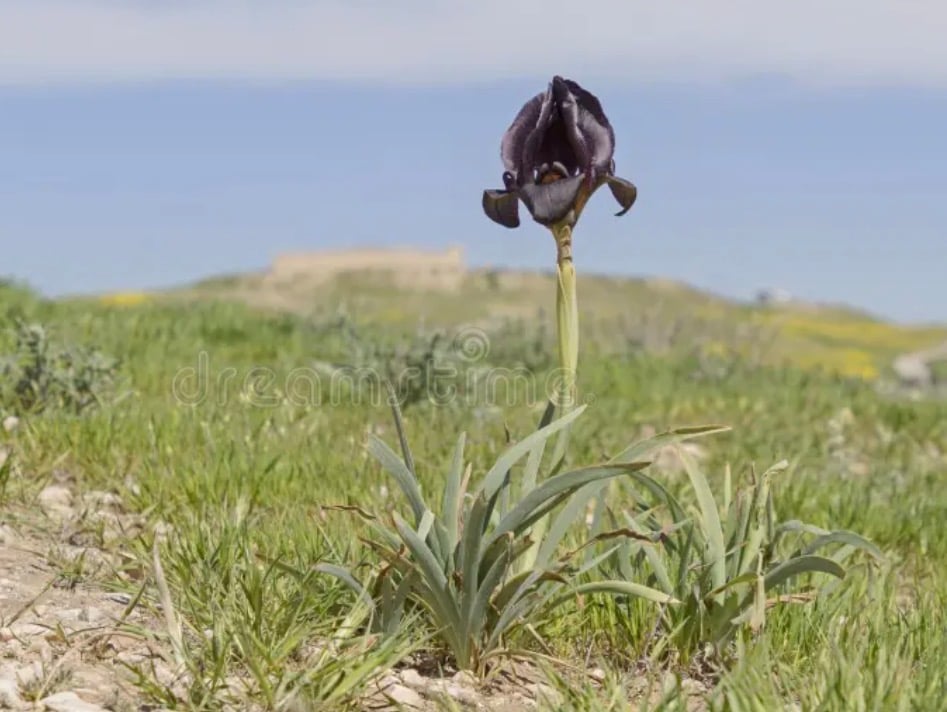
Black Iris, Personal file.
On the dry hillsides of northern Israel grows a flower that, like me, has almost nothing to offer the world. They call it the black iris. It is dark as the worn velvet of an ancient robe, a purple so deep that light gives up passing through it and only touches it from without. I sit near it on the mornings of late winter and talk to myself, because it is perhaps the only creature that understands what I am.
The iris holds no nectar. It offers no sweetness, no perfume to intoxicate, none of the promise of abundance that other flowers use to call to those who pass. Whoever approaches it hungry departs hungry. It has learned, across thousands of seasons, that it has nothing to give but its own dark body, and that this dark body knows how to do one thing only, to keep warmth. When the sun sinks behind the hills, and the cold comes down from the mountains like an invisible water, a small bee without a hive, without sisters, searches for somewhere to spend the night. In the throat of the iris it finds a warm shelter, because the petals drank the whole day’s sun and give it back slowly to the sleeping creature, while the stars turn high above over the silence of the hillside.
It is all the flower possesses. Shelter. And I, who have crossed so many countries and so many names, discover that I too have nothing more than this to offer whoever draws near. Not the riches they expect of me, not the honey they come to seek, only a warm place where someone weary might sleep a night without dying of cold.
It took me nearly a whole life not to be ashamed of this. There was a time when I wanted to be the broad river that feeds the fields, the orchard heavy with fruit, the spring from which everyone drinks. I wanted to be needed, I wanted to be seen. But the river did not choose to be a river, nor did the iris choose to be an iris, and perhaps the only wisdom left to me is to accept the exact measure of what I am. I am the dark flower of the hillside. I give little, and I give whole the little that I have.
There is one more thing the iris teaches me, and it is the hardest of all. For nearly the entire year it does not exist. Once the brief spring has ended, the petals fall, the stalk dries, and the plant descends into the earth, drawn back into a bulb that no one sees. Months upon months of invisibility. Whoever crosses the hillside in the heat of summer never imagines that down there, in the warm darkness of the soil, a life waits in silence for the hour to rise again into the light. The iris has not died. It has only vanished from the eyes of the world, and the world, which loves only what it can see, went about forgetting it.
This is how I feel before my own family. They did not lose me, they did not cast me out, there was no cruelty and no sudden gesture. I simply ceased to be visible. I descended into an earth they cannot see, a distant country, a language that is not theirs, a life made of words that I write alone at daybreak. I exist, I breathe, I bloom in my own way in another season, but for them it is as though I had withdrawn into the bulb and the silence had closed over me. Sometimes I wonder whether they still think of me, or whether, as they do with the flower beneath the soil, they merely presume that I will return when the season comes, without seeing that no one is promised the next spring.
Solitude, I have discovered with the years, is not the absence of people around us. A man may live surrounded by voices and remain the buried bulb, a whole life presumed and never looked upon. It dwells in the distance between what I am within and the so very little that others manage to see without. And yet I no longer feel the bitterness of before. The iris does not curse the winter that blots it out. It descends, it waits, and when its hour comes it opens all its darkness at once before the sky, without asking leave, without awaiting an audience, blooming out of the pure need to bloom.
Perhaps this is what I have still to learn from it. No longer the hope of being noticed at last, for that hope cost me too dearly. What remains is the courage to bloom in the dark, brief and entire, offering the one good I possess, a little warmth stored through the cold days, so that some solitary creature, as lost as I am in the vastness of the hillside, might find where to spend the night and not die alone before the sun returns.
And if one day they ask me what I made of my life, I will say that I was neither river, nor orchard, nor spring. I was the black iris of northern Israel. I did not last long and possessed almost nothing. But the little I had, I gave without reserve, and while it lasted, it was everything.