
‘I don’t know’ is also an answer
We Jews have established a reputation for believing that asking questions is not only acceptable, but sacred. Questioning, pushing, delving deeply: these are all parts of our search for Truth, Emet, a quality we associate with God.
What I believe we need to work on is living with the discomfort we may feel when after generations of digging, we sometimes cannot reach an answer. We can unroll a Torah and clearly see the pitch-black ink on the snow-white parchment, yet the life this Torah informs is often lived in shades of grey.
This unquenchable thirst for answers sometimes leads to unfathomable ideas. While our trek through Genesis has had us hopscotching around several of these awkward moments so far, there is one instance in this week’s parasha of Vayishlach that calls out to me for a public reaction.
The rape of Jacob’s only daughter, Dinah, was a tragedy. It was also a violent crime. The reason rape occurs is because a man aggressively attacks a woman sexually. That is why. Yet our rabbis and teachers, who obviously understand that, still stop to ponder, really, WHY? A common Jewish perspective is to seek deeper reasons, to look beyond the story as it is plainly presented to extract some meaning that endures beyond the simple, in this case ugly, facts. Here is one thread that emerges from this exercise.
Jacob is preparing to meet his brother Esau with the expectation that he and his family may need to battle him. “That same night he (Jacob) arose, and taking his two wives, his two maidservants, and his eleven sons, he crossed the ford of the Jabbok.” (Genesis 32:23). The question is glaring and Rashi here quotes a midrash that makes it plain, “And his eleven sons — But where was Dinah? He placed her in a chest and locked her in so that Esau should not desire to marry her. On this account Jacob was punished (the midrash implies this; Rashi makes it plain) because he had kept her away from his brother. (Had he not,) she might have led him back to the right path; she therefore fell into the power of Shechem.” (Genesis Rabbah 76:9)
The midrash uses its foreknowledge of Dinah’s rape to circle back to this episode. The Torah gives no reason why Dinah is not included in the transport of the children. The question is a good one, and it is right that it was noted. But the answer uses the rape of Dinah, literally uses her, as Jacob’s punishment for withholding her from marrying Esau. There is a lot of conjecture here. A) That Esau would want to take Dinah, B) That Dinah could influence Esau to turn away from evil, C) That there is no other innocuous reason why Dinah’s transfer was not mentioned. But sweeping all of this aside, Rashi brings us a midrash that provides an answer, but in doing so places God into the role of an enforcer who terrorizes a child and makes her father watch in order to punish him.
There is enormous value in searching for meaning beyond the plain text. But sometimes an explanation raises more troubling questions than the one it set out to answer. This midrash exists. We have no standing to remove it. But Rashi, why did you have to perpetuate its teaching? You could have noted the question, and left it at that. You might have learned from … Hey! You might have learned from Rashi! Just a bit later in this very same parasha, after Jacob wrestled with the “man” and God conferred the name Yisrael upon him, we come across this verse, “God parted from him at the spot where God spoke with him.” (Genesis 35:13) Rashi wants to know, why do we need the words “at the spot where God spoke with him.” His answer, “I do not know what this comes to teach us.”
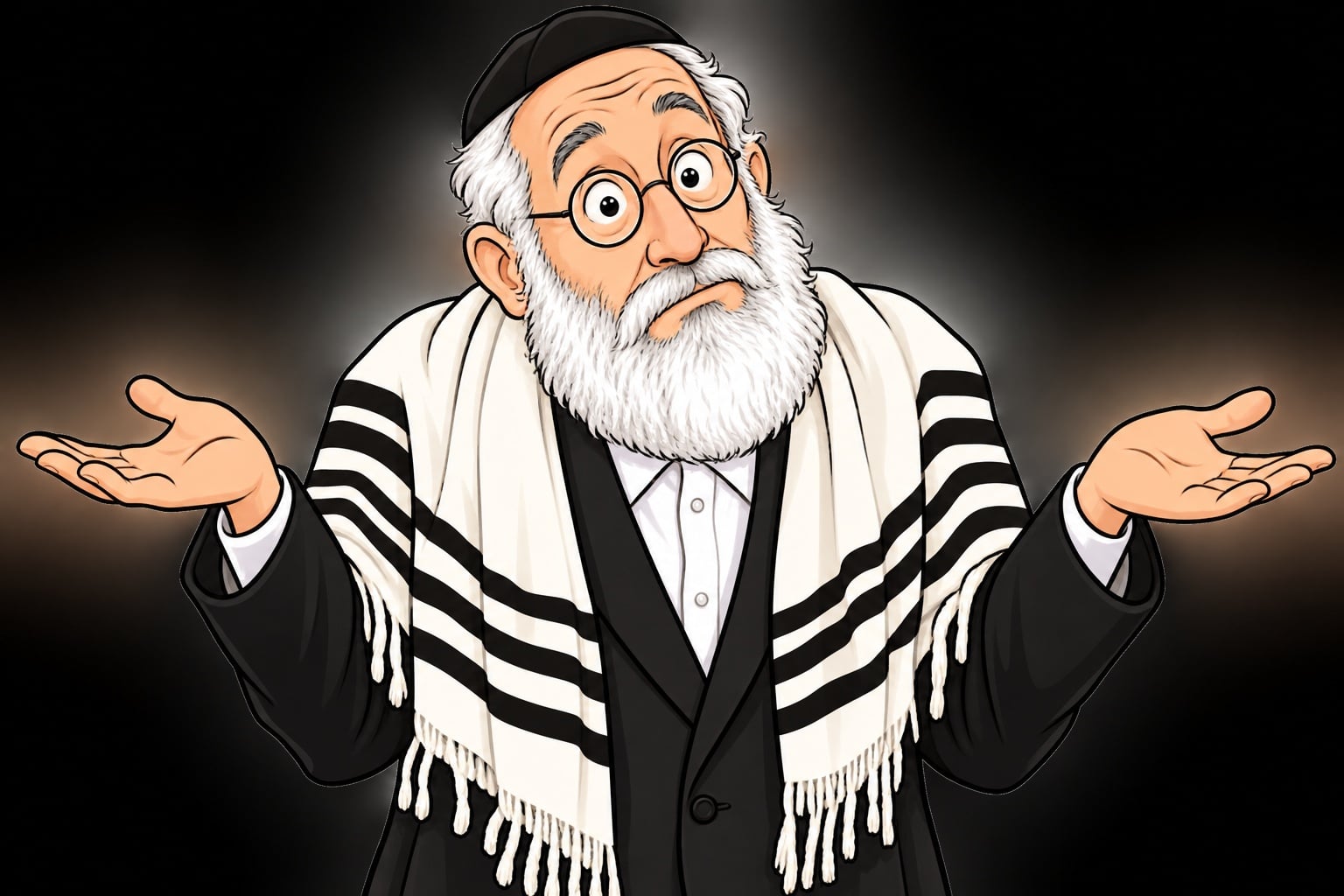
I don’t know. Sometimes Rashi does not know. And that’s okay.
Rashi may have adopted this posture from this advice in Brakhot 4a, “Accustom your tongue to say: I do not know, lest you become entangled in a web of deceit.” In fact, Rashi comments here, “You will be caught up and ensnared by your own words.” Indeed.
The Babylonian Talmud that is so saturated with questions, queries and quagmires is fairly comfortable in answering, “I don’t know.” It uses the term, Tayku over 300 times. Tayku has traditionally come to be understood as the Hebrew acronym, Tishbi Yetaretz Kushiyot U’ba’ayot, “The Tishbite (Elijah, heralding the Messiah) will resolve difficulties and unanswered questions.”
Yet even Elijah does not know it all. This from Sanhedrin 97b:
“Elijah said to Rav Yehuda: The world will exist for no fewer than eighty-five Jubilee cycles, and during the final Jubilee, the son of David (Messiah) will come.
Rav Yehuda asked him: Will he come at the beginning of that Jubilee or at its end?
Elijah answered: I do not know.
Rav Yehuda then asked: Will that final Jubilee cycle be completed before he comes, or will it not be completed?
Elijah answered: I do not know.”
“I don’t know.” It is an instructive thing for a parent to say. It is an honest thing for a friend to say. It is a liberating thing for a teacher to say.
Shechem raped Dinah. Why? Because Shechem abused his power and wielded his strength in a most horrible way.
Dinah was not accounted for in Jacob’s transport of his family. Why? I don’t know.