


A comedic survival guide to a country that breaks you, rebuilds you, and calls it Tuesday.
I Don’t Need Love to Be Blind. I Need It to See Precisely.
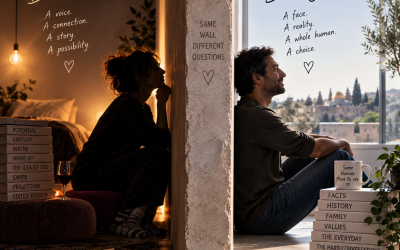
I recently discovered that Love Is Blind: Israel doesn’t exist. This seems an extraordinary oversight, particularly in a country where marriage, dating, and the question “why are you still single?” are considered matters of legitimate public interest.
For those fortunate enough never to have surrendered several hours of their lives to Netflix reality television, Love Is Blind puts single people into separate rooms called pods and lets them date without seeing one another. They talk through a wall, fall in love, someone proposes, and only then do they meet—apparently an experiment to see whether love is genuinely blind and not, as I initially assumed, what happens when nobody on the production team has a Jewish mother.
Israel clearly needs its own version and, G-D help us all, I think I should be on it. I am probably not Netflix’s preferred demographic. Reality dating television traditionally favours women who are young, exquisitely groomed, and capable of saying, “I just want someone who is here for the right reasons,” without wondering what the wrong reasons for entering a televised marriage experiment might be. (Where do they find the contestants? There were some serious psycho vibes radiating from a few of them!! Narcissist *Sam*cough* Maybe it’s Botox, maybe he suffered a stroke and has zero movement in his face… Or… he is a psychopath and doesn’t have a natural inclination to laugh or smile, or frown when appropriate *Eddie*cough*)
I would enter the pod with reading glasses, three cats waiting at home, several decades of evidence and questions. Are you Jewish? How Jewish? Define Jewish. Where did you grow up? When did you make Aliyah? Kosher? Shabbat? Which shul? Have you been married? How many times? Are you still friends? Why not? Who did you vote for? Actually, leave that one until episode three. We need somewhere for the relationship to deteriorate.
The fundamental problem with Love Is Blind: Israel is that nobody in Israel is more than three WhatsApp messages away from your entire romantic history. Within seventeen minutes, somebody will have messaged somebody’s cousin in Modi’in who went to school with the man’s sister in Johannesburg, who remembers his first wife from Bnei Akiva and has Opinions. By dinner, there will be documentation; by breakfast, screenshots; and by lunchtime, an aunt in Netanya will have established that he behaved badly at a wedding in 2009. Love may be blind, but the Jewish people have sources.
Still, there is something about the pods that appeals to me because dating has become an extraordinarily visual business. We examine photographs of strangers as if they were forensic evidence. Too old. Too short. Too serious. Why is he holding a fish? Why are they all holding fish? And why is there invariably one photograph apparently taken during the Rabin administration? Swipe, reject, next. We call this having standards because “disposing of human beings with your thumb” sounds unpleasant.
I am hardly innocent. I have preferences, prejudices and deal-breakers, plus enough emotional scar tissue to upholster a small sofa. Attraction matters too. You can adore somebody’s soul and still not want them anywhere near your underwear, so I don’t particularly want love to be blind. I want it to take a thorough look.
There was a time when the great romantic question for me was whether someone would choose me. I became exceptionally good at auditioning: funny enough, useful enough, understanding enough, forgiving enough. There are humiliations we recognise immediately, and then there are the ones we dress beautifully and call love. I spent years worrying about whether I would get the part without realising I was also meant to be casting.
That changes the questions completely. Not: does he want me? Do I like myself around him? Can I disagree without preparing a legal submission, three affidavits and an apology? Can I say what I need? Can I be quiet? Ridiculous? Difficult? Do I feel more myself in his company, or do I spend the relationship quietly removing pieces of myself so there is more room for him?
None of this would make especially sexy television. There is no hot tub, nobody throws a drink, and the soundtrack would struggle terribly, but I suspect these questions have rather more to do with love than whether two attractive strangers can maintain eye contact beside an infinity pool.
An Israeli version would complicate things further because none of us enters the pod alone. We bring families, countries, languages, exes, children, wars, grief, traditions, beliefs, the places we left and the places we chose. A wall can hide my face, but it cannot hide my life, and at this point I don’t want it to.
Perhaps that is the advantage of arriving at love after enough mistakes to constitute longitudinal research. I no longer want somebody to fall for the edited version and spend the relationship discovering the footnotes. Nor do I want to fall for potential: the imaginary man someone might become once he heals, changes, commits, apologises, stops, starts or finally understands what I have been patiently explaining since 1991.
So if Netflix calls, I’ll consider the pod. I’ll sit behind the wall with my reading glasses and inconvenient history and, for once, I won’t be waiting for the verdict. I won’t be wondering whether he chooses me because I’ll finally remember that I am choosing too.
Then the wall can open, and we can see each other properly. If we are extraordinarily lucky, neither of us will look away, although because this is Love Is Blind: Israel, we will have approximately eleven seconds to enjoy the moment before somebody’s mother rings.
She knows his family, and apparently, I can do better.