

I Expected to see the Big Bad Settler Terrorists – I saw Boys on Donkeys
Last Sunday was my third day of Protective Presence. I drove up to Tayibe from Tel Aviv with Eyal, a teacher of Bible and Jewish studies at a small college, and Benny, an American rabbi at a Conservative synagogue.
When we arrived, the road was blocked. We didn’t know the reason. I saw the remains of what looked like a car burned down on the street and theorized that there was a connection.
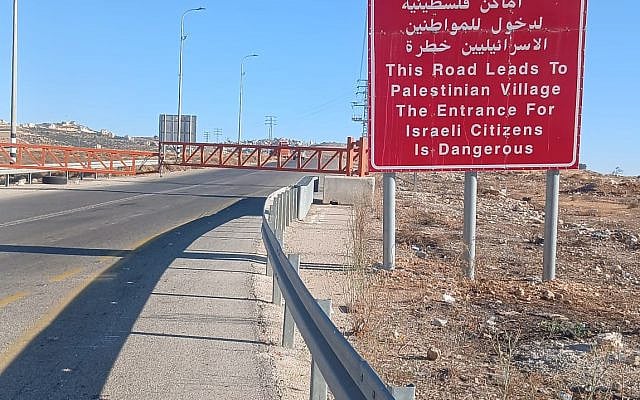
I’d like to make a note about the sign in this picture. It says that the entrance to a Palestinian village is dangerous for Israeli citizens. The reason it says “dangerous” and not “illegal” is because it is in Area C. In the past I encountered a similar sign that used the word “illegal,” because the road we were driving on was in Area C but the village was in either Area A or B.
You need to understand how things worked during the Oslo years to understand why it ended up like this. There was a specific amount of territory that Arafat was allowed to liberate from Israeli control, but he was free to choose where the territory was located, so instead of dividing the West Bank into three neatly organized sections, he chose over a hundred little splotches in order to maximize the amount of people who would be able to live under the Palestinian Authority.
The people who made that sign don’t know anything about the people who live in Tayibe. The reality is that it is much safer for me as an Israeli than the people who live there, however the settlers have become less hesitant about assaulting Israeli and international volunteers in recent years.
An Israeli guy arrived on the other side, ready to leave from an overnight shift of protective presence. A Palestinian taxi driver and another Palestinian car showed up. We called the military to ask them to open the road.
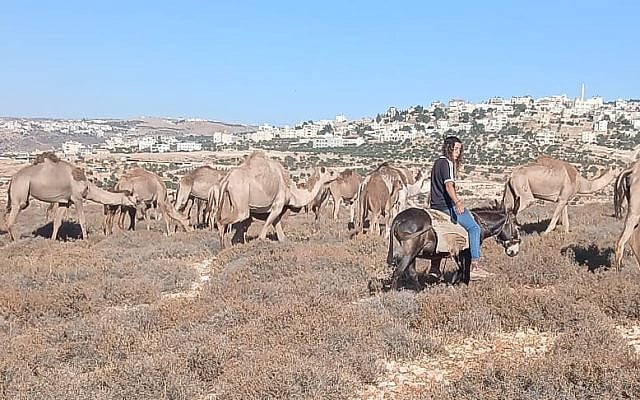
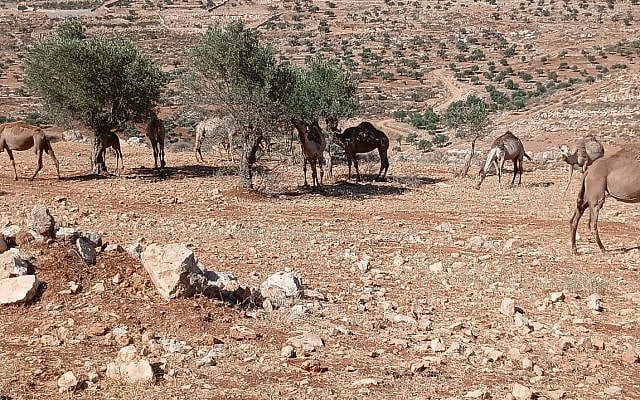
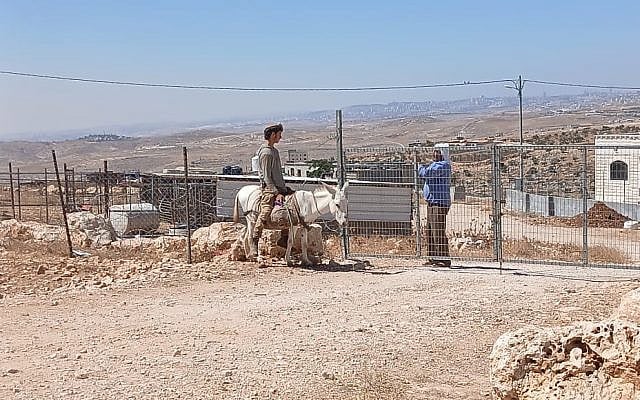
A young settler boy arrived, riding a donkey, together with a herd of camels. I learned on a previous shift that the settlers don’t use the camels for any commercial purpose; they only use them to sabotage Palestinian olive trees. I went over to him to take pictures. He called me a “son of a prostitute,” as I walked away.
Benny called the military police and I recorded the conversation. I have evidence in my phone that the military knew already at sunrise what was going on. The woman on the other line told us not to go into the village because it’s Area A. She may have confused it with a different village. I mentioned afterwards that he should’ve asked if it’s OK for the settler to go into area A.
We went to a small compound of homes on the outskirts of Tayibe because that was where the camels went. I took pictures of the camels eating from the olive trees and we sent it to the police. They opened a file number for us, so we could continue to update them.
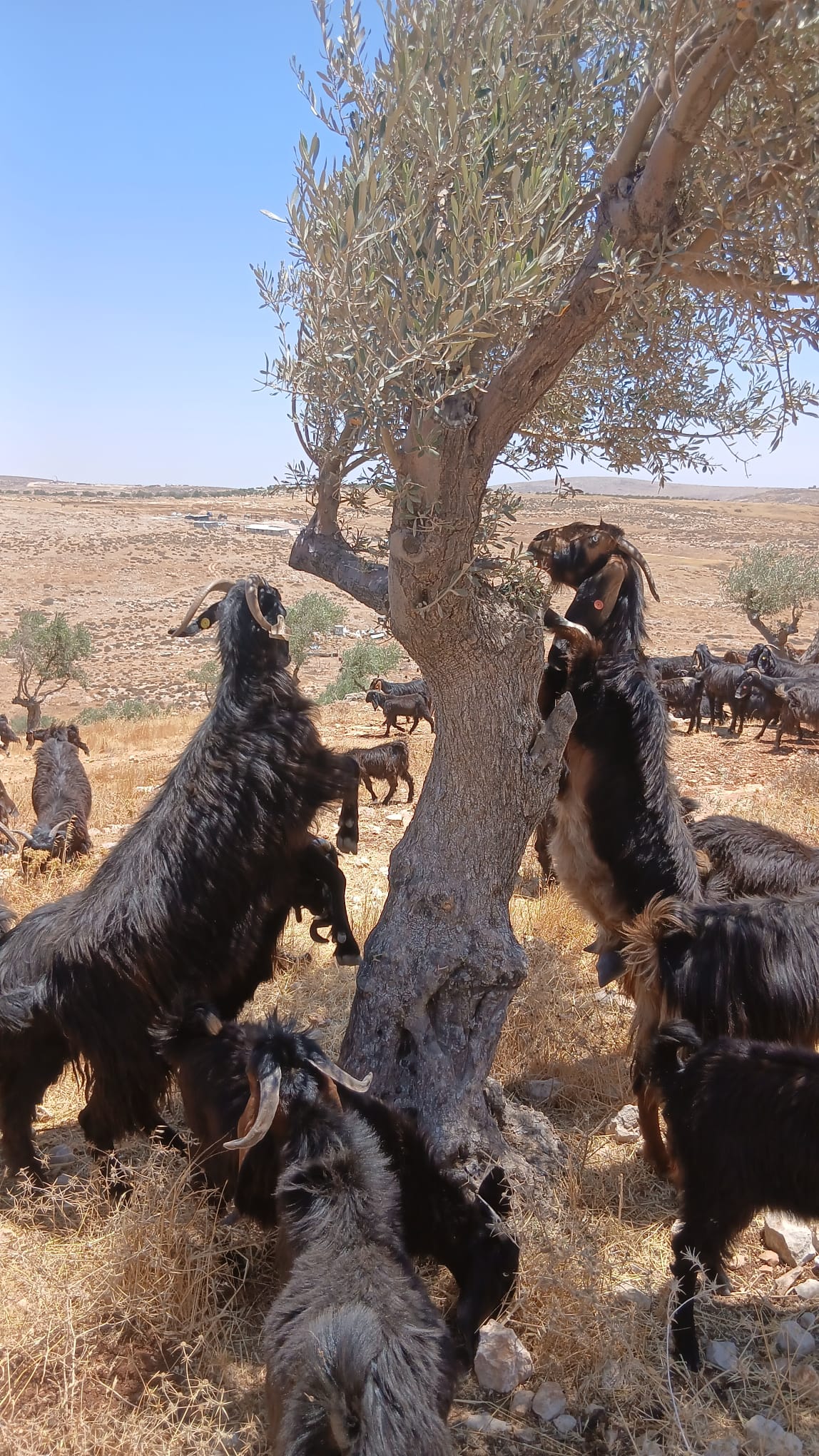
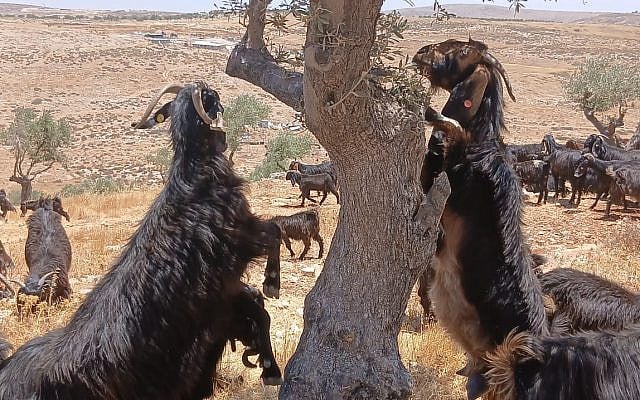
Another settler boy arrived, also on a donkey, accompanying a herd of goats. They consolidated their animals outside another compound of homes and they rode around while we filmed them. Not much was happening.
We got a call that there was a crisis at Naib’s property (where I spent most of the day on my previous shift). Eyal stayed. When Benny and I arrived, there was a lot of screaming and pushing. Two teenage boys were trying to get through the gate of the compound. When the settlers saw Benny and I, one of them hopped on his donkey and left, and the situation became calmer. We managed to herd the goats of the remaining settler away from the compound, but they continued to graze on the olive trees.
There was a lot of yelling and insults in both directions. Both sides were filming each other. There were five volunteers, one local Palestinian man, and one settler. It was weird seeing so many adults in conflict with such a young boy. He was maybe 15. I couldn’t judge the other volunteers because I didn’t witness much of what was going down before I arrived. The boy was trying to push the Palestinian man and other people were putting themselves in the middle.
After the event ended, the locals served us an elaborate meal as a token of their gratitude.
Benny and I returned to the previous compound. There were two boys riding around with herds of animals. A car pulled up and three more settler boys got out. At first they were just sitting around and talking.
This is a picture of some local kids looking down at the threatening teenager who is plotting to get past the fence.
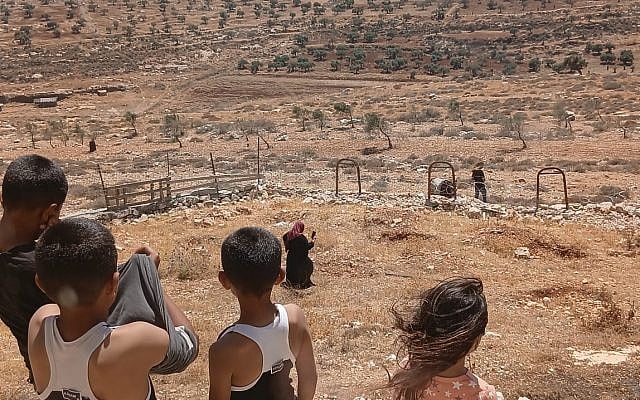
I filmed a boy who hung out beside the fence and switched off between playing with his phone and removing stones from under the fence. As long as I was filming him, or holding my phone and pretending to be filming him, he wouldn’t remove any stones. In any case, he managed to create a hole big enough for someone his size to slide under. An older Palestinian woman came to film him and he threw rocks at her.
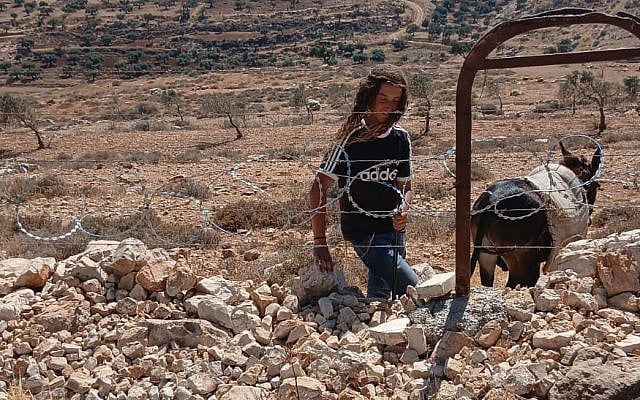
I sat down close to the fence and looked closely at the boy, into his eyes. I saw the face of the “bad boy,” that I have seen so many times as a teacher.
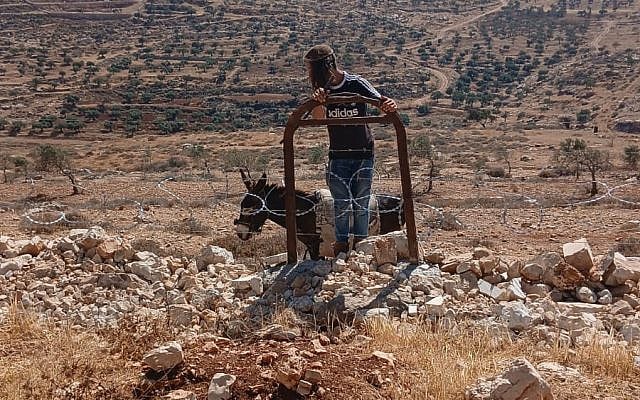
At one point, one of the local kids brought me some cold water. I stood up and took a drink, dramatically displaying how much I enjoyed it. Why did I do that? I guess I felt bullied. My reasoning was that it would weaken him and get him to go back home and get some cold water himself. What is home to him? He probably lives in a trailer surrounded by a scorched landscape. I mentioned to Benny that this is their summer break; they should be playing basketball. I later learned that this isn’t actually their summer break because they don’t go to school. What I witnessed them doing today is what they do the entire year.
I refuse to use the word “terrorist” to describe children. If you say that’s not fair to the victims, I will respond that there is a terrorist but it’s not them. The terrorists are their parents and the terrorist is the state that we pay taxes to. These boys are victims of neglect and indoctrination. They are victims of a state that refuses to intervene.
There were numerous phone calls with the police throughout the day, though they never showed up. I learned from Benny that during his previous shift, there was a particularly ugly scene, and the police did arrive. They took down names and left, and the scene continued as before.
Towards the end of my shift things calmed down, though after we left, our replacements had to deal with a settler who showed up at Naib’s property with pepper spray. I took some pictures of empty goat sheds. I learned during my previous visit that Palestinians get rid of their goats when an outpost gets set up nearby.
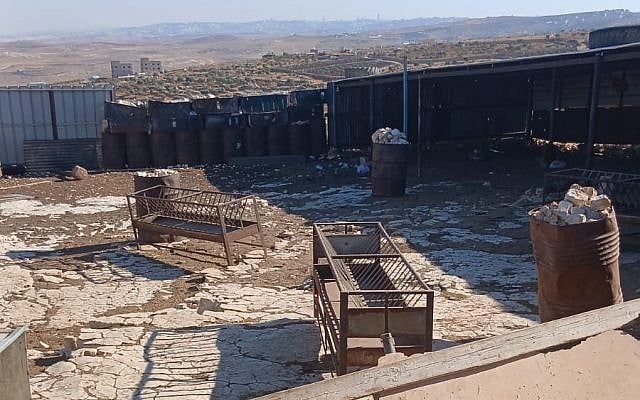
It’s hard to feel motivated to spend so much time protecting such a small number of people. Now that they don’t have goats, there isn’t much reason for them to be living in such an isolated way. But if they leave, then the settlers will just choose a new victim. Maybe after the next elections it will be possible for them to work as shepherds again.
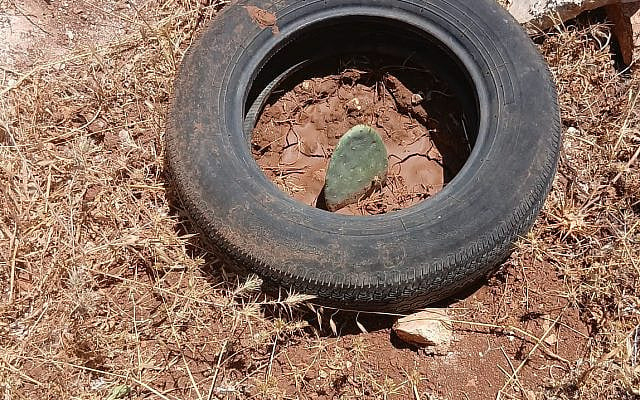 A newly planted cactus is a sign that the locals do have hope for the future.